Paragraph Writing
Paragraph on Albert Einstein

This exercise will help us write about “Albert Einstein” through Expository, Persuasive, Descriptive, and Narrative paragraphs, while organizing ideas using frameworks like PEEL, TEEL, TEXAS, and the Hamburger approach.
Most of our paragraphs are in 150 to 200 words. You can also find longer paragraphs (in 300 words) on ‘Albert Einstein’ or essays on the same topic on the web.
Read This Article in Other Languages
- अल्बर्ट आइंस्टीन पर अनुच्छेद (Hindi / हिंदी)
- Párrafo sobre Albert Einstein (Spanish / Español)
- Paragraphe sur Albert Einstein (French / Français)
- Absatz über Albert Einstein (German / Deutsch)
- فقرة عن ألبرت أينشتاين (Arabic / العربية)
- আলবার্ট আইনস্টাইন সম্পর্কে অনুচ্ছেদ (Bengali / বাংলা)
- ஆல்பர்ட் ஐன்ஸ்டீன் பற்றிய பத்தி (Tamil / தமிழ்)
- ఆల్బర్ట్ ఐన్స్టీన్ పై పేరా (Telugu / తెలుగు)
- ആൽബർട്ട് ഐൻസ്റ്റൈൻ സംബന്ധിച്ച പരിച്ഛേദം (Malayalam / മലയാളം)
- البرٹ آئنسٹائن پر پیراگراف (Urdu / اردو)
- Parágrafo sobre Albert Einstein (Portuguese / Português)
Translation Disclaimer: These links use Google Translate, an automated translation service. Translations may vary in accuracy and are provided for convenience only.
Different Styles of Paragraphs on ‘Albert Einstein’
1. Expository Paragraph on Albert Einstein (Explains with Facts)

Albert Einstein was one of the greatest scientists in history, best known for developing the Theory of Relativity. Born in Germany in 1879, Einstein showed curiosity about science and mathematics from a young age. His famous equation, E = mc², revealed the relationship between energy and mass, changing the way scientists understood the universe. Einstein’s theories helped explain how time and space are connected and laid the foundation for modern physics. In 1921, he received the Nobel Prize in Physics for his discovery of the photoelectric effect, which proved that light behaves both as a wave and as particles. Besides his scientific achievements, Einstein also supported peace and education. He moved to the United States during World War II and worked at Princeton University. His dedication to knowledge and humanity continues to inspire scientists and students around the world.
2. Persuasive Paragraph on Albert Einstein (Tries to Convince You)
Albert Einstein should be celebrated as one of the most influential thinkers of all time. His discoveries reshaped our understanding of space, time, and energy, laying the groundwork for modern technology. Without Einstein’s work, we wouldn’t have GPS systems, nuclear energy, or many medical advancements that rely on his theories. More importantly, Einstein was not just a scientist but also a humanitarian. He used his fame to promote peace, equality, and education for all. His humble lifestyle and passion for learning show that true greatness lies in curiosity and kindness, not fame or wealth. Students everywhere should study Einstein’s life, not only to understand science but to learn how perseverance and imagination can change the world. Honoring Einstein means valuing education, creativity, and peace — principles that can guide us toward a better and more intelligent future.
3. Descriptive Paragraph on Albert Einstein (Paints a Picture with Words)
Albert Einstein was a man whose appearance reflected his genius and simplicity. With his wild white hair, thoughtful eyes, and calm expression, he looked like someone lost in deep thought. Often seen in a simple sweater instead of a suit, Einstein cared little about fashion and more about ideas. His soft voice carried wisdom, and his gentle smile showed kindness. Behind that modest look was a brilliant mind that changed the world of science forever. He could spend hours thinking about the mysteries of the universe, imagining light beams, stars, and time itself. His cluttered desk symbolized his busy mind filled with questions and creativity. Einstein’s image — the thoughtful scientist with untamed hair — has become a timeless symbol of intelligence and curiosity, reminding us that great minds think beyond appearances.
4. Narrative Paragraph on Albert Einstein (Tells a Story)
One quiet afternoon in 1905, a young patent clerk in Switzerland sat by his desk, lost in thought. His name was Albert Einstein, and he was imagining himself riding on a beam of light. As his mind wandered, a revolutionary idea began to take shape — one that would change science forever. That year, he published papers explaining the Theory of Relativity and the photoelectric effect, which amazed the scientific world. Years later, Einstein became a famous professor, but he remained humble and curious, always asking questions. Even during tough times, he believed in the power of peace and human kindness. When he moved to America, he continued his research and inspired countless students. Looking back, that young man’s daydream about light became one of the brightest ideas in human history — proving that imagination can truly shape the universe.
‘Albert Einstein’ Paragraphs in Different Structured Methods
1. Albert Einstein Paragraph Writing with PEEL Method
PEEL Method (Point, Evidence, Explanation, Link)
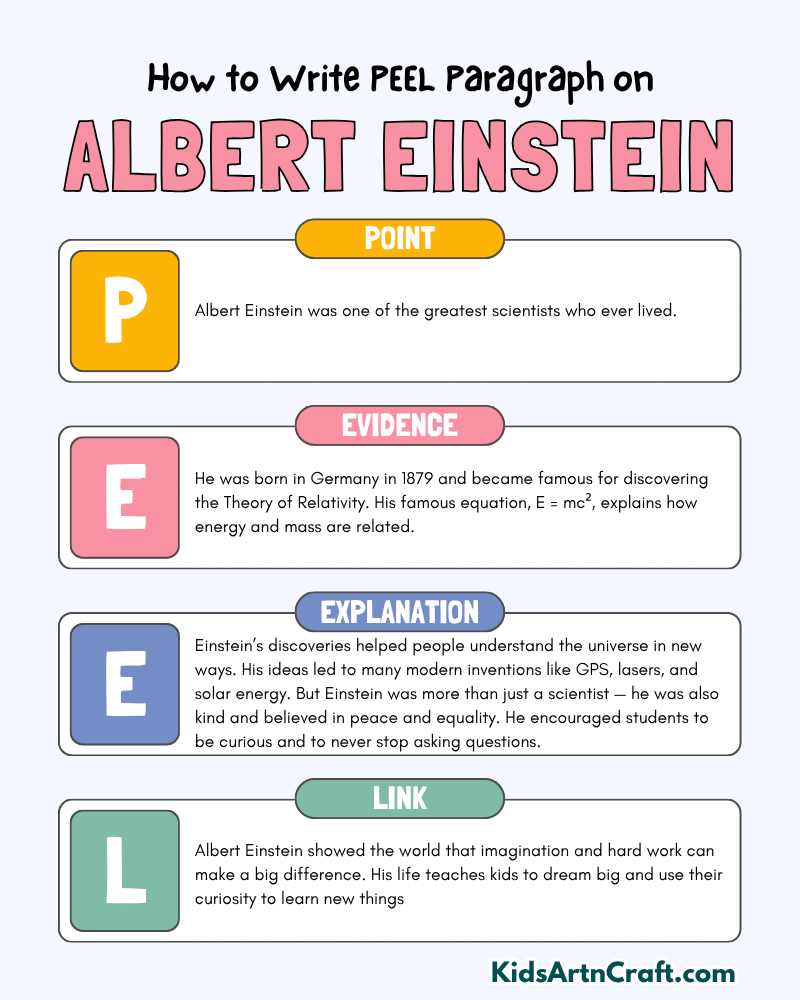

Point: Albert Einstein was one of the greatest scientists who ever lived.
Evidence: He was born in Germany in 1879 and became famous for discovering the Theory of Relativity. His famous equation, E = mc², explains how energy and mass are related.
Explanation: Einstein’s discoveries helped people understand the universe in new ways. His ideas led to many modern inventions like GPS, lasers, and solar energy. But Einstein was more than just a scientist — he was also kind and believed in peace and equality. He encouraged students to be curious and to never stop asking questions.
Link: Albert Einstein showed the world that imagination and hard work can make a big difference. His life teaches kids to dream big and use their curiosity to learn new things
2. Albert Einstein Paragraph Writing with TEEL Method
TEEL Method (Topic, Evidence, Explanation, Link)
Topic: Albert Einstein was a brilliant scientist who changed how people see the world.
Evidence: One of his famous discoveries, E = mc², helped scientists understand how energy can be changed into matter. He also won the Nobel Prize in Physics for explaining the photoelectric effect.
Explanation: He loved to learn about science and math, even as a child. Though he didn’t speak much when he was young, his mind was full of big ideas. Later, he developed the Theory of Relativity, which explained how time and space work together.
Link: Einstein’s story reminds kids that it’s okay to be different or think in unique ways. With curiosity and imagination, anyone can achieve something great — just like Albert Einstein did.
3. Albert Einstein Paragraph Writing with the TEXAS Method
TEXAS Method (Topic, Example, Explanation, Analysis, Summary/Significance)
Topic: Albert Einstein is known as one of the most intelligent people in history.
Example: Einstein discovered the Theory of Relativity and wrote the famous equation E = mc², which became one of the most important scientific formulas ever.
Explanation: He was born in Germany in 1879 and loved asking questions about how the world works. Even as a boy, he was fascinated by light, time, and space.
Analysis: His discoveries helped create new technology, including satellites and energy systems. But Einstein was also a kind person who believed in peace and education. He showed that imagination is just as important as knowledge.
Summary: Albert Einstein’s life proves that thinking deeply, asking questions, and believing in your ideas can help you make a difference in the world.
4. Albert Einstein Paragraph Writing with Hamburger Method
Hamburger Method (Top Bun, The Fillings, Bottom Bun)
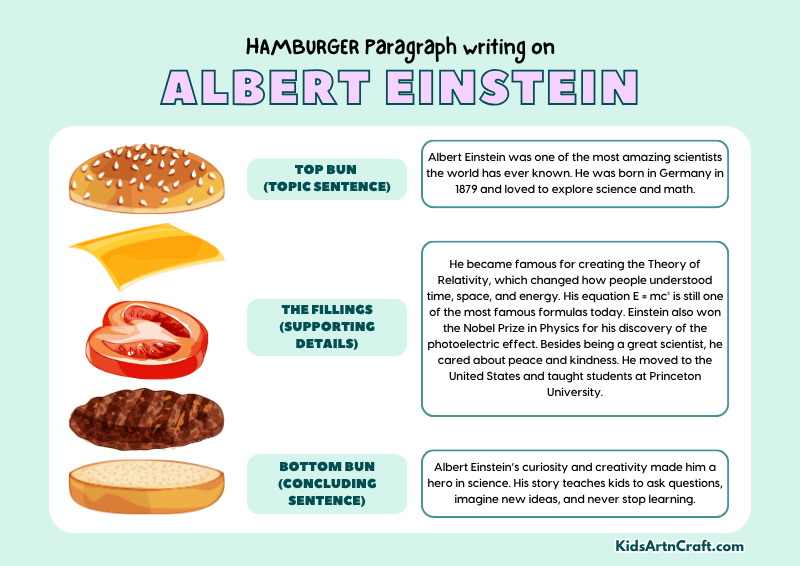

Top Bun (Topic Sentence):
Albert Einstein was one of the most amazing scientists the world has ever known. He was born in Germany in 1879 and loved to explore science and math.
The Fillings (Supporting Details):
He became famous for creating the Theory of Relativity, which changed how people understood time, space, and energy. His equation E = mc² is still one of the most famous formulas today. Einstein also won the Nobel Prize in Physics for his discovery of the photoelectric effect. Besides being a great scientist, he cared about peace and kindness. He moved to the United States and taught students at Princeton University.
Bottom Bun (Concluding Sentence):
Albert Einstein’s curiosity and creativity made him a hero in science. His story teaches kids to ask questions, imagine new ideas, and never stop learning.
Importance of Albert Einstein
- Albert Einstein revolutionized science with his theories of relativity and contributions to quantum physics. [Source: Nobel Prize]
- His work on the photoelectric effect earned him the Nobel Prize in Physics in 1921. [Source: Nobel Prize – Photoelectric Effect]
Additional Facts about Albert Einstein
- Einstein influenced modern physics, atomic energy, and cosmology. [Source: Encyclopaedia Britannica]
- He advocated for peace, civil rights, and global cooperation throughout his life. [Source: History]
- Einstein emphasized curiosity, critical thinking, and lifelong learning as keys to discovery. [Source: National Geographic]
Hope you liked these paragraphs on ‘Albert Einstein’. Don’t forget to join the Telegram group for FREE Printables.
Check this article to get knowledge about what gravity is.