Paragraph Writing
Paragraph on The Science Behind Volcanoes

Volcanoes form when molten rock, called magma, rises from beneath the Earth’s surface. Pressure builds until it erupts as lava, ash, and gases, shaping landscapes and affecting the environment. Hone your paragraph-writing abilities by practicing ‘The Science Behind Volcanoes‘ in four styles—Expository, Persuasive, Descriptive, and Narrative—and clearly structure your ideas using structures with PEEL, TEEL, TEXAS, and the Hamburger Model.
Read This Article in Other Languages
- ज्वालामुखियों के पीछे के विज्ञान पर अनुच्छेद (Hindi / हिंदी)
- Párrafo sobre la ciencia detrás de los volcanes (Spanish / Español)
- Paragraphe sur la science derrière les volcans (French / Français)
- Absatz über die Wissenschaft hinter Vulkanen (German / Deutsch)
- فقرة عن علم البراكين (Arabic / العربية)
- আগ্নেয়গিরির পেছনের বিজ্ঞান সম্পর্কে অনুচ্ছেদ (Bengali / বাংলা)
- போக்குவரத்து மீது இருக்கும் விஞ்ஞானம் பற்றிய பத்தி (Tamil / தமிழ்)
- జ్వాలాముఖాల వెనుక శాస్త్రం గురించి పేరా (Telugu / తెలుగు)
- അഗ്നിപർവതങ്ങളുടെ പിന്നിലെ ശാസ്ത്രത്തെക്കുറിച്ചുള്ള പാരഗ്രാഫ് (Malayalam / മലയാളം)
- آتش فشاں کے پیچھے سائنس پر پیراگراف (Urdu / اردو)
- Parágrafo sobre a ciência por trás dos vulcões (Portuguese / Português)
Translation Disclaimer: These links use Google Translate, an automated translation service. Translations may not be fully accurate and are provided for convenience only.
Different Styles of Paragraphs on ‘The Science Behind Volcanoes’
1. Expository Paragraph on The Science Behind Volcanoes (Explains with Facts)

Volcanoes are natural openings in the Earth’s surface that release molten rock, gases, and ash from beneath the ground. The science behind volcanoes involves the movement of tectonic plates and the buildup of pressure in the Earth’s mantle. Magma, which is molten rock, rises through cracks in the Earth’s crust and erupts as lava, forming mountains or volcanic cones over time. Different types of volcanoes, like shield, composite, and cinder cone volcanoes, erupt in various ways, producing lava flows, ash clouds, or pyroclastic material. Scientists study volcanoes to understand their behavior, predict eruptions, and reduce the risk to human life and property. Volcanoes also play a role in shaping landscapes, creating fertile soil, and affecting the climate by releasing gases into the atmosphere. Understanding the science behind volcanoes helps us appreciate both their power and their importance to the Earth’s ecosystem.
2. Persuasive Paragraph on The Science Behind Volcanoes (Tries to Convince You)
Everyone should learn about the science behind volcanoes because it is fascinating and important for safety. Volcanoes erupt when magma rises through cracks in the Earth, releasing lava, gases, and ash. Knowing how and why this happens helps scientists predict eruptions and protect people living nearby. Volcanoes can be dangerous, but they also create fertile land for farming and add minerals to the soil. By studying volcanoes, we can better understand Earth’s processes and prepare for natural disasters. Schools should teach children about volcanoes using experiments, models, and videos to make learning exciting. Understanding volcanoes is not just about danger—it is about curiosity, science, and respecting the power of nature. Everyone should explore how these natural giants work to stay safe and appreciate Earth’s amazing forces.
3. Descriptive Paragraph on The Science Behind Volcanoes (Paints a Picture with Words)
Volcanoes are powerful and awe-inspiring natural formations. Their peaks rise high above the land, sometimes capped with snow, while dark craters mark where molten lava can emerge. When a volcano erupts, glowing red lava flows down its slopes, accompanied by billowing clouds of smoke and ash that fill the sky. The ground shakes slightly as magma moves deep beneath the Earth, building pressure until it bursts out in a spectacular display. Rivers of molten rock glow under the sun, and the air smells of sulfur. Over time, layers of lava and ash create mountains, valleys, and fertile plains. Watching a volcano, even in a safe video or photograph, is a reminder of Earth’s immense power. The combination of fire, smoke, and molten rock makes volcanoes both dangerous and mesmerizing.
4. Narrative Paragraph on The Science Behind Volcanoes (Tells a Story)
Last year, I visited a volcano with my school, and it was an unforgettable experience. Our guide explained how magma rises from deep inside the Earth through cracks in the crust, building pressure until an eruption occurs. We saw cooled lava flowing down old slopes and learned how volcanoes form mountains over time. The guide showed pictures of eruptions, with bright red lava, dark ash clouds, and glowing rocks rolling down the sides. I imagined the ground trembling as the magma forced its way out, filling the air with heat and smoke. It was amazing to see how powerful and dangerous volcanoes can be, yet how they also create fertile land and shape the Earth. That visit made me curious about the science behind volcanoes and the forces of nature that continue to shape our world every day.
‘The Science Behind Volcanoes’ Paragraphs in Different Structured Methods
1. The Science Behind Volcanoes Paragraph Writing with PEEL Method
PEEL Method (Point, Evidence, Explanation, Link)
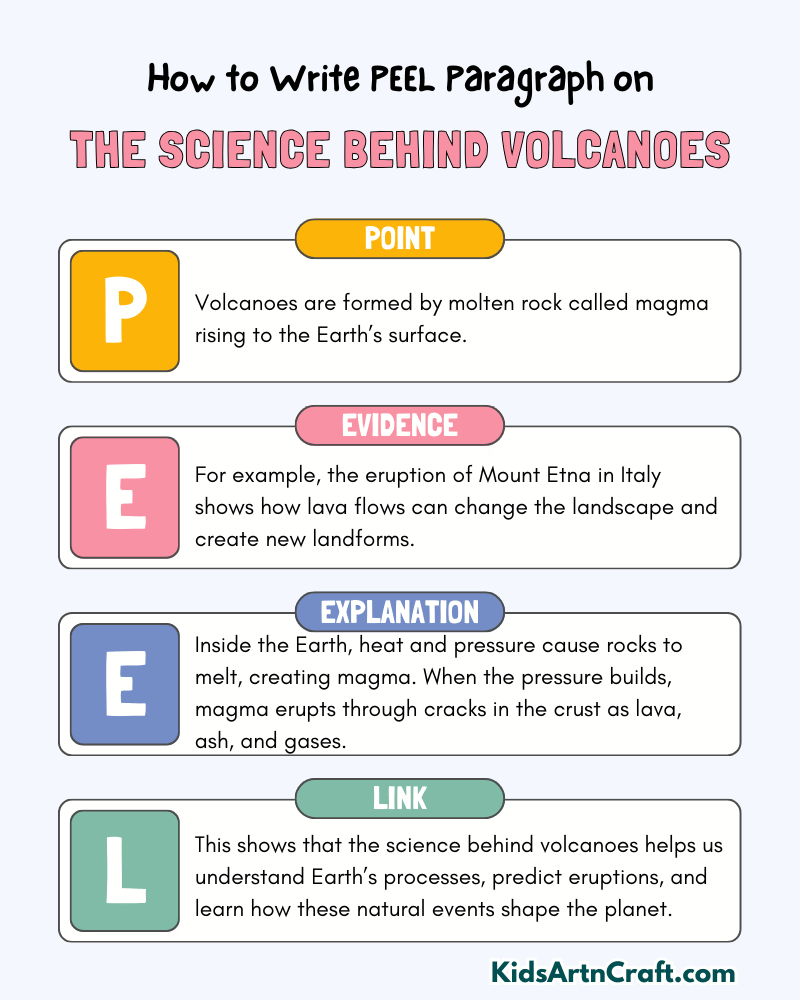

Point: Volcanoes are formed by molten rock called magma rising to the Earth’s surface.
Evidence: For example, the eruption of Mount Etna in Italy shows how lava flows can change the landscape and create new landforms.
Explanation: Inside the Earth, heat and pressure cause rocks to melt, creating magma. When the pressure builds, magma erupts through cracks in the crust as lava, ash, and gases.
Link: This shows that the science behind volcanoes helps us understand Earth’s processes, predict eruptions, and learn how these natural events shape the planet.
2. The Science Behind Volcanoes Paragraph Writing with TEEL Method
TEEL Method (Topic, Evidence, Explanation, Link)
Topic: Volcanoes are caused by magma rising from inside the Earth.
Evidence: For instance, when pressure builds, eruptions occur, releasing lava, ash, and gases into the air.
Explanation: Heat and pressure melt rocks underground, forming magma that pushes through the crust.
Link: So, studying volcanoes teaches us how they form, how eruptions happen, and how they affect the land, helping scientists keep people safe.
3. The Science Behind Volcanoes Paragraph Writing with TEXAS Method
TEXAS Method (Topic, Example, Explanation, Analysis, Summary/Significance)
Topic: Volcanoes are created by molten magma.
Example: During eruptions, lava flows down the volcano, and ash spreads into the sky.
Explanation: Magma rises from deep inside the Earth through cracks in the crust.
Analysis: The heat, pressure, and movement of magma explain why volcanoes erupt and change the land.
Summary: That is why understanding volcanoes is important—it helps us learn about Earth and predict natural events safely.
4. The Science Behind VolcanoesParagraph Writing with Hamburger Method
Hamburger Method (Top Bun, The Fillings, Bottom Bun)
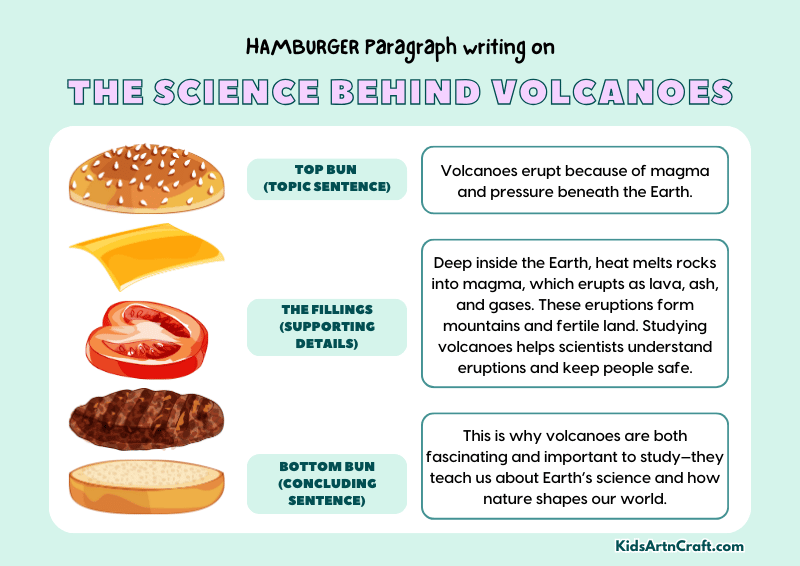

Top Bun (Topic Sentence):
Volcanoes erupt because of magma and pressure beneath the Earth.
The Fillings (Supporting Details):
Deep inside the Earth, heat melts rocks into magma, which erupts as lava, ash, and gases. These eruptions form mountains and fertile land. Studying volcanoes helps scientists understand eruptions and keep people safe.
Bottom Bun (Concluding Sentence):
This is why volcanoes are both fascinating and important to study—they teach us about Earth’s science and how nature shapes our world.
Importance of Volcanoes
- Volcanoes are openings in Earth’s crust that allow molten rock, gases, and ash to escape to the surface. [Source: U.S. Geological Survey]
- Volcanoes shape landscapes, create new land, and influence Earth’s climate and ecosystems. [Source: National Geographic]
Additional Facts About Volcanoes
- Most volcanoes form at tectonic plate boundaries where magma rises to the surface. [Source: National Park Service]
- Volcanoes can be explosive or gentle depending on magma type and gas content. [Source: National Geographic Kids]
- Hotspots create volcanoes away from plate edges, like the Hawaiian Islands. [Source: National Geographic]
Hope you liked these paragraphs on ‘The Science Behind Volcanoes’. Don’t forget to join the Telegram group for FREE Printables.