Paragraph Writing
Paragraph on Should Every Child Learn Self-Defence?

Every child should learn self-defense because it builds confidence, teaches safety skills, and helps protect themselves in dangerous situations. It also encourages discipline, focus, and physical fitness. Advance your paragraph-writing abilities with ‘Should Every Child Learn Self-Defence?’ in four styles—Expository, Persuasive, Descriptive, and Narrative—and clearly organize your ideas using structures with PEEL, TEEL, TEXAS, and the Hamburger Model.
Read This Article in Other Languages
- अनुच्छेद: क्या हर बच्चे को आत्मरक्षा सीखनी चाहिए? (Hindi / हिंदी)
- Párrafo: ¿Debería cada niño aprender defensa personal? (Spanish / Español)
- Paragraphe : Chaque enfant devrait-il apprendre l’autodéfense ? (French / Français)
- Absatz: Sollte jedes Kind Selbstverteidigung lernen? (German / Deutsch)
- فقرة: هل يجب على كل طفل تعلم الدفاع عن النفس؟ (Arabic / العربية)
- অনুচ্ছেদ: প্রতিটি শিশুকে কি আত্মরক্ষা শিখানো উচিত? (Bengali / বাংলা)
- பத்தி: ஒவ்வொரு குழந்தையும் சுய பாதுகாப்பை கற்றுக்கொள்ள வேண்டுமா? (Tamil / தமிழ்)
- పేరాగ్రాఫ్: ప్రతి పిల్లవాడు స్వీయ రక్షణ నేర్చుకోవాలా? (Telugu / తెలుగు)
- പാരഗ്രാഫ്: ഓരോ കുട്ടിയും സ്വയംരക്ഷ പഠിക്കണോ? (Malayalam / മലയാളം)
- پیراگراف: کیا ہر بچے کو خود کا دفاع سیکھنا چاہیے؟ (Urdu / اردو)
- Parágrafo: Cada criança deve aprender defesa pessoal? (Portuguese / Português)
Translation Disclaimer: These links use Google Translate, an automated translation service. Translations may vary in accuracy and are provided for convenience only.
Different Styles of Paragraphs on ‘Should Every Child Learn Self-Defence?’
1. Expository Paragraph on Should Every Child Learn Self-Defence? (Explains with Facts)

Every child should learn self-defence because it teaches important skills for safety and confidence. Self-defence training helps children protect themselves in dangerous situations, recognize risks, and respond calmly to threats. It also improves physical fitness, coordination, and reflexes. Learning self-defence builds confidence and reduces fear, allowing children to feel secure in school, parks, or while traveling. Techniques such as basic kicks, blocks, and escapes can prevent accidents or bullying. Additionally, self-defence teaches discipline, focus, and respect for others. When children practice these skills regularly, they develop both mental and physical strength. Schools and parents who include self-defence in a child’s routine help them become aware of their surroundings and prepared for emergencies. Overall, learning self-defence equips children with practical skills, confidence, and safety awareness that benefit them throughout life.
2. Persuasive Paragraph on Should Every Child Learn Self-Defence? (Tries to Convince You)
Every child should learn self-defence because it is essential for safety and confidence. Children who know how to defend themselves can stay safe from accidents, bullying, or dangerous situations. Self-defence classes also improve fitness, flexibility, and reflexes, which help in everyday activities. Beyond physical skills, children gain confidence and learn discipline, focus, and responsibility. Parents and schools should encourage children to take classes in karate, judo, or simple self-defence techniques. Even basic skills like blocking, escaping holds, or shouting for help can make a big difference. Children who learn self-defence feel secure and independent, knowing they can protect themselves if needed. By teaching every child self-defence, we empower them with the skills, courage, and awareness to stay safe and confident in any situation.
3. Descriptive Paragraph on Should Every Child Learn Self-Defence? (Paints a Picture with Words)
Imagine a class full of children learning self-defence. The room is filled with energy as kids practice kicks, punches, and defensive moves on mats. Some children focus intently, while others cheer for their friends during practice. Their faces show determination and confidence as they learn to protect themselves. The instructor teaches them not just moves, but also awareness, discipline, and respect. After class, the children feel strong, safe, and proud of what they can do. They walk home with more confidence, knowing they have the skills to stay safe if a problem arises. The experience makes them more alert, disciplined, and independent. Seeing children empowered in this way shows how self-defence training builds not only strength but also courage, confidence, and a sense of security that stays with them every day.
4. Narrative Paragraph on Should Every Child Learn Self-Defence? (Tells a Story)
Last summer, I joined a self-defence class at our community center. At first, I felt nervous and unsure of what to do. Our instructor taught us simple moves to block attacks, escape holds, and stay aware of our surroundings. Every day, I practiced kicks, punches, and balancing exercises. Slowly, I started feeling stronger, braver, and more confident. One afternoon, I helped a younger student who was struggling with a move, and it felt amazing to share what I had learned. I realized that learning self-defence was not just about fighting; it was about confidence, safety, and awareness. After a few weeks, I felt ready to handle difficult situations calmly and safely. That experience showed me why every child should learn self-defence: it teaches skills, courage, and confidence that help children feel safe and independent in their daily lives.
‘Should Every Child Learn Self-Defence?’ Paragraphs in Different Structured Methods
1. Should Every Child Learn Self-Defence? Paragraph Writing with PEEL Method
PEEL Method (Point, Evidence, Explanation, Link)
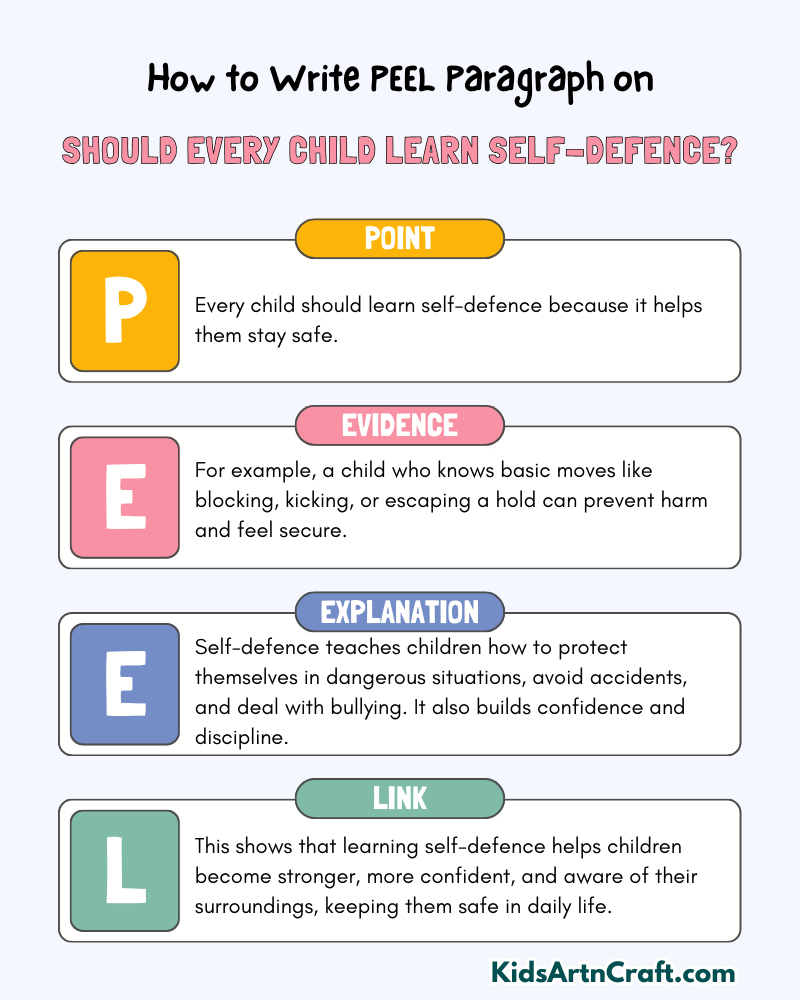

Point: Every child should learn self-defence because it helps them stay safe.
Evidence: For example, a child who knows basic moves like blocking, kicking, or escaping a hold can prevent harm and feel secure.
Explanation: Self-defence teaches children how to protect themselves in dangerous situations, avoid accidents, and deal with bullying. It also builds confidence and discipline.
Link: This shows that learning self-defence helps children become stronger, more confident, and aware of their surroundings, keeping them safe in daily life.
2. Should Every Child Learn Self-Defence? Paragraph Writing with TEEL Method
TEEL Method (Topic, Evidence, Explanation, Link)
Topic: Self-defence is important for all children.
Evidence: For instance, children who practice self-defence can avoid dangerous situations and respond calmly if problems occur.
Explanation: It teaches safety, awareness, and confidence while improving fitness and coordination.
Link: Therefore, learning self-defence helps children stay safe, active, and confident in everyday life.
3. Should Every Child Learn Self-Defence? Paragraph Writing with TEXAS Method
TEXAS Method (Topic, Example, Explanation, Analysis, Summary/Significance)
Topic: Children should learn self-defence.
Example: For example, learning basic moves like blocking or escaping a hold can prevent accidents or bullying.
Explanation: Self-defence teaches them to protect themselves and stay safe.
Analysis: It also builds confidence, focus, and awareness of surroundings.
Summary: That is why every child should learn self-defence for safety and personal growth.
4. Should Every Child Learn Self-Defence? Paragraph Writing with Hamburger Method
Hamburger Method (Top Bun, The Fillings, Bottom Bun)
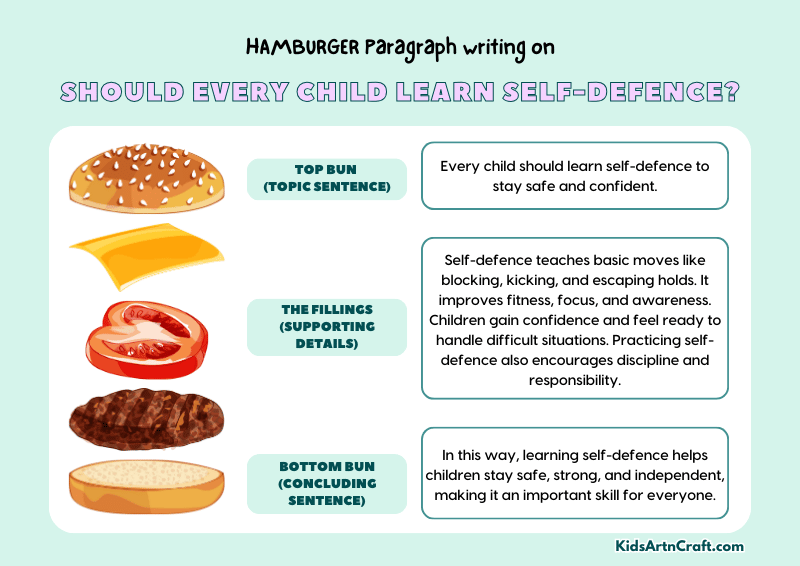

Top Bun (Topic Sentence):
Every child should learn self-defence to stay safe and confident.
The Fillings (Supporting Details):
Self-defence teaches basic moves like blocking, kicking, and escaping holds. It improves fitness, focus, and awareness. Children gain confidence and feel ready to handle difficult situations. Practicing self-defence also encourages discipline and responsibility.
Bottom Bun (Concluding Sentence):
In this way, learning self-defence helps children stay safe, strong, and independent, making it an important skill for everyone.
Importance of Self-Defense for Children
- Learning self-defense helps children develop confidence, self-esteem, and the ability to respond safely in dangerous situations. [Source: Journal of Health and Allied Sciences]
- Self-defense programs teach children to recognize unsafe situations and assert personal boundaries effectively. [Source: ScienceDirect]
Additional Facts About Child Self-Defense
- Structured training can reduce risk of abuse and bullying while improving knowledge about personal safety. [Source: Paediatric Nursing]
- Self-defense enhances self-control, discipline, and behavioral regulation in children. [Source: Atlantis Press]
- Programs including parental involvement and repeated practice show better long-term safety outcomes. [Source: PMC / NIH]
- Positive-practice approaches recommended by child-safety experts improve children’s real-life response skills. [Source: Kidpower International]
Hope you liked these paragraphs on ‘Should Every Child Learn Self-Defence?’. Don’t forget to join the Telegram group for FREE Printables.