Paragraph Writing
Paragraph on Should Student Mistakes Be Graded?

Student mistakes should not always be graded harshly. Learning from errors helps understanding, builds confidence, and encourages improvement, making education a supportive and effective experience. Step up your paragraph-writing skills by practicing “Should Student Mistakes Be Graded?” in four styles—Expository, Persuasive, Descriptive, and Narrative—and clearly organize your ideas using structures with PEEL, TEEL, TEXAS, and the Hamburger Model.
Read This Article in Other Languages
- क्या छात्रों की गलतियों को ग्रेड किया जाना चाहिए पर अनुच्छेद (Hindi / हिंदी)
- Párrafo sobre si los errores de los estudiantes deben ser calificados (Spanish / Español)
- Paragraphe sur la question de savoir si les erreurs des élèves doivent être notées (French / Français)
- Absatz darüber, ob die Fehler der Schüler benotet werden sollten (German / Deutsch)
- فقرة حول ما إذا كان يجب تقييم أخطاء الطلاب (Arabic / العربية)
- শিক্ষার্থীদের ভুলকে গ্রেড করা উচিত কি না সে সম্পর্কে অনুচ্ছেদ (Bengali / বাংলা)
- மாணவர்களின் தவறுகளை மதிப்பீடு செய்ய வேண்டுமா என்பதைக் குறித்து பத்தி (Tamil / தமிழ்)
- విద్యార్థుల తప్పులను గ్రేడ్ చేయాలా అనే అంశంపై పేరాగ్రాఫ్ (Telugu / తెలుగు)
- വിദ്യാർത്ഥികളുടെ പിഴവുകൾ ഗ്രേഡ് ചെയ്യണോ എന്നതിനെക്കുറിച്ചുള്ള പരിച്ഛേദം (Malayalam / മലയാളം)
- کیا طلباء کی غلطیوں کو گریڈ کیا جانا چاہئے پر پیراگراف (Urdu / اردو)
- Parágrafo sobre se os erros dos alunos devem ser avaliados (Portuguese / Português)
Translation Disclaimer: These links use Google Translate, an automated translation service. Translations may vary in accuracy and are provided for convenience only.
Different Styles of Paragraphs on ‘Should Student Mistakes Be Graded?’
1. Expository Paragraph on Should Student Mistakes Be Graded? (Explains with Facts)

Student mistakes are a natural part of learning, and grading them can be helpful if done carefully. Mistakes show where students need improvement and help teachers understand which areas require more attention. For example, if a student makes errors in math, grading allows the teacher to guide them in understanding the concepts better. However, focusing too much on mistakes can make students feel stressed or afraid to try. Instead, mistakes should be graded in a way that encourages learning, not punishment. Teachers can give feedback, suggestions, and encouragement alongside grades to help students grow. By balancing assessment with guidance, grading mistakes can be educational and motivating. It teaches students to learn from errors, think critically, and improve their skills over time. Overall, student mistakes, when graded constructively, become a useful tool for learning and personal growth.
2. Persuasive Paragraph on Should Student Mistakes Be Graded? (Tries to Convince You)
Student mistakes should be graded carefully because they are important for learning. Grading helps students see where they need improvement and motivates them to try harder. However, teachers should focus on constructive feedback rather than punishment. For instance, if a student writes the wrong answer in a test, pointing out the mistake and explaining the correct method helps them understand better. Grading mistakes teaches responsibility, encourages problem-solving, and helps students build confidence. Ignoring mistakes or only focusing on correct answers can prevent learning and growth. Therefore, mistakes should be graded in a positive and supportive way. This approach encourages students to learn, try again, and improve their skills while understanding that errors are a natural part of learning.
3. Descriptive Paragraph on Should Student Mistakes Be Graded? (Paints a Picture with Words)
Imagine a classroom where students are learning new topics and trying their best. Some students make mistakes while solving problems or writing answers. The teacher carefully marks these mistakes, writes helpful notes, and explains the correct solutions. Students feel guided rather than punished, and they understand where they went wrong. Grading mistakes this way creates a supportive and encouraging environment. It shows that errors are part of learning, not failures. The classroom feels lively, with students asking questions, trying new methods, and learning from their errors. Mistakes become stepping stones for improvement, helping children grow, gain confidence, and enjoy learning. Constructive grading turns errors into valuable lessons and motivates students to keep improving without fear or stress.
4. Narrative Paragraph on Should Student Mistakes Be Graded? (Tells a Story)
Last term, I made many mistakes in my math homework. At first, I felt disappointed and thought I would never understand the problems. My teacher graded my work but didn’t just mark the wrong answers. She wrote notes explaining where I went wrong and gave tips to solve the problems correctly. With her feedback, I practiced again and slowly improved. By the next test, I was able to solve most questions correctly. I realized that grading mistakes wasn’t about punishment—it was a way to learn and grow. This experience taught me that mistakes are normal and helpful when we understand them and try again. Constructive grading encourages students to learn from errors, gain confidence, and improve their skills over time.
‘Should Student Mistakes Be Graded?’ Paragraphs in Different Structured Methods
1. Should Student Mistakes Be Graded? Paragraph Writing with PEEL Method
PEEL Method (Point, Evidence, Explanation, Link)
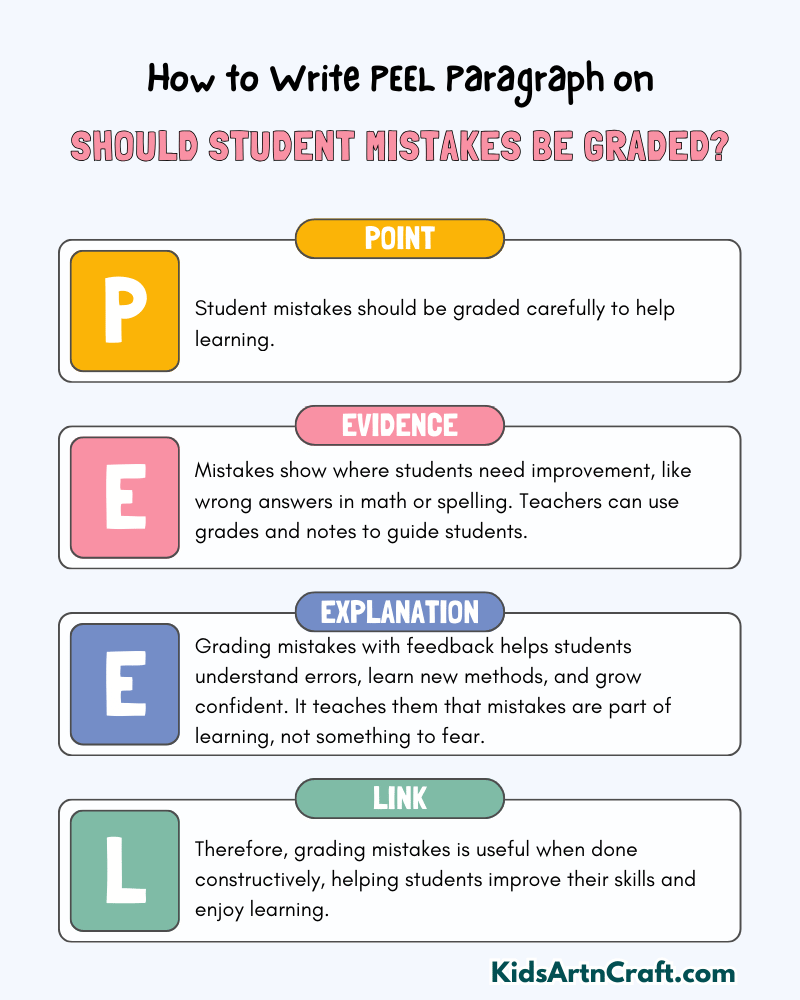

Point: Student mistakes should be graded carefully to help learning.
Evidence: Mistakes show where students need improvement, like wrong answers in math or spelling. Teachers can use grades and notes to guide students.
Explanation: Grading mistakes with feedback helps students understand errors, learn new methods, and grow confident. It teaches them that mistakes are part of learning, not something to fear.
Link: Therefore, grading mistakes is useful when done constructively, helping students improve their skills and enjoy learning.
2. Should Student Mistakes Be Graded? Paragraph Writing with TEEL Method
TEEL Method (Topic, Evidence, Explanation, Link)
Topic: Student mistakes should be graded in a positive way.
Evidence: For example, a teacher can mark wrong answers and give helpful suggestions to correct them.
Explanation: Grading shows students what they need to improve and encourages learning.
Link: Constructive grading teaches responsibility, problem-solving, and confidence, making learning easier and more enjoyable.
3. Should Student Mistakes Be Graded? Paragraph Writing with TEXAS Method
TEXAS Method (Topic, Example, Explanation, Analysis, Summary/Significance)
Topic: Mistakes can be graded to help learning.
Example: For example, if a student writes a wrong answer, the teacher can explain the correct method.
Explanation: Grading shows students their errors and areas to improve.
Analysis: This helps students learn from errors, gain confidence, and understand subjects better.
Summary: Grading mistakes in a supportive way encourages growth and makes students more motivated to try again.
4. Should Student Mistakes Be Graded? Paragraph Writing with Hamburger Method
Hamburger Method (Top Bun, The Fillings, Bottom Bun)
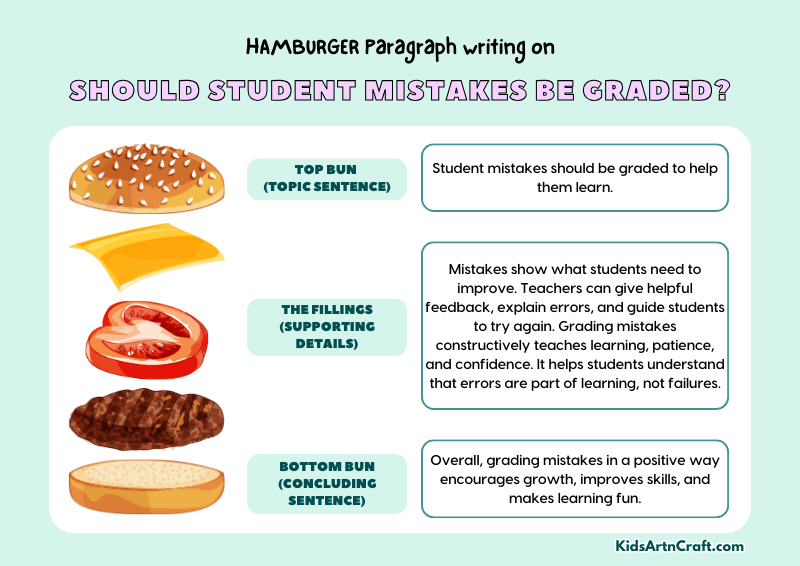

Top Bun (Topic Sentence):
Student mistakes should be graded to help them learn.
The Fillings (Supporting Details):
Mistakes show what students need to improve. Teachers can give helpful feedback, explain errors, and guide students to try again. Grading mistakes constructively teaches learning, patience, and confidence. It helps students understand that errors are part of learning, not failures.
Bottom Bun (Concluding Sentence):
Overall, grading mistakes in a positive way encourages growth, improves skills, and makes learning fun.
Importance of Learning from Mistakes
- Mistakes help students understand concepts deeply and improve problem-solving skills. [Source: Scientific American]
- Constructive feedback encourages growth and skill development better than grades alone. [Source: National Library of Medicine (PMC)]
Additional Facts About Student Mistakes
- Focusing too much on errors can reduce motivation and increase anxiety. [Source: Edutopia]
- A growth mindset helps students learn from mistakes and fosters long-term academic success. [Source: Mindset Works]
- Balancing feedback and encouragement promotes creativity and resilience in learning. [Source: Frontiers in Psychology]
Hope you liked these paragraphs on ‘Should Student Mistakes Be Graded?’. Don’t forget to join the Telegram group for FREE Printables.