





Paragraph Writing
Paragraph on Animals That Can Be Trained


Many animals can be trained, such as dogs, cats, horses, and birds. Training helps them follow commands, perform tasks, and interact safely with humans, creating strong bonds and useful skills. Develop your paragraph-writing skills through ‘Animals That Can Be Trained’ in four styles—Expository, Persuasive, Descriptive, and Narrative—while clearly structuring your ideas with PEEL, TEEL, TEXAS, and the Hamburger Model.
Read This Article in Other Languages
- जिन जानवरों को प्रशिक्षित किया जा सकता है पर अनुच्छेद (Hindi / हिंदी)
- Párrafo sobre animales que se pueden entrenar (Spanish / Español)
- Paragraphe sur les animaux qui peuvent être dressés (French / Français)
- Absatz über Tiere, die trainiert werden können (German / Deutsch)
- فقرة عن الحيوانات التي يمكن تدريبها (Arabic / العربية)
- যে প্রাণীকে প্রশিক্ষিত করা যায় – অনুচ্ছেদ (Bengali / বাংলা)
- பயிற்சி பெறக்கூடிய உயிரினங்கள் பற்றி பத்தி (Tamil / தமிழ்)
- అభ్యసించగల జంతువులు గురించి పేరా (Telugu / తెలుగు)
- പരിശീലനം ലഭിക്കാവുന്ന ജീവികളെക്കുറിച്ചുള്ള പാരഗ്രാഫ് (Malayalam / മലയാളം)
- جن جانوروں کو تربیت دی جا سکتی ہے پر پیراگراف (Urdu / اردو)
- Parágrafo sobre animais que podem ser treinados (Portuguese / Português)
Translation Disclaimer: These links use Google Translate, an automated translation service. Translations may vary in accuracy and are provided for convenience only.
Different Styles of Paragraphs on ‘Animals That Can Be Trained’
1. Expository Paragraph on Animals That Can Be Trained (Explains with Facts)

Animals have long been companions to humans, and many species can be trained to perform tasks or follow commands. Dogs are the most common, known for their intelligence and loyalty. They can learn to fetch, guard, or assist people with disabilities. Birds, especially parrots, are also trainable; they can mimic sounds and even perform simple tricks. Horses can be trained for riding, sports, and farm work due to their strength and responsiveness. Dolphins, recognized for their intelligence, can follow complex instructions in marine parks and research facilities. Training involves repetition, positive reinforcement, and patience. Different animals require different training methods depending on their natural behavior, learning capacity, and environment. For example, cats can learn basic commands like “sit” or “come,” but they usually respond better to rewards than to strict discipline. Understanding the nature and abilities of an animal is key to successful training. Through proper training, humans and animals can form strong, mutually beneficial relationships.
2. Persuasive Paragraph on Animals That Can Be Trained (Tries to Convince You)
Training animals is not only enjoyable but also highly beneficial for both humans and animals. Dogs, for instance, can be trained as service animals, helping people with disabilities live independent lives. Horses trained for riding teach discipline, responsibility, and empathy to their caretakers. Even birds and dolphins can be trained, providing mental stimulation that keeps them healthy and happy. Critics may argue that training is unnatural, but done responsibly, it respects the animal’s nature and enhances their life. Positive reinforcement makes learning a fun activity rather than a chore. Training also reduces behavioral problems, making pets more sociable and safer around humans. Imagine a world where more animals were trained to assist humans, from rescue dogs saving lives in disasters to dolphins aiding scientific research. Not only do humans gain practical help, but animals gain structure, exercise, and mental challenges. Training fosters a unique bond between humans and animals, built on trust, communication, and mutual respect. Therefore, everyone should consider training animals in a kind and ethical manner.
3. Descriptive Paragraph on Animals That Can Be Trained (Paints a Picture with Words)
Imagine a lively dog sitting obediently on a bright green lawn, wagging its tail as it waits for the next command. Its coat glistens in the sun, and its eyes sparkle with intelligence, ready to fetch a ball or follow its owner’s instructions. Nearby, a parrot perches on a wooden stand, repeating cheerful words with perfect clarity, its colorful feathers shimmering in red, blue, and yellow. In the stable, a majestic horse prances gracefully, responding to gentle nudges from its rider, muscles rippling with strength and coordination. In a pool, dolphins leap and twirl, perfectly synchronized, following the trainer’s gestures with playful enthusiasm. Training these animals requires patience, gentle guidance, and rewards like treats or praise. Each interaction is a dance of understanding, where the animal learns, grows, and communicates in its own way. Observing trained animals demonstrates not only their intelligence but also the deep bond between them and humans, a connection built on trust, care, and shared experiences.
4. Narrative Paragraph on Animals That Can Be Trained (Tells a Story)
Last summer, I visited a local animal training center and witnessed something truly amazing. A trainer worked with a young dog named Max, showing him how to fetch a ball and perform a series of tricks. At first, Max was clumsy, missing the ball and jumping too early, but with gentle guidance and treats, he soon mastered the commands. I also saw a parrot named Ruby, repeating words and even waving her wings on cue, making everyone laugh. In the next enclosure, a horse elegantly responded to every signal from its rider, moving in harmony as if they shared one mind. The highlight was watching dolphins in the pool, leaping and spinning with joyful precision, following the trainer’s hand gestures flawlessly. It amazed me how animals could learn so much through patience, repetition, and kindness. That day, I realized that training animals is not just about teaching them tricks; it builds understanding, trust, and a special connection that humans and animals can share for a lifetime.
‘Animals That Can Be Trained’ Paragraphs in Different Structured Methods
1. Animals That Can Be Trained Paragraph Writing with PEEL Method
PEEL Method (Point, Evidence, Explanation, Link)
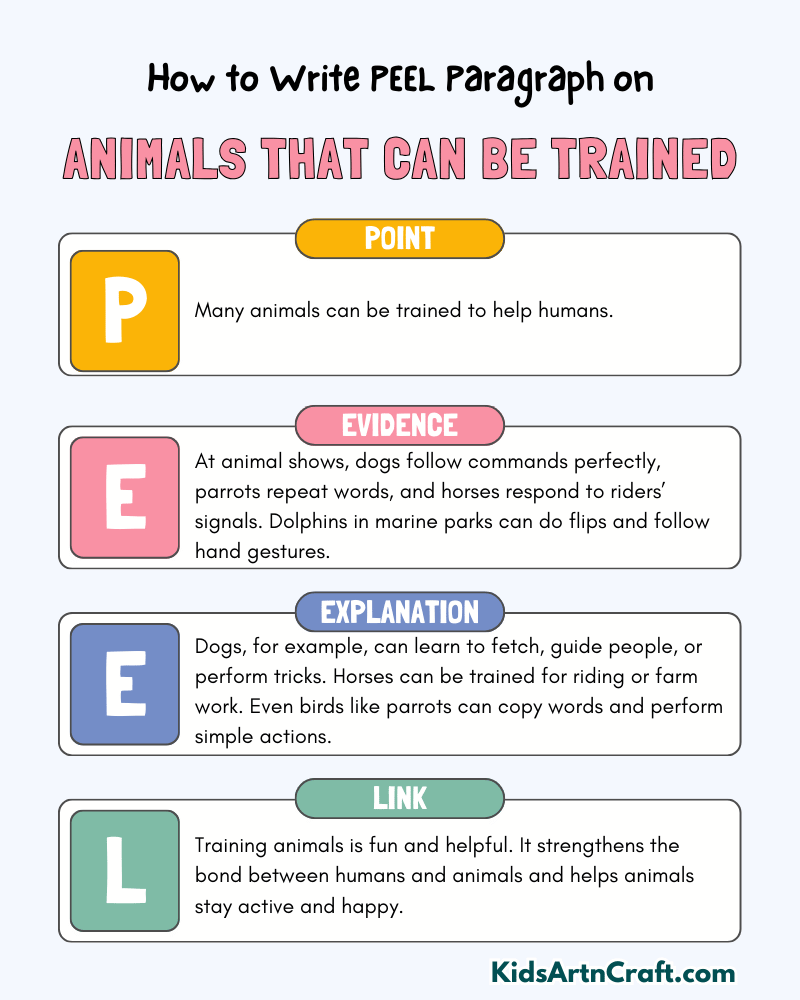
Point: Many animals can be trained to help humans.
Evidence: At animal shows, dogs follow commands perfectly, parrots repeat words, and horses respond to riders’ signals. Dolphins in marine parks can do flips and follow hand gestures.
Explanation: Dogs, for example, can learn to fetch, guide people, or perform tricks. Horses can be trained for riding or farm work. Even birds like parrots can copy words and perform simple actions.
Link: Training animals is fun and helpful. It strengthens the bond between humans and animals and helps animals stay active and happy.
2. Animals That Can Be Trained Paragraph Writing with TEEL Method
TEEL Method (Topic, Evidence, Explanation, Link)
Topic: Some animals are very smart and can be trained to do amazing things.
Evidence: For instance, guide dogs help blind people move safely, and dolphins can follow trainers’ signals in pools.
Explanation: Dogs can learn to help people, horses can be taught riding skills, and parrots can mimic human words.
Link: Training animals is important because it makes them happy, teaches them new skills, and creates a strong friendship with humans.
3. Animals That Can Be Trained Paragraph Writing with the TEXAS Method
TEXAS Method (Topic, Example, Explanation, Analysis, Summary/Significance)
Topic: Animals can be trained to learn new skills and help humans.
Example: Dogs fetch balls, parrots repeat words, and horses respond to riders’ cues.
Explanation: Dogs, horses, parrots, and even dolphins can follow commands and perform tricks.
Analysis: This shows that training is not just fun but also useful for humans and animals.
Summary: By training animals kindly, we can help them learn, keep them active, and build a strong bond with them.
4. Animals That Can Be Trained Paragraph Writing with Hamburger Method
Hamburger Method (Top Bun, The Fillings, Bottom Bun)
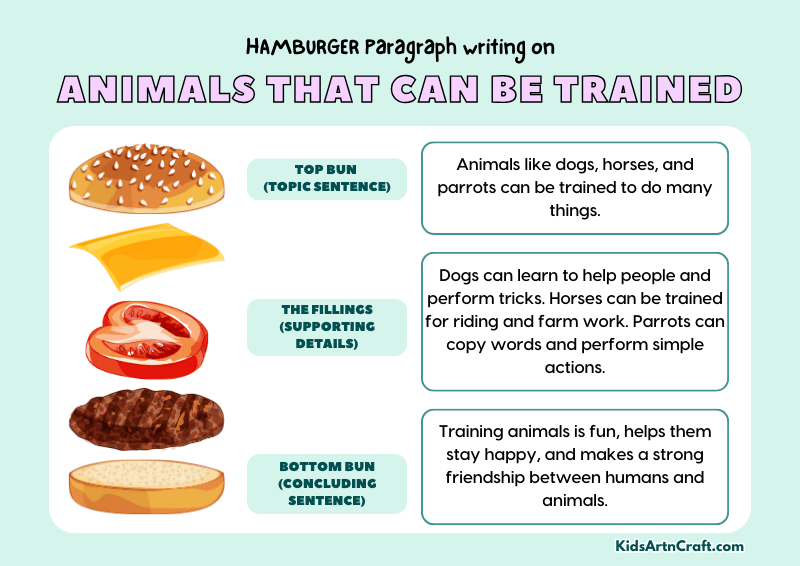
Top Bun (Topic Sentence):
Animals like dogs, horses, and parrots can be trained to do many things.
The Fillings (Supporting Details):
Dogs can learn to help people and perform tricks. Horses can be trained for riding and farm work. Parrots can copy words and perform simple actions.
Bottom Bun (Concluding Sentence):
Training animals is fun, helps them stay happy, and makes a strong friendship between humans and animals.
Importance of Trainable Animals
- Dogs can learn commands and tricks through rewards and practice. [Source: American Psychological Association]
- Dolphins are smart and can follow human signals to perform tasks. [Source: NOAA – National Ocean Service]
Additional Facts About Trainable Animals
- Horses respond to cues and rewards, improving behavior and trust with humans. [Source: Utah State University Animal Science]
- Parrots can mimic sounds and words through repeated practice. [Source: Britannica – Parrot]
- Rats can learn mazes and tasks, showing strong memory and learning skills. [Source: NIH – National Library of Medicine]
- Cats can learn tricks with patience and positive reinforcement. [Source: VCA Animal Hospitals]
Hope you liked these paragraphs on ‘Animals That Can Be Trained’. Don’t forget to join the Telegram group for FREE Printables.
Check this article to write a paragraph on cat.