



Paragraph Writing
Paragraph on How Poverty Impacts Education


Poverty impacts education because children from low-income families may lack books, uniforms, or school fees. It can limit learning opportunities, reduce attendance, and make it harder for students to succeed academically. Master paragraph-writing by studying in four styles—Expository, Persuasive, Descriptive, and Narrative—using structures with PEEL, TEEL, TEXAS, and the Hamburger Model.
Read This Article in Other Languages
- गरीबी शिक्षा को कैसे प्रभावित करती है (Hindi / हिंदी)
- Cómo la pobreza impacta la educación (Spanish / Español)
- Comment la pauvreté affecte l’éducation (French / Français)
- Wie Armut die Bildung beeinflusst (German / Deutsch)
- كيف تؤثر الفقر على التعليم (Arabic / العربية)
- দারিদ্রতা শিক্ষা কীভাবে প্রভাবিত করে (Bengali / বাংলা)
- தனியாதலை கல்விக்கு எப்படி பாதிக்கிறது (Tamil / தமிழ்)
- పేదరికం విద్యపై ఎలా ప్రభావం చూపుతుంది (Telugu / తెలుగు)
- ബാങ്ക് പഠനത്തെ ദാരിദ്ര്യം എങ്ങനെ ബാധിക്കുന്നു (Malayalam / മലയാളം)
- غربت تعلیم کو کیسے متاثر کرتی ہے (Urdu / اردو)
- Cómo a pobreza impacta a educação (Portuguese / Português)
Translation Disclaimer: These links use Google Translate, an automated translation service. Translations may vary in accuracy and are provided for convenience only.
Different Styles of Paragraphs on ‘How Poverty Impacts Education’
1. Expository Paragraph on How Poverty Impacts Education (Explains with Facts)
Poverty can affect education in many ways. School has taught me that children from poor families often face challenges that make learning difficult. They may not have enough money for books, uniforms, or school supplies, which can prevent them from participating fully in lessons. Some children may have to work to help their families, leaving little time for study. Poverty can also affect nutrition and health, making it hard to concentrate in class. For example, a child who is hungry or tired may struggle to focus during lessons. Teachers often notice that students from low-income families need extra support and encouragement. Addressing these challenges requires schools and communities to provide resources, scholarships, and support programs. When children receive help, they can attend school regularly, learn effectively, and reach their potential. School has taught me that education is a key to breaking the cycle of poverty, and supporting students in need is important to create a fair and successful society.
2. Persuasive Paragraph on How Poverty Impacts Education (Tries to Convince You)
We should help children from poor families because poverty affects their education and future. School has taught me that students who lack money for books, uniforms, or meals often struggle to learn. Some children must work instead of attending school, which limits their opportunities. For example, a child who cannot afford stationery may fall behind in classwork. Poverty also affects health, concentration, and confidence. Everyone deserves a chance to learn, regardless of their financial background. Schools and communities should provide support, such as scholarships, free meals, and learning materials. By helping children from poor families, we can ensure that they attend school regularly, enjoy learning, and build better futures. Education can break the cycle of poverty, giving children the skills and knowledge to succeed. Teaching kindness, fairness, and support in school helps students understand the importance of helping others. Poverty should not stop anyone from achieving their dreams, and everyone must work together to make education accessible for all.
3. Descriptive Paragraph on How Poverty Impacts Education (Paints a Picture with Words)
Imagine a classroom where some children have worn-out shoes, torn uniforms, and no books to follow the lessons. School has taught me that poverty can make education very challenging. Some students go to school hungry, their stomachs growling, making it hard to pay attention. Others may be tired from working long hours to support their families. The expressions on their faces show worry and fatigue, even as teachers try to help them. Supplies like pencils, notebooks, or backpacks are missing, and participating in class feels impossible. Poverty also affects self-confidence; children may feel embarrassed or left out. Despite these challenges, schools provide meals, books, and support programs to help students succeed. When children receive assistance, they smile, concentrate better, and enjoy learning. School teaches that education is a pathway to a better life. By helping students overcome poverty, communities give them hope, opportunity, and the chance to reach their full potential. Seeing these differences makes me understand the importance of fairness, empathy, and support in life.
4. Narrative Paragraph on How Poverty Impacts Education (Tells a Story)
Last year, I noticed a classmate, Rohan, who often came to school without proper books or uniforms. School had taught me that poverty affects education, and I realized this firsthand. Rohan sometimes struggled to complete assignments because he did not have the materials other students had. He also appeared tired and hungry, which made paying attention in class difficult. Our teacher noticed and arranged for extra support, including textbooks and meals from the school program. Slowly, Rohan began participating more, answering questions, and smiling during lessons. Watching his progress taught me how poverty can create barriers but also how support can make a difference. School has shown me that helping students in need is essential. Every child deserves the opportunity to learn, grow, and succeed, regardless of their family’s financial situation. Rohan’s journey reminded me that kindness, resources, and encouragement can help children overcome challenges. Education is a tool to fight poverty, and with support, students can achieve their dreams and build a brighter future.
‘How Poverty Impacts Education’ Paragraphs in Different Structured Methods
1. How Poverty Impacts Education Paragraph Writing with PEEL Method
PEEL Method (Point, Evidence, Explanation, Link)
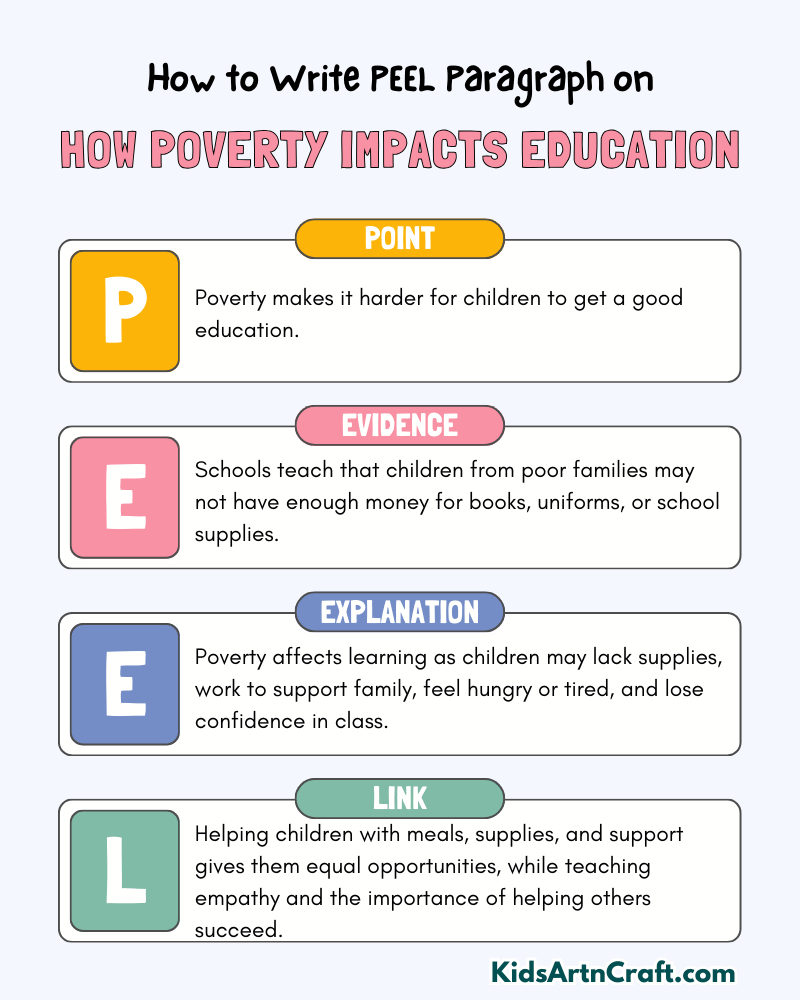
Point: Poverty makes it harder for children to get a good education.
Evidence: Schools teach that children from poor families may not have enough money for books, uniforms, or school supplies.
Explanation: Poverty affects learning as children may lack supplies, work to support family, feel hungry or tired, and lose confidence in class.
Link: Helping children with meals, supplies, and support gives them equal opportunities, while teaching empathy and the importance of helping others succeed.
2. How Poverty Impacts Education Paragraph Writing with TEEL Method
TEEL Method (Topic, Evidence, Explanation, Link)
Topic: Poverty affects education because it limits opportunities for learning.
Evidence: For example, a student who is hungry or missing books may struggle to complete homework or participate in class.
Explanation: Children from poor families may not have school supplies, proper uniforms, or enough food to concentrate.
Link: School teaches that providing support, like free meals, books, and guidance, can help children overcome these challenges. When poverty is addressed, students can learn, grow, and reach their full potential.
3. How Poverty Impacts Education Paragraph Writing with TEXAS Method
TEXAS Method (Topic, Example, Explanation, Analysis, Summary/Significance)
Topic: Poverty impacts education.
Example: For instance, a child who must work to help their family may miss school or be too tired to focus.
Explanation: Children without enough money may lack books, uniforms, and school materials.
Analysis: These challenges make it harder for students to learn, participate, and feel confident.
Summary: Schools teach that helping children with resources and support can reduce the effects of poverty and give every student a fair chance to succeed.
4. How Poverty Impacts Education Paragraph Writing with Hamburger Method
Hamburger Method (Top Bun, The Fillings, Bottom Bun)

Top Bun (Topic Sentence):
Poverty makes learning difficult for many children.
The Fillings (Supporting Details):
Students from poor families may lack books, pencils, or uniforms, and face hunger or work at home. Schools can help with meals, supplies, and guidance, boosting confidence so all children can focus, participate, and enjoy learning equally.
Bottom Bun (Concluding Sentence):
Understanding how poverty affects education teaches us empathy and the importance of helping others. With support, every child can learn, grow, and achieve their dreams.
Importance of Education
- Poverty makes it harder for children to go to school and learn well. [Source: UNICEF/UNESCO/World Bank]
- Many children in poorer families cannot read or understand simple texts by age 10. [Source: UNICEF/UNESCO/World Bank]
Additional Facts About Poverty and Learning
- Poverty increases the risk that children drop out of school entirely. [Source: UNESCO Institute for Statistics]
- Children in poor areas often have fewer books, teachers, and learning materials. [Source: UNESCO]
- Missing education due to poverty makes it harder to earn money in the future. [Source: UNICEF]
Hope you liked these paragraphs on ‘How Poverty Impacts Education’. Don’t forget to join the Telegram group for FREE Printables.