Science Experiments
Easy Gear Transmission Working Model for Kids – Creative STEM School Project


Have you ever wondered how bicycles, clocks, or machines move smoothly? This Gear Transmission Model shows how gears work together to transfer motion from one wheel to another. When one gear turns, it makes the other gear spin too! This fun STEM project helps kids see how machines use gears to change speed, direction, and power.
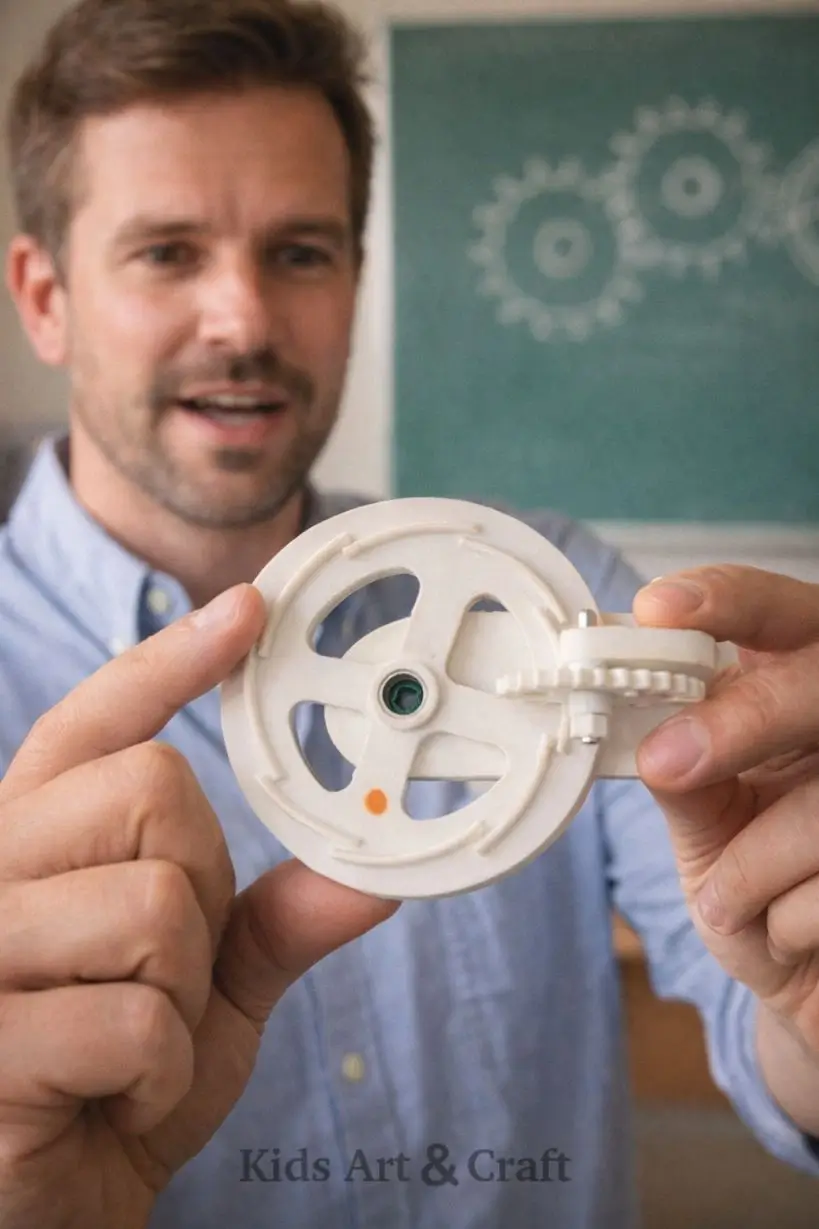
Gear transmission shows how rotational speed and torque change between meshing gears.
Understanding the Science of Gear Systems
Gears are wheels with teeth around their edges. When two gears touch, the teeth fit together like puzzle pieces.
When one gear spins:
- Its teeth push the teeth of the other gear.
- This makes the second gear spin.
Cool things happen with gears:
- Direction changes: If one gear spins clockwise, the other spins the opposite way.
- Speed changes: Big gears and small gears spin at different speeds.
- Power transfer: Gears help machines move heavy things with less effort.
This is called gear transmission — moving motion from one part of a machine to another.
Supplies Needed for the Gear Transmission Project
- Plastic or cardboard gears (big and small)
- Base board (cardboard, foam board, or wood)
- Axles or sticks (skewers or small rods)
- Glue or tape
- Spacer beads or washers
- Marker for marking rotation points
Easy Step-by-Step Guide to Build the Model
- Place the first gear on the base board using a stick or axle so it can spin freely.
- Attach the second gear so its teeth touch the first gear’s teeth.
- Make sure the gears fit tightly but can still rotate smoothly.
- Turn the first gear with your finger.
- Watch what happens:
- The second gear starts spinning automatically.
- It spins in the opposite direction.
- If the gears are different sizes:
- The small gear spins faster
- The big gear spins slower
This shows how machines control speed and movement.
Important Concepts Kids Will Discover
- How gears transfer motion
- How direction of movement changes
- How machines control speed
- Basic mechanical engineering ideas
- Problem-solving and building skills
Everyday Uses of Gears Around Us
Gears are everywhere! For example:
- Bicycles – gears help you pedal more easily uphill
- Clocks and watches – gears move the hands
- Cars – gears control speed and power
- Factory machines – gears run heavy equipment
- Robots – gears help parts move precisely
Safety Guidelines for Kids
- Be careful with sharp sticks or tools.
- Make sure gears are securely attached.
- Do not spin gears too fast near fingers.
Benefits of This STEM Gear Project
- Hands-on learning makes science fun
- Easy to build with simple materials
- Helps kids understand how real machines work
- Encourages creativity and engineering thinking
- Perfect for STEM projects and science fairs
Fun Ways to Upgrade Your Gear Model
- Add More Gears: Create a gear chain with 3–5 gears and observe how the direction keeps changing.
- Motorize It: Attach a small battery motor to the first gear and watch the whole system spin.
- Test Speed: Use a big gear and a tiny gear and count how many turns each makes.
Explore our gear transmission model, demonstrating how gears transfer motion and torque efficiently. Ideal for engineering projects, educational experiments, and science demonstrations, it highlights mechanical principles, gear ratios, and practical applications in automotive, industrial, and machinery systems. Discover new content instantly through our Telegram community. Follow us on YouTube & Facebook for craft tips, art hacks, and more!