





Paragraph Writing
Paragraph on AI in Smart Homes


Artificial intelligence in smart homes controls lights, temperature, security, and appliances automatically, making daily life easier, safer, and more energy-efficient. In this lesson, you will learn to write paragraphs using four main styles—Expository, Persuasive, Descriptive, and Narrative—while organising your ideas structures with PEEL, TEEL, TEXAS, and the Hamburger Model.
Read This Article in Other Languages
- स्मार्ट होम्स में एआई पर अनुच्छेद (Hindi / हिंदी)
- Párrafo sobre IA en hogares inteligentes (Spanish / Español)
- Paragraphe sur l’IA dans les maisons intelligentes (French / Français)
- Absatz über KI in Smart Homes (German / Deutsch)
- فقرة عن الذكاء الاصطناعي في المنازل الذكية (Arabic / العربية)
- স্মার্ট হোমে এআই সম্পর্কে অনুচ্ছেদ (Bengali / বাংলা)
- ஸ்மார்ட் வீடுகளில் AI பற்றிய பத்தி (Tamil / தமிழ்)
- స్మార్ట్ హోమ్లలో AIపై పేరాగ్రాఫ్ (Telugu / తెలుగు)
- സ്മാർട്ട് ഹോംസിൽ എഐയെക്കുറിച്ചുള്ള പാരഗ്രാഫ് (Malayalam / മലയാളം)
- سمارٹ ہومز میں مصنوعی ذہانت پر پیراگراف (Urdu / اردو)
- Parágrafo sobre IA em casas inteligentes (Portuguese / Português)
Translation Disclaimer: These links use Google Translate, an automated translation service. Translations may vary in accuracy and are provided for convenience only.
Different Styles of Paragraphs on ‘AI in Smart Homes’
1. Expository Paragraph on AI in Smart Homes (Explains with Facts)
Artificial Intelligence (AI) is changing the way people live in smart homes. Smart homes use AI to control lights, temperature, security systems, and household appliances. AI-powered devices can learn the habits of family members and adjust settings automatically. For example, a smart thermostat can regulate the temperature based on when people are home or asleep. Smart lights can turn on and off when someone enters or leaves a room. AI can also control security cameras, locks, and alarms, keeping homes safe. Voice assistants like Alexa or Google Assistant allow residents to give commands or ask questions, making everyday tasks easier. AI even helps in kitchens by suggesting recipes, controlling smart ovens, or managing groceries. By using AI, smart homes save energy, increase comfort, and improve security. Overall, AI makes daily life more convenient, efficient, and enjoyable, helping people focus on important tasks while technology handles routine chores.
2. Persuasive Paragraph on AI in Smart Homes (Tries to Convince You)
AI should be used in smart homes because it makes life easier, safer, and more comfortable. Smart devices powered by AI can control lights, temperature, and appliances automatically, saving energy and reducing bills. AI security systems keep homes safe by monitoring doors, windows, and cameras, alerting owners to any unusual activity. Voice assistants allow people to control devices with simple commands, making chores faster and easier. AI can even suggest recipes, manage groceries, and remind residents about important tasks. For elderly or disabled people, AI makes living independently much safer and simpler. Governments, developers, and families should embrace AI-powered smart homes because they improve comfort, security, and efficiency. When AI works alongside humans, homes become smarter, safer, and more convenient, providing a better quality of life for everyone.
3. Descriptive Paragraph on AI in Smart Homes (Paints a Picture with Words)
AI in smart homes feels like having an invisible helper that manages everything automatically. Lights brighten or dim as people enter a room, and the thermostat adjusts the temperature without anyone touching it. Smart fridges remind residents to buy groceries, and smart ovens start cooking at the right time. Voice assistants respond instantly to commands, turning on music, setting reminders, or answering questions. Security cameras and alarms monitor the house, detecting movement or unusual activities to keep the family safe. AI learns habits and routines, making the home more comfortable and energy-efficient. Every device seems alive, responding intelligently to needs and preferences. Living in a smart home with AI feels convenient, safe, and futuristic. AI quietly works behind the scenes, managing chores, protecting the home, and providing comfort while people focus on their activities.
4. Narrative Paragraph on AI in Smart Homes (Tells a Story)
Last weekend, Anaya visited her friend’s AI-powered smart home and was amazed by what she saw. The lights turned on automatically when she entered a room, and the temperature adjusted perfectly to make her comfortable. In the kitchen, the smart oven started cooking cookies at the right time, while the fridge reminded her friend’s mom about groceries. She asked the voice assistant to play music, and it responded instantly. Security cameras monitored the house quietly, making everyone feel safe. Anaya noticed that AI seemed to know the family’s routines, turning off lights when rooms were empty and controlling appliances efficiently. She realized that AI made the home smart, safe, and easy to live in. Anaya imagined having a smart home herself, where everyday tasks were handled automatically, leaving more time for fun and relaxation. That visit made her excited about the future of AI in homes.
‘AI in Smart Homes’ Paragraphs in Different Structured Methods
1. AI in Smart Homes Paragraph Writing with PEEL Method
PEEL Method (Point, Evidence, Explanation, Link)
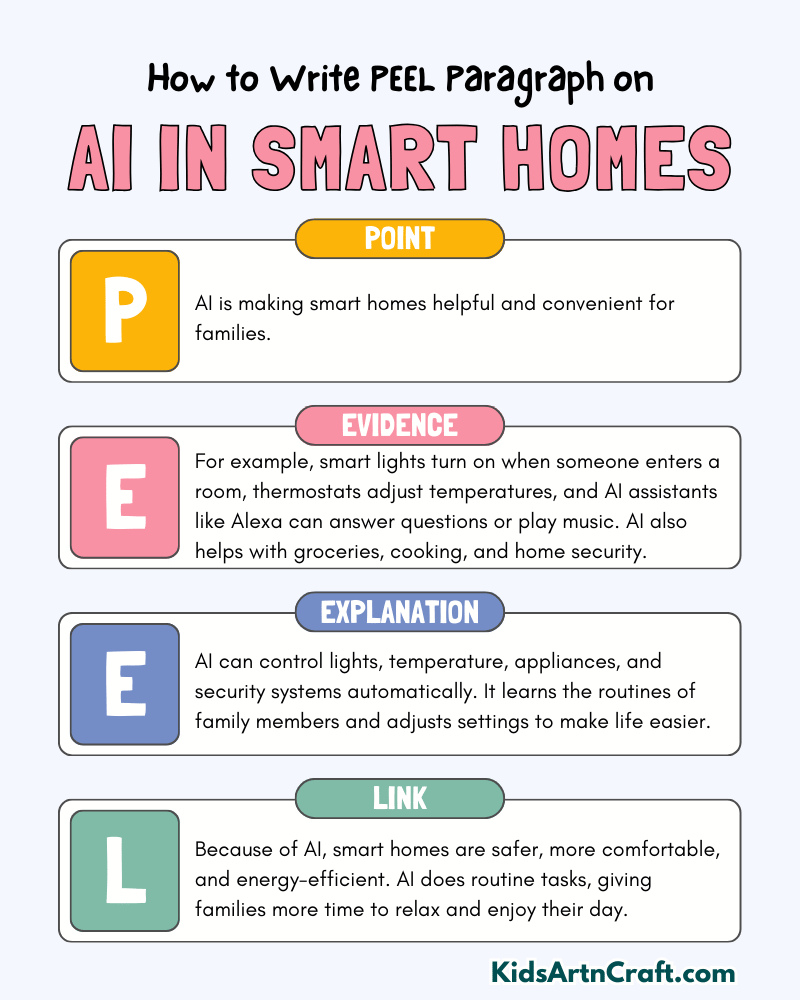
Point: AI is making smart homes helpful and convenient for families.
Evidence: For example, smart lights turn on when someone enters a room, thermostats adjust temperatures, and AI assistants like Alexa can answer questions or play music. AI also helps with groceries, cooking, and home security.
Explanation: AI can control lights, temperature, appliances, and security systems automatically. It learns the routines of family members and adjusts settings to make life easier.
Link: Because of AI, smart homes are safer, more comfortable, and energy-efficient. AI does routine tasks, giving families more time to relax and enjoy their day.
2. AI in Smart Homes Paragraph Writing with TEEL Method
TEEL Method (Topic, Evidence, Explanation, Link)
Topic: AI is changing the way people live in smart homes.
Evidence: For instance, smart ovens can start cooking at the right time, fridges can remind families to buy groceries, and lights and thermostats adjust automatically. Security systems can monitor doors, windows, and cameras.
Explanation: AI controls home devices and learns family routines to make life easier and safer.
Link: As a result, AI makes smart homes convenient, secure, and comfortable. Families can focus on fun and important tasks while AI manages daily chores.
3. AI in Smart Homes Paragraph Writing with TEXAS Method
TEXAS Method (Topic, Example, Explanation, Analysis, Summary/Significance)
Topic: AI is very useful in smart homes.
Example: For example, AI assistants can play music, answer questions, and remind people about groceries. Smart devices adjust settings based on routines and habits.
Explanation: It controls lights, temperature, appliances, and security systems automatically.
Analysis: This makes homes safer, more comfortable, and energy-efficient. Families spend less time on chores and more time enjoying life.
Summary: In short, AI in smart homes improves comfort, safety, and daily life for everyone.
4. AI in Smart Homes Paragraph Writing with Hamburger Method
Hamburger Method (Top Bun, The Fillings, Bottom Bun)
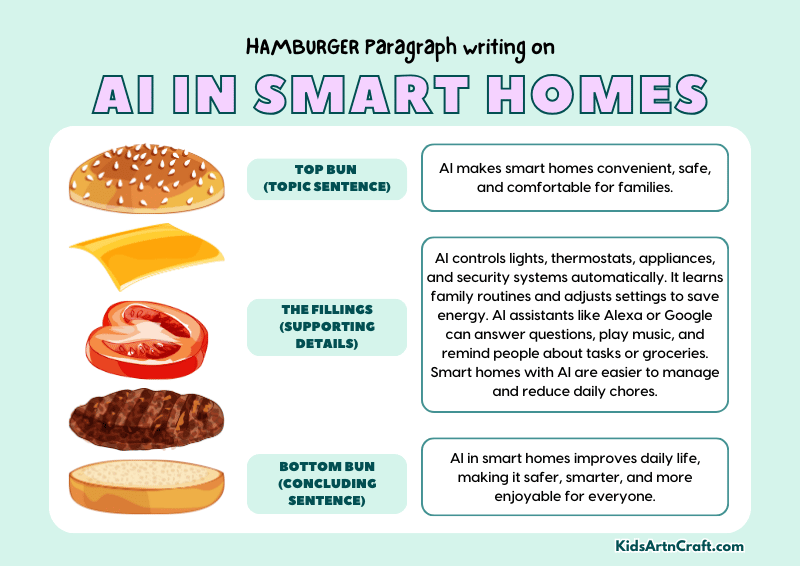
Top Bun (Topic Sentence):
AI makes smart homes convenient, safe, and comfortable for families.
The Fillings (Supporting Details):
AI controls lights, thermostats, appliances, and security systems automatically. It learns family routines and adjusts settings to save energy. AI assistants like Alexa or Google can answer questions, play music, and remind people about tasks or groceries. Smart homes with AI are easier to manage and reduce daily chores.
Bottom Bun (Concluding Sentence):
AI in smart homes improves daily life, making it safer, smarter, and more enjoyable for everyone.
Importance of AI in Smart Homes
- AI enables smart devices to automate everyday tasks, such as adjusting lighting and temperature, improving convenience and energy efficiency. [Source: U.S. Department of Energy – Smart Homes]
- Voice‑controlled AI assistants (like Alexa and Google Assistant) help users manage devices. [Source: NIH / PubMed – Voice Assistants Accessibility Study]
Additional Facts of AI in Smart Homes
- AI can improve home safety by detecting unusual activity or hazards, such as smoke, carbon monoxide, or water leaks. [Source: NIST – Smart Home IoT Safety & Security Report]
- Research shows smart home systems can significantly reduce energy use by learning residents’ routines and optimizing schedules. [Source: International Energy Agency – Energy Efficiency Reports]
- Privacy and security are key considerations — trusted frameworks help protect data generated by smart devices and ensure user control. [Source: ISO/IEC – Privacy and Security Standards for Smart Homes]
Hope you liked these paragraphs on ‘AI in Smart Homes’. Don’t forget to join the Telegram group for FREE Printables.