





Paragraph Writing
Paragraph on AI and Job Automation


Artificial intelligence in job automation performs repetitive tasks, increases efficiency, and helps workers focus on complex work, changing how jobs are done in many industries. Discover how to write strong, structured paragraphs in Expository, Persuasive, Descriptive, and Narrative styles or structures with PEEL, TEEL, TEXAS, and the Hamburger Model.
Read This Article in Other Languages
- नौकरी स्वचालन में एआई पर अनुच्छेद (Hindi / हिंदी)
- Párrafo sobre IA en la automatización de trabajos (Spanish / Español)
- Paragraphe sur l’IA dans l’automatisation des emplois (French / Français)
- Absatz über KI in der Arbeitsautomatisierung (German / Deutsch)
- فقرة عن الذكاء الاصطناعي في أتمتة الوظائف (Arabic / العربية)
- চাকরি স্বয়ংক্রিয়করণে এআই সম্পর্কে অনুচ্ছেদ (Bengali / বাংলা)
- வேலை தானியக்கத்தில் AI பற்றிய பத்தி (Tamil / தமிழ்)
- జాబ్ ఆటోమేషన్లో AIపై పేరాగ్రాఫ్ (Telugu / తెలుగు)
- ജോബ് ഓട്ടോമേഷനിൽ എഐയെക്കുറിച്ചുള്ള പാരഗ്രാഫ് (Malayalam / മലയാളം)
- نوکری کی خودکاری میں مصنوعی ذہانت پر پیراگراف (Urdu / اردو)
- Parágrafo sobre IA na automação de empregos (Portuguese / Português)
Translation Disclaimer: These links use Google Translate, an automated translation service. Translations may vary in accuracy and are provided for convenience only.
Different Styles of Paragraphs on ‘AI and Job Automation’
1. Expository Paragraph on AI and Job Automation (Explains with Facts)
Artificial Intelligence (AI) is changing the way people work through job automation. AI can perform tasks that were once done by humans, such as data entry, customer service, and even factory work. Machines and robots powered by AI can work faster and more accurately than humans, reducing mistakes and increasing productivity. In offices, AI programs can organize files, schedule meetings, and respond to emails automatically. In factories, robots can assemble products efficiently and safely. AI also helps in industries like healthcare and logistics by analyzing data and performing repetitive tasks. While some jobs may be replaced, new jobs are also created that require humans to manage AI systems and develop new technologies. Learning AI skills will be important for future workers. Overall, AI and job automation are making work faster, safer, and more efficient, while also preparing people for a future where humans and machines collaborate to achieve more.
2. Persuasive Paragraph on AI and Job Automation (Tries to Convince You)
AI should be embraced in workplaces because it improves productivity, safety, and efficiency. Machines and robots can handle repetitive, dangerous, or boring tasks, allowing humans to focus on creative and important work. For example, AI can manage schedules, answer customer queries, and assemble products in factories quickly and accurately. Automation reduces mistakes and saves time, making businesses more efficient. It also opens opportunities for new jobs, such as AI specialists, robot operators, and data analysts. Workers who learn AI skills will be prepared for the jobs of the future. Governments and companies should invest in AI and automation to make workplaces smarter and safer. When humans and AI work together, productivity increases, tasks become easier, and businesses thrive. AI is not a threat but a helpful tool that will make jobs safer, faster, and more enjoyable.
3. Descriptive Paragraph on AI and Job Automation (Paints a Picture with Words)
AI in job automation feels like having an invisible helper at work. In offices, AI programs organize files, schedule meetings, and answer emails automatically. In factories, robots assemble products with speed and precision, working without fatigue or mistakes. AI analyzes data in real time, helping doctors, scientists, and business managers make decisions quickly. Even repetitive or dangerous tasks are handled efficiently, making workplaces safer for humans. Machines and AI systems seem to learn from experience, improving performance every day. Employees can focus on creative, strategic, and important tasks while AI handles routine work. Workplaces with AI feel faster, smoother, and more organized. The environment becomes productive and efficient, where humans and machines collaborate as a team. AI quietly works behind the scenes, making tasks easier, reducing errors, and transforming jobs for a smarter future.
4. Narrative Paragraph on AI and Job Automation (Tells a Story)
Last week, Aryan visited his father’s factory and saw AI at work. Robots were assembling products quickly, while humans supervised and managed the machines. Aryan noticed that the robots never made mistakes and could work nonstop, even on heavy tasks. In the office, AI programs were organizing schedules, answering emails, and sorting data automatically. His father explained that AI automation saves time and reduces errors, allowing employees to focus on more important tasks. Aryan realized that some jobs might change because of AI, but new opportunities also appear for people who learn how to use these machines. He imagined a future where humans and AI work together, making workplaces safer, faster, and more productive. That day, Aryan felt excited about technology and understood how AI would shape jobs in the years to come.
‘AI and Job Automation’ Paragraphs in Different Structured Methods
1. AI and Job Automation Paragraph Writing with PEEL Method
PEEL Method (Point, Evidence, Explanation, Link)
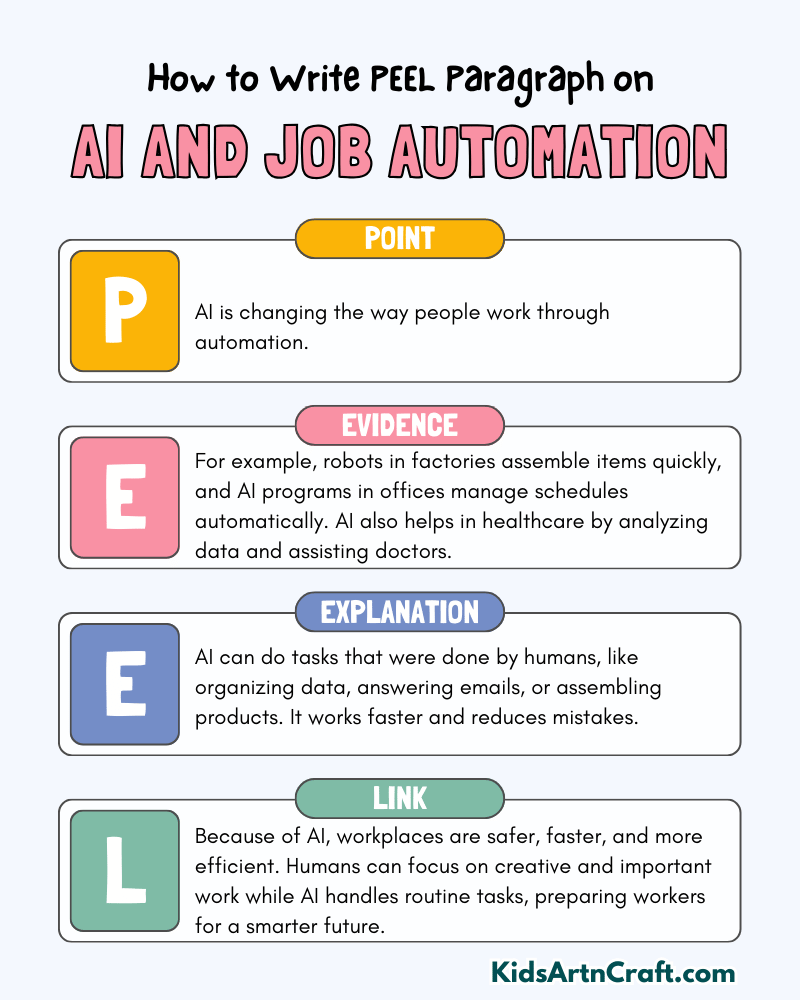
Point: AI is changing the way people work through automation.
Evidence: For example, robots in factories assemble items quickly, and AI programs in offices manage schedules automatically. AI also helps in healthcare by analyzing data and assisting doctors.
Explanation: AI can do tasks that were done by humans, like organizing data, answering emails, or assembling products. It works faster and reduces mistakes.
Link: Because of AI, workplaces are safer, faster, and more efficient. Humans can focus on creative and important work while AI handles routine tasks, preparing workers for a smarter future.
2. AI and Job Automation Paragraph Writing with TEEL Method
TEEL Method (Topic, Evidence, Explanation, Link)
Topic: AI is changing jobs through automation.
Evidence: For instance, robots assemble products in factories, and AI programs organize office work or help doctors with data.
Explanation: AI can perform repetitive, boring, or dangerous tasks faster and more accurately than humans.
Link: As a result, AI makes workplaces more efficient and safer. People can focus on creative tasks while AI helps with routine jobs, making the future of work smarter.
3. AI and Job Automation Paragraph Writing with TEXAS Method
TEXAS Method (Topic, Example, Explanation, Analysis, Summary/Significance)
Topic: AI is very useful for automating jobs.
Example: For example, robots assemble products, and AI programs sort emails or manage schedules.
Explanation: AI handles tasks like data entry, customer service, and factory work automatically.
Analysis: This saves time, reduces mistakes, and makes workplaces safer and faster.
Summary: In short, AI in job automation helps humans work smarter and prepares them for future jobs.
4. AI and Job Automation Paragraph Writing with Hamburger Method
Hamburger Method (Top Bun, The Fillings, Bottom Bun)
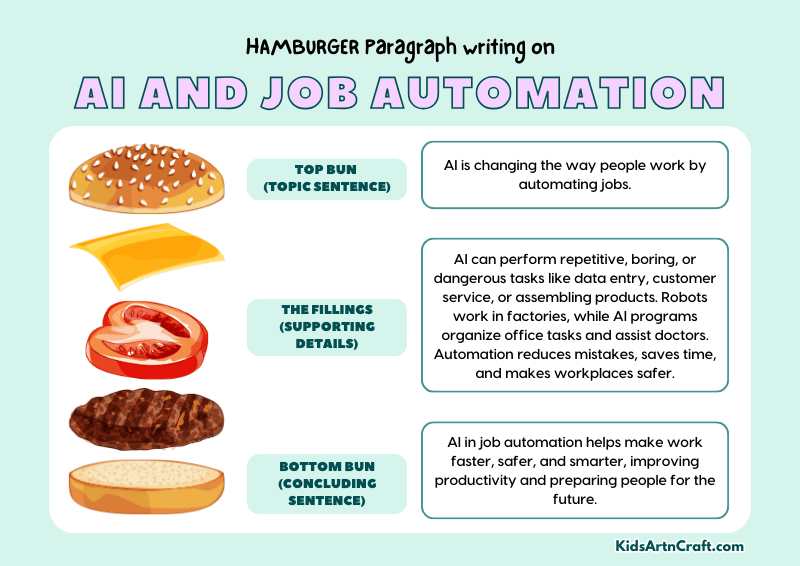
Top Bun (Topic Sentence):
AI is changing the way people work by automating jobs.
The Fillings (Supporting Details):
AI can perform repetitive, boring, or dangerous tasks like data entry, customer service, or assembling products. Robots work in factories, while AI programs organize office tasks and assist doctors. Automation reduces mistakes, saves time, and makes workplaces safer.
Bottom Bun (Concluding Sentence):
AI in job automation helps make work faster, safer, and smarter, improving productivity and preparing people for the future.
Importance of AI in Job Automation
- AI increases productivity by automating routine tasks and allowing humans to focus on creative work. [Source: OECD – AI & Automation Report]
- AI improves workplace safety by performing dangerous jobs in manufacturing, mining, and hazardous environments. [Source: International Labour Organization – Workplace Safety]
Additional Facts of AI in Job Automation
- AI transforms job roles, creating new opportunities while shifting others, highlighting the need for reskilling. [Source: World Economic Forum – Future of Jobs 2023]
- Automation creates growth in tech, data analysis, and AI support roles. [Source: McKinsey Global Institute – Jobs & Future of Work]
- AI adoption encourages lifelong learning and upskilling to meet evolving workforce demands. [Source: OECD – Employment Outlook]
Hope you liked these paragraphs on ‘AI and Job Automation’. Don’t forget to join the Telegram group for FREE Printables.