






Paragraph Writing
Paragraph on Animals That Survive in Extreme Climates


Some animals survive in extreme climates, like camels in deserts and polar bears in the Arctic. They adapt with special features, such as thick fur, water storage, or heat tolerance, to stay alive. In this lesson, you will learn to write paragraphs on ‘Animals That Survive in Extreme Climates‘ in four styles—Expository, Persuasive, Descriptive, and Narrative—while organizing your ideas clearly using structures with PEEL, TEEL, TEXAS, and the Hamburger Model.
Read This Article in Other Languages
- जानवर कठिन जलवायु में कैसे जीवित रहते हैं पर अनुच्छेद (Hindi / हिंदी)
- Párrafo sobre cómo los animales sobreviven en climas extremos (Spanish / Español)
- Paragraphe sur la façon dont les animaux survivent dans des climats extrêmes (French / Français)
- Absatz darüber, wie Tiere extreme Klimazonen überleben (German / Deutsch)
- فقرة عن كيفية بقاء الحيوانات في المناخات القاسية (Arabic / العربية)
- চরম আবহাওয়ায় প্রাণীরা কীভাবে বাঁচে – অনুচ্ছেদ (Bengali / বাংলা)
- கடுமையான காலநிலைகளில் உயிரினங்கள் எப்படி உயிர் வாழ்கின்றன பற்றி பத்தி (Tamil / தமிழ்)
- చరమ వాతావరణాలలో జంతువులు ఎలా జీవిస్తాయి గురించి పేరా (Telugu / తెలుగు)
- പ്രളയ കാലാവസ്ഥയിൽ മൃഗങ്ങൾ എങ്ങനെയാണ് ജീവനോടെ ഇരിക്കുന്നത് എന്ന പാരഗ്രാഫ് (Malayalam / മലയാളം)
- جانور انتہائی موسمی حالات میں کیسے زندہ رہتے ہیں پر پیراگراف (Urdu / اردو)
- Parágrafo sobre como os animais sobrevivem em climas extremos (Portuguese / Português)
Translation Disclaimer: These links use Google Translate, an automated translation service. Translations may vary in accuracy and are provided for convenience only.
Different Styles of Paragraphs on ‘Animals That Survive in Extreme Climates’
1. Expository Paragraph on Animals That Survive in Extreme Climates (Explains with Facts)
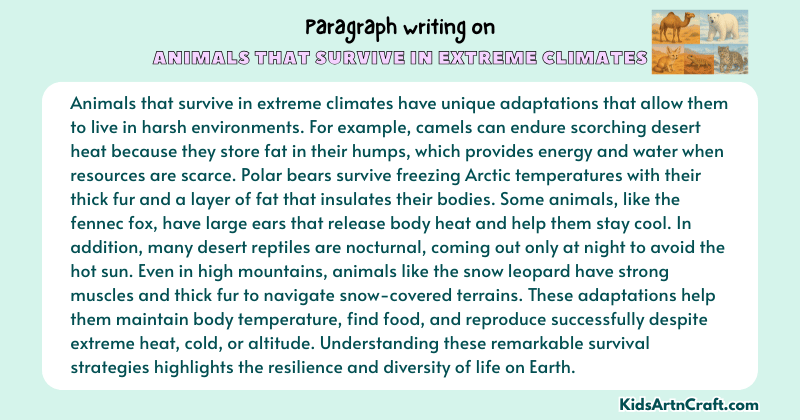
Animals that survive in extreme climates have unique adaptations that allow them to live in harsh environments. For example, camels can endure scorching desert heat because they store fat in their humps, which provides energy and water when resources are scarce. Polar bears survive freezing Arctic temperatures with their thick fur and a layer of fat that insulates their bodies. Some animals, like the fennec fox, have large ears that release body heat and help them stay cool. In addition, many desert reptiles are nocturnal, coming out only at night to avoid the hot sun. Even in high mountains, animals like the snow leopard have strong muscles and thick fur to navigate snow-covered terrains. These adaptations help them maintain body temperature, find food, and reproduce successfully despite extreme heat, cold, or altitude. Understanding these remarkable survival strategies highlights the resilience and diversity of life on Earth.
2. Persuasive Paragraph on Animals That Survive in Extreme Climates (Tries to Convince You)
Humans should protect animals that survive in extreme climates because their survival strategies are both fascinating and vital to ecosystems. These creatures, like polar bears, camels, and snow leopards, face challenges from climate change and habitat loss. Without their protection, we risk losing not only these incredible species but also the ecological balance they help maintain. For instance, desert animals prevent overpopulation of certain insects, while Arctic predators regulate prey populations. Preserving these animals allows future generations to study and admire their extraordinary adaptations. Moreover, these species inspire scientific research, leading to innovations in survival gear and technology. By taking action to safeguard their habitats, we ensure that nature’s wonders continue to thrive. Protecting animals in extreme climates is not just a moral duty—it is an investment in the planet’s health and our understanding of life’s resilience.
3. Descriptive Paragraph on Animals That Survive in Extreme Climates (Paints a Picture with Words)
In the icy Arctic, polar bears roam across endless white snowfields, their thick white fur blending perfectly with the frozen landscape. Their black noses and sharp eyes scan for prey, while massive paws leave deep tracks in the snow. In scorching deserts, camels stride across golden dunes, their humps swaying rhythmically as they conserve water in their bodies. The fennec fox’s enormous ears twitch at every sound, helping it detect insects hidden beneath the sand. High in snowy mountains, the elusive snow leopard moves gracefully over rocky slopes, its long tail balancing each jump. These animals appear perfectly designed for their extreme homes—the desert’s heat, the Arctic’s chill, and the mountain’s rugged heights. Watching them survive and thrive in such harsh conditions is a vivid reminder of nature’s remarkable ingenuity. Every adaptation, from thick fur to nocturnal habits, paints a picture of resilience, patience, and extraordinary beauty.
4. Narrative Paragraph on Animals That Survive in Extreme Climates (Tells a Story)
Last winter, I went on a wildlife expedition in the Arctic, hoping to see polar bears in their natural habitat. One morning, I spotted a mother bear with her cubs, trudging carefully across the snowy landscape. Their thick white fur glistened in the weak sunlight, and I noticed how their massive paws helped them move effortlessly on ice. Later, I visited a desert wildlife reserve, where a camel caravan was resting under the scorching sun. The camels’ humps rose and fell as they napped, storing energy and water for the long journey ahead. A small fennec fox peeked out from its sandy burrow, its huge ears twitching nervously. Experiencing these animals up close made me realize how perfectly they are adapted to survive extreme climates. Each moment was a lesson in resilience, showing that life can thrive even in the harshest conditions, provided creatures have the right adaptations and instincts.
‘Animals That Survive in Extreme Climates’ Paragraphs in Different Structured Methods
1. Animals That Survive in Extreme Climates Paragraph Writing with PEEL Method
PEEL Method (Point, Evidence, Explanation, Link)
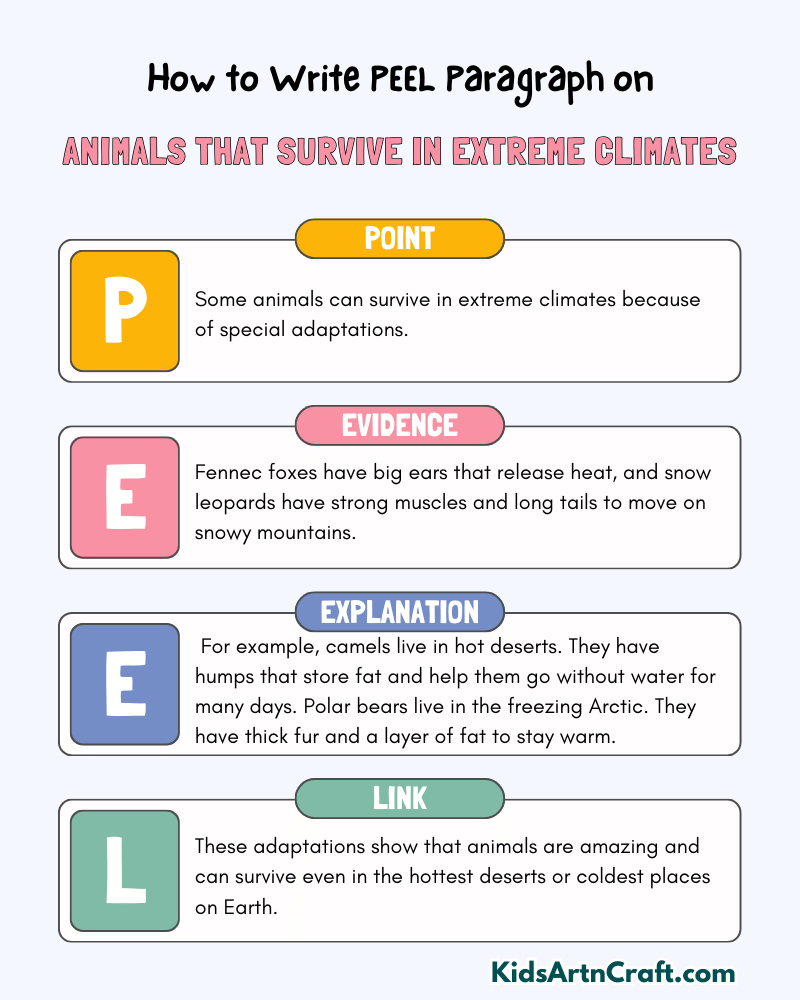
Point: Some animals can survive in extreme climates because of special adaptations.
Evidence: Fennec foxes have big ears that release heat, and snow leopards have strong muscles and long tails to move on snowy mountains.
Explanation: For example, camels live in hot deserts. They have humps that store fat and help them go without water for many days. Polar bears live in the freezing Arctic. They have thick fur and a layer of fat to stay warm.
Link: These adaptations show that animals are amazing and can survive even in the hottest deserts or coldest places on Earth.
2. Animals That Survive in Extreme Climates Paragraph Writing with TEEL Method
TEEL Method (Topic, Evidence, Explanation, Link)
Topic: Animals survive in extreme climates using clever adaptations.
Evidence: Fennec foxes use their large ears to cool down, and snow leopards have strong legs and tails to move in snowy mountains.
Explanation: Camels store fat in their humps to stay alive in deserts. Polar bears stay warm with thick fur and fat in the Arctic.
Link: These special features help animals live safely and find food, showing how nature helps them survive anywhere.
3. Animals That Survive in Extreme Climates Paragraph Writing with the TEXAS Method
TEXAS Method (Topic, Example, Explanation, Analysis, Summary/Significance)
Topic: Some animals can live in very hot or cold places.
Example: Fennec foxes’ big ears help them stay cool, and snow leopards’ tails help them balance on icy slopes.
Explanation: Camels store water and energy in their humps, while polar bears have thick fur to keep warm.
Analysis: These traits allow them to hunt, move, and stay alive in harsh climates.
Summary: Animals have amazing skills to survive in deserts, mountains, and icy lands.
4. Animals That Survive in Extreme Climates Paragraph Writing with Hamburger Method
Hamburger Method (Top Bun, The Fillings, Bottom Bun)
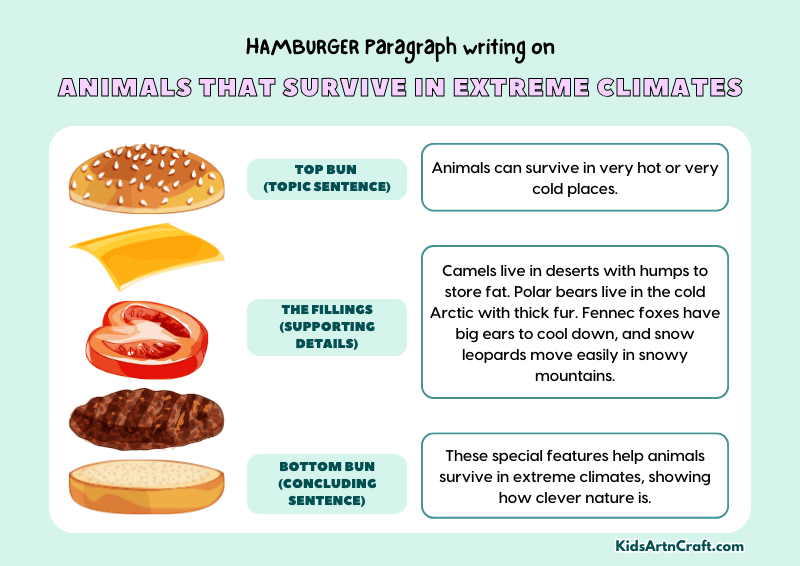
Top Bun (Topic Sentence):
Animals can survive in very hot or very cold places.
The Fillings (Supporting Details):
Camels live in deserts with humps to store fat. Polar bears live in the cold Arctic with thick fur. Fennec foxes have big ears to cool down, and snow leopards move easily in snowy mountains.
Bottom Bun (Concluding Sentence):
These special features help animals survive in extreme climates, showing how clever nature is.
Survival in Hot Climates
- Many animals stay active at night or rest in shade to avoid heat and save water. [Source: Institute for Environmental Research and Education]
- Desert animals like kangaroo rats and fennec foxes have special features to stay cool and reduce water loss. [Source: Science Times]
Survival in Cold Climates
- Polar animals like penguins and seals have thick fur or blubber to stay warm. [Source: Institute for Environmental Research and Education]
- Some animals, like fish and insects, produce natural antifreeze to prevent freezing in extreme cold. [Source: Animals Around The Globe]
- Tiny creatures like tardigrades can survive extreme heat, cold, or even space by entering a suspended state. [Source: Science Digest]
Hope you liked these paragraphs on ‘Animals That Survive in Extreme Climates’. Don’t forget to join the Telegram group for FREE Printables.
Check this article for hands-on climate change activities for kids.