Paragraph Writing
Paragraph on AI and Data Privacy

Artificial intelligence and data privacy focus on protecting personal information while using AI, ensuring data is secure, confidential, and not misused. Understand how to write well-structured paragraphs on ‘AI and Data Privacy’ through four key styles—Expository, Persuasive, Descriptive, and Narrative—clearly using structures with PEEL, TEEL, TEXAS, and the Hamburger Model.
Read This Article in Other Languages
- एआई और डेटा गोपनीयता पर अनुच्छेद (Hindi / हिंदी)
- Párrafo sobre IA y privacidad de datos (Spanish / Español)
- Paragraphe sur l’IA et la confidentialité des données (French / Français)
- Absatz über KI und Datenschutz (German / Deutsch)
- فقرة عن الذكاء الاصطناعي وخصوصية البيانات (Arabic / العربية)
- এআই এবং ডেটা গোপনীয়তা সম্পর্কে অনুচ্ছেদ (Bengali / বাংলা)
- AI மற்றும் தரவு தனியுரிமை பற்றிய பத்தி (Tamil / தமிழ்)
- AI మరియు డేటా గోప్యతపై పేరాగ్రాఫ్ (Telugu / తెలుగు)
- AI ഡാറ്റാ പ്രൈവസിയെക്കുറിച്ചുള്ള പാരഗ്രാഫ് (Malayalam / മലയാളം)
- AI اور ڈیٹا پرائیویسی پر پیراگراف (Urdu / اردو)
- Parágrafo sobre IA e privacidade de dados (Portuguese / Português)
Translation Disclaimer: These links use Google Translate, an automated translation service. Translations may vary in accuracy and are provided for convenience only.
Different Styles of Paragraphs on ‘AI and Data Privacy’
1. Expository Paragraph on AI and Data Privacy (Explains with Facts)

Artificial Intelligence (AI) is used in many areas of life, from social media to healthcare, but it raises concerns about data privacy. AI systems collect, store, and analyze large amounts of personal information, including search history, messages, location, and preferences. While this data helps AI provide better recommendations and services, it can also be misused if not protected properly. For example, hackers could steal private information, or companies might share data without consent. Data privacy laws and secure systems are necessary to prevent misuse and protect individuals. People should be aware of how AI uses their data and take steps to safeguard it, like using strong passwords and privacy settings. By ensuring AI respects privacy, we can enjoy its benefits safely. Protecting data is essential to maintain trust in technology, allowing AI to improve our lives without compromising personal information.
2. Persuasive Paragraph on AI and Data Privacy (Tries to Convince You)
AI is helpful, but people must protect their data to stay safe. AI collects personal information to provide better services, like recommendations, ads, and learning tools. However, if data is misused, it can harm privacy, lead to identity theft, or allow companies to share private information without permission. Everyone should follow strong safety practices, such as using passwords, privacy settings, and secure apps. Governments and companies should make strict rules to protect data and make AI transparent. When people use AI responsibly and protect their information, they can enjoy its benefits safely, like smarter apps, faster services, and personalized experiences. Protecting data is not optional—it is necessary for safety and trust. Ethical AI and good privacy practices go hand in hand to make technology helpful, fair, and safe for everyone.
3. Descriptive Paragraph on AI and Data Privacy (Paints a Picture with Words)
AI feels like a smart helper, but it quietly collects information about people. Every click, search, and message can be stored and analyzed. AI uses this data to suggest videos, recommend friends, or help doctors with treatment. While it seems helpful, it can also be risky if personal information is not kept private. Hackers could steal it, or companies could share it without permission. Secure systems, strong passwords, and privacy settings act like shields that protect people. Ethical AI works carefully, respecting privacy and following rules. When data is safe, AI can make life easier, like helping in schools, hospitals, and homes. Data privacy creates trust, ensuring AI remains a helpful and friendly tool. Without it, the technology can feel unsafe. Using AI responsibly keeps both people and their information protected while still enjoying its many advantages.
4. Narrative Paragraph on AI and Data Privacy (Tells a Story)
Last week, Anaya noticed her favorite app suggesting new videos that matched her recent searches. She wondered how it knew her preferences and learned that AI was collecting and analyzing her data. At first, it seemed helpful, but she also thought about privacy risks. What if her personal information was stolen or shared without permission? Anaya decided to check the app’s privacy settings and create a stronger password. She realized that while AI could make life easier, protecting personal data was very important. Her parents explained that ethical AI and good data privacy practices help people use technology safely. That day, Anaya understood that AI is smart and useful, but it must respect privacy. She felt confident that by protecting her data, she could enjoy AI safely and responsibly. AI, when combined with data privacy, could improve life without putting personal information at risk.
‘AI and Data Privacy’ Paragraphs in Different Structured Methods
1. AI and Data Privacy Paragraph Writing with PEEL Method
PEEL Method (Point, Evidence, Explanation, Link)
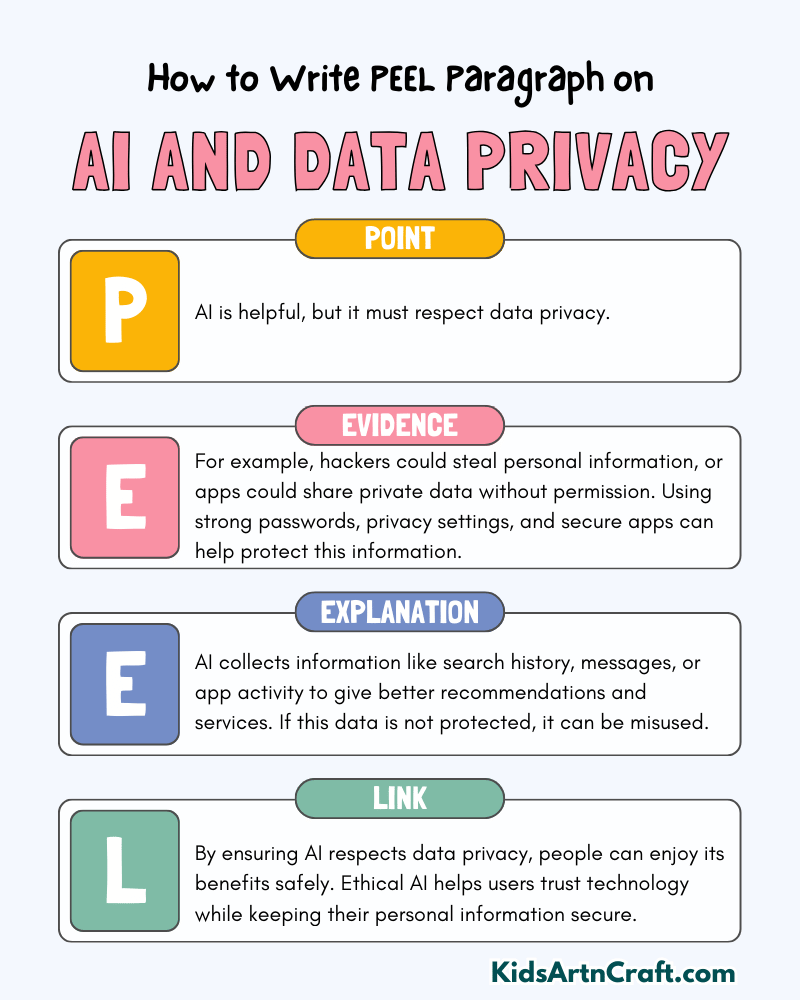

Point: AI is helpful, but it must respect data privacy.
Evidence: For example, hackers could steal personal information, or apps could share private data without permission. Using strong passwords, privacy settings, and secure apps can help protect this information.
Explanation: AI collects information like search history, messages, or app activity to give better recommendations and services. If this data is not protected, it can be misused.
Link: By ensuring AI respects data privacy, people can enjoy its benefits safely. Ethical AI helps users trust technology while keeping their personal information secure.
2. AI and Data Privacy Paragraph Writing with TEEL Method
TEEL Method (Topic, Evidence, Explanation, Link)
Topic: AI collects a lot of personal information, so privacy is important.
Evidence: For instance, AI can suggest videos or help doctors analyze health data, but if it is not protected, private information could be leaked.
Explanation: Data like location, messages, or searches is used to make apps and services smarter.
Link: Therefore, using strong passwords, privacy settings, and safe apps helps protect data. Ethical AI ensures technology is safe and trustworthy for everyone.
3. AI and Data Privacy Paragraph Writing with TEXAS Method
TEXAS Method (Topic, Example, Explanation, Analysis, Summary/Significance)
Topic: AI is useful, but data privacy must be protected.
Example: For example, it helps suggest content, assist students, or guide doctors with reports.
Explanation: AI collects personal information to improve services and apps.
Analysis: If privacy is not protected, hackers or companies could misuse the data.
Summary: In short, ethical AI and strong data privacy practices keep people safe while enjoying the benefits of technology.
4. AI and Data Privacy Paragraph Writing with Hamburger Method
Hamburger Method (Top Bun, The Fillings, Bottom Bun)
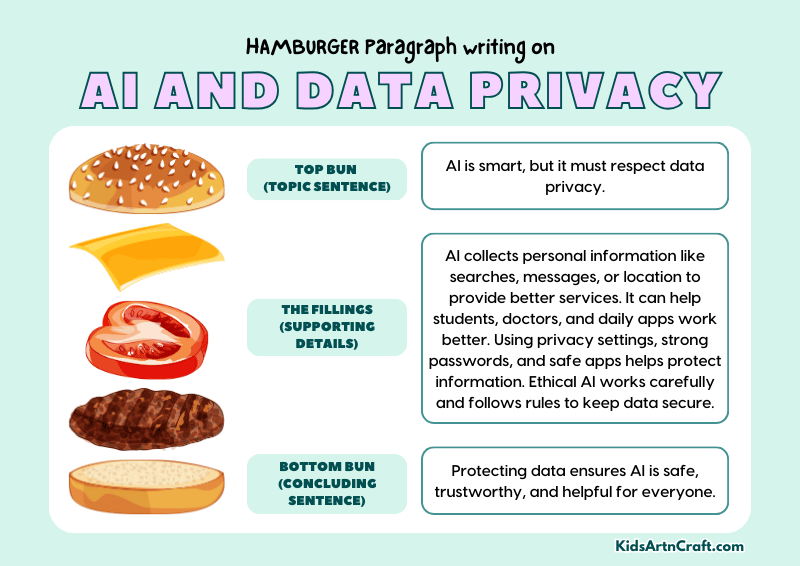

Top Bun (Topic Sentence):
AI is smart, but it must respect data privacy.
The Fillings (Supporting Details):
AI collects personal information like searches, messages, or location to provide better services. It can help students, doctors, and daily apps work better. Using privacy settings, strong passwords, and safe apps helps protect information. Ethical AI works carefully and follows rules to keep data secure.
Bottom Bun (Concluding Sentence):
Protecting data ensures AI is safe, trustworthy, and helpful for everyone.
Importance of AI Data Privacy
- AI systems often use large amounts of personal data, making privacy protection essential to maintain trust. [Source: IAPP – Consumer Perspectives on Privacy and AI]
- Privacy-preserving AI techniques like differential privacy and federated learning protect sensitive data while enabling insights. [Source: IndiaAI – Privacy Preserving AI]
Additional Facts of AI Data Privacy
- AI privacy risks include profiling, surveillance, and re-identification of anonymized data. [Source: arXiv – AI Privacy Risks Taxonomy]
- Data protection laws and regulatory frameworks are evolving globally to safeguard personal information in AI applications. [Source: International Journal of Research and Innovation in Social Science]
- Effective AI privacy practices enhance trust, reduce legal risks, and promote ethical AI use across industries. [Source: IAPP – Consumer Perspectives on Privacy and AI]
Hope you liked these paragraphs on ‘AI and Data Privacy’. Don’t forget to join the Telegram group for FREE Printables.