







Paragraph Writing
Paragraph on How Airplanes Stay in the Air


Airplanes stay in the air because of their wings, engines, and the principles of lift and thrust. Air moving over the wings creates lift, while engines provide thrust to move forward and stay airborne. Develop strong paragraph-writing skills by practicing ‘How Airplanes Stay in the Air‘ in four styles—Expository, Persuasive, Descriptive, and Narrative—and organize your ideas using structures with PEEL, TEEL, TEXAS, and the Hamburger Model.
Read This Article in Other Languages
- विमान हवा में कैसे रहते हैं पर अनुच्छेद (Hindi / हिंदी)
- Párrafo sobre cómo los aviones se mantienen en el aire (Spanish / Español)
- Paragraphe sur la façon dont les avions restent en l’air (French / Français)
- Absatz darüber, wie Flugzeuge in der Luft bleiben (German / Deutsch)
- فقرة عن كيفية بقاء الطائرات في الهواء (Arabic / العربية)
- বিমান কীভাবে বাতাসে থাকে সম্পর্কে অনুচ্ছেদ (Bengali / বাংলা)
- விமானங்கள் காற்றில் எப்படி இருக்கின்றன என்பதைக் குறித்து பத்தி (Tamil / தமிழ்)
- విమానాలు గాలి లో ఎలా ఉంటాయో గురించి పేరా (Telugu / తెలుగు)
- വിമാനങ്ങൾ വായുവിൽ എങ്ങനെ നിലനിൽക്കുന്നു എന്ന പാരഗ്രാഫ് (Malayalam / മലയാളം)
- طیارے ہوا میں کیسے رہتے ہیں پر پیراگراف (Urdu / اردو)
- Parágrafo sobre como os aviões permanecem no ar (Portuguese / Português)
Translation Disclaimer: These links use Google Translate, an automated translation service. Translations may not be fully accurate and are provided for convenience only.
Different Styles of Paragraphs on ‘How Airplanes Stay in the Air’
1. Expository Paragraph on How Airplanes Stay in the Air (Explains with Facts)
Airplanes stay in the air because of the science of aerodynamics. The wings of an airplane are shaped to create lift, which is an upward force that counteracts gravity. When the engines push the plane forward, air moves over and under the wings, generating lift and allowing the plane to rise. Pilots control the plane using flaps, ailerons, and rudders to steer, climb, or descend safely. The engines provide thrust, while the wings and tail balance the airplane to keep it stable. Airplanes also rely on careful design, including light materials and proper weight distribution, to fly efficiently. Weather conditions and air pressure are important too, as they affect how smoothly the plane moves. Understanding these scientific principles helps engineers build safe airplanes and allows pilots to navigate through the sky. Overall, airplanes stay in the air through the combination of lift, thrust, weight, and careful control.
2. Persuasive Paragraph on How Airplanes Stay in the Air (Tries to Convince You)
Everyone should understand how airplanes stay in the air because it shows the amazing power of science and engineering. Airplanes fly because of lift, which is created by their specially shaped wings. Engines give thrust to push the plane forward, while pilots use controls to keep it stable and safe. Learning about flight helps people appreciate the effort and skill needed to travel safely across the sky. Instead of taking flying for granted, everyone should realize that planes combine physics, technology, and human skill to stay aloft. Understanding this can inspire curiosity, encourage learning about science, and make flying less intimidating. Airplanes are incredible machines, and knowing how they work reminds us of human innovation. Everyone should take a moment to appreciate how lift, thrust, and careful control make it possible to soar above the clouds safely.
3. Descriptive Paragraph on How Airplanes Stay in the Air (Paints a Picture with Words)
The airplane glides gracefully through the sky, its wings cutting through the air like blades. Air rushes over and under the curved wings, creating a powerful lift that pushes the plane upward. The engines roar steadily, giving thrust that drives the airplane forward with confidence. Pilots sit in the cockpit, their hands moving over levers and buttons, guiding the plane with careful precision. The tail wobbles slightly with the wind, adjusting the plane’s balance as it moves through fluffy clouds. Sunlight reflects off the metallic body, and the sky looks endless and blue around it. Inside, passengers feel the smooth motion as the plane rises higher, floating almost effortlessly. Every part of the airplane, from the wings to the engines, works together in harmony. Watching it fly makes the science of aerodynamics feel magical, showing how lift, thrust, and balance keep the airplane soaring safely above the earth.
4. Narrative Paragraph on How Airplanes Stay in the Air (Tells a Story)
Last summer, I flew on an airplane for the first time, and I was amazed at how it stayed in the air. I watched the wings stretch out on either side, curving perfectly to lift the plane. The engines roared as we sped down the runway, and soon we were rising into the sky. The pilot explained that the wings create lift while the engines provide thrust, and small flaps help control the direction. As we soared above the clouds, I could feel the gentle motion of the plane balancing against the wind. Looking out of the window, I saw fields and rivers far below, and I realized how carefully every part of the plane works together to keep it stable and safe. That flight made me curious about science, and I understood that airplanes stay in the air thanks to lift, thrust, balance, and skilled pilots guiding them through the sky.
‘How Airplanes Stay in the Air’ Paragraphs in Different Structured Methods
1. How Airplanes Stay in the Air Paragraph Writing with PEEL Method
PEEL Method (Point, Evidence, Explanation, Link)
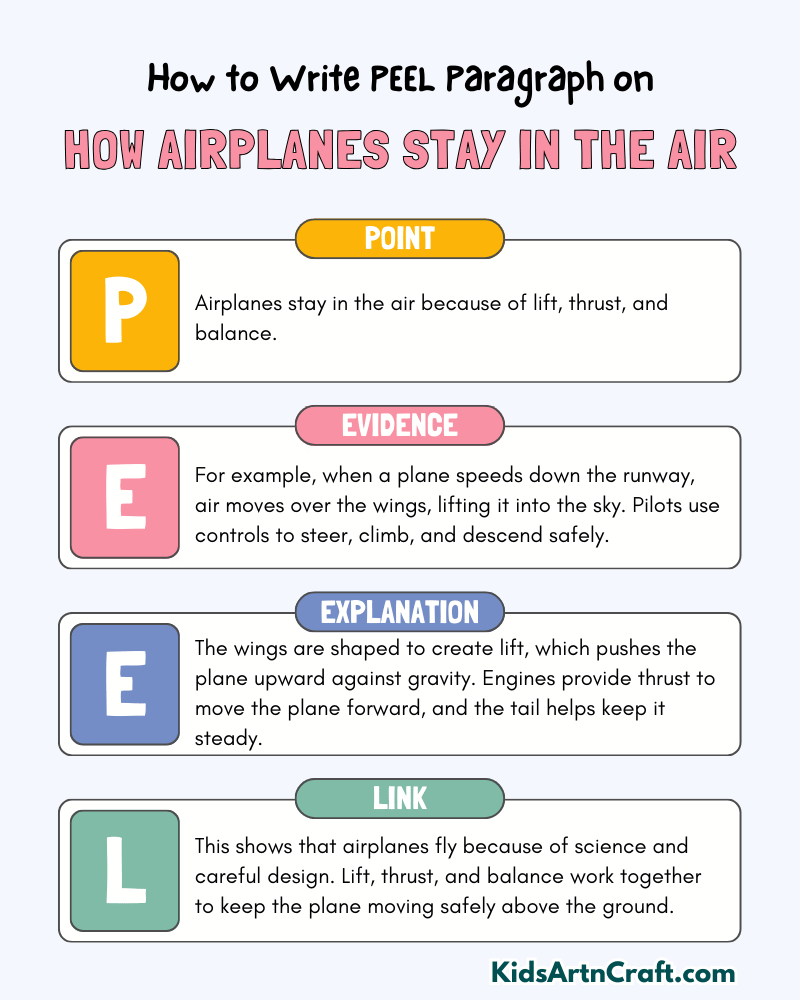
Point: Airplanes stay in the air because of lift, thrust, and balance.
Evidence: For example, when a plane speeds down the runway, air moves over the wings, lifting it into the sky. Pilots use controls to steer, climb, and descend safely.
Explanation: The wings are shaped to create lift, which pushes the plane upward against gravity. Engines provide thrust to move the plane forward, and the tail helps keep it steady.
Link: This shows that airplanes fly because of science and careful design. Lift, thrust, and balance work together to keep the plane moving safely above the ground.
2. How Airplanes Stay in the Air Paragraph Writing with TEEL Method
TEEL Method (Topic, Evidence, Explanation, Link)
Topic: Airplanes fly because of lift, thrust, and control.
Evidence: For instance, a plane rises into the sky as air moves over the curved wings, while the engines push it forward.
Explanation: The wings create lift, engines give thrust, and pilots control the plane’s direction.
Link: So, airplanes stay in the air by using science and engineering to combine lift, thrust, and balance, keeping passengers safe and the flight smooth.
3. How Airplanes Stay in the Air Paragraph Writing with the TEXAS Method
TEXAS Method (Topic, Example, Explanation, Analysis, Summary/Significance)
Topic: Airplanes can fly because of lift and thrust.
Example: Pilots adjust flaps and ailerons to control the plane’s direction.
Explanation: The wings push air down, which lifts the plane, and the engines move it forward.
Analysis: Combining lift, thrust, and balance allows the plane to stay in the air safely.
Summary: That is why airplanes can fly high in the sky, carrying people and cargo efficiently.
4. How Airplanes Stay in the Air Paragraph Writing with Hamburger Method
Hamburger Method (Top Bun, The Fillings, Bottom Bun)

Top Bun (Topic Sentence):
Airplanes stay in the air because of lift, thrust, and control.
The Fillings (Supporting Details):
Wings create lift by moving air over and under them, engines give thrust to move the plane forward, and the tail and flaps help keep it balanced. Pilots guide the plane using controls to climb, turn, or descend. Every part works together to ensure safety and a smooth flight. The combination of physics, engineering, and skill makes it possible for airplanes to soar high above the ground.
Bottom Bun (Concluding Sentence):
This is why airplanes can fly safely, allowing people to travel across the world in just a few hours.
Importance of Airplane Flight
- Airplanes stay in the air due to lift generated by their wings and thrust from engines. [Source: NASA Glenn Research Center]
- Balancing lift, weight, thrust, and drag ensures stable and safe flight. [Source: Federal Aviation Administration (FAA)]
Additional Facts About Flight
- Aerodynamic wing design and engine efficiency improve flight performance. [Source: Encyclopedia Britannica]
- Physics principles like Bernoulli’s and Newton’s laws govern how airplanes fly. [Source: National Geographic]
- Scientific research and engineering innovations continuously enhance aviation safety and efficiency. [Source: NASA]
Hope you liked these paragraphs on ‘How Airplanes Stay in the Air’. Don’t forget to join the Telegram group for FREE Printables.
Check this article to create an easy origami airplane tutorial for kids.