Paragraph Writing
Paragraph on How Animals Communicate Without Talking

Animals communicate without talking by using sounds, body movements, facial expressions, scents, and signals to warn others, find food, and show feelings. Build confidence in paragraph-writing by studying in four styles—Expository, Persuasive, Descriptive, and Narrative—using structures like PEEL, TEEL, TEXAS, and the Hamburger Model.
Read This Article in Other Languages
- बिना बात किए जानवर कैसे संवाद करते हैं (Hindi / हिंदी)
- Cómo los animales se comunican sin hablar (Spanish / Español)
- Comment les animaux communiquent sans parler (French / Français)
- Wie Tiere ohne zu sprechen kommunizieren (German / Deutsch)
- كيف تتواصل الحيوانات بدون التحدث (Arabic / العربية)
- জানা যায় না কথা বলে প্রাণীরা কীভাবে যোগাযোগ করে (Bengali / বাংলা)
- விடாமல் பேசாமல் விலங்குகள் எப்படி தொடர்பு செலுத்துகின்றன (Tamil / தமிழ்)
- మాట్లాడకుండానే జంతువులు ఎలా కమ్యూనికేట్ చేస్తాయి (Telugu / తెలుగు)
- മാത്യപ്പെട്ടു സംസാരിക്കാതെ ജീവികള് എങ്ങനെ ആശയ വിനിമയം നടത്തുന്നു (Malayalam / മലയാളం)
- جانور بغیر بات کئے کیسے بات چیت کرتے ہیں (Urdu / اردو)
- Como os animais se comunicam sem falar (Portuguese / Português)
Translation Disclaimer: These links use Google Translate, an automated translation service. Translations may vary in accuracy and are provided for convenience only.
Different Styles of Paragraphs on ‘How Animals Communicate Without Talking’
1. Expository Paragraph on How Animals Communicate Without Talking (Explains with Facts)

School has taught me that animals communicate without talking by using sounds, body movements, and signals. Animals do not use words like humans, but they still share messages clearly. Birds chirp to warn others of danger or to attract mates. Dogs wag their tails to show happiness or tuck them to show fear. Bees perform special dances to tell other bees where flowers are located. In class, I learned that animals also use smells, such as ants leaving scent trails to guide their group. Facial expressions and posture also help animals communicate feelings like anger, fear, or excitement. This lesson taught me that communication is more than speaking. School has shown me that listening and observing are important life skills. Just like animals, humans can express feelings through actions and expressions. Understanding how animals communicate helps us respect them and reminds us that good communication is about understanding others, not just using words.
2. Persuasive Paragraph on How Animals Communicate Without Talking (Tries to Convince You)
School has taught me that understanding how animals communicate without talking is very important. Animals use sounds, movements, and signals to express their needs and feelings. When we understand these signs, we can treat animals more kindly and safely. For example, a growling dog is not being mean but warning us to stay away. Birds sing to protect their space, and cats purr to show comfort. School lessons showed me that ignoring these signals can cause harm to both animals and people. This taught me an important life lesson: listening is just as important as speaking. We should pay attention to actions, not only words. If humans learn from animals, we can become better listeners and more caring individuals. School has helped me understand that communication is about respect and awareness. By learning how animals communicate, we learn to be patient, understanding, and kind in our own lives.
3. Descriptive Paragraph on How Animals Communicate Without Talking (Paints a Picture with Words)
In school, I learned a beautiful life lesson by observing how animals communicate without talking. I imagine birds singing in the morning, sharing messages across the sky. A dog lifts its ears, wags its tail, or barks softly to show how it feels. Bees move in small dances, guiding others to sweet flowers. Even a horse communicates by stamping its feet or moving its head. These silent messages are powerful. Teachers explained that animals use sounds, movements, and expressions instead of words. Watching these actions feels like reading a secret language. This lesson taught me that communication does not always need speech. School has shown me that feelings can be shared through actions, expressions, and care. Just like animals, humans can show kindness, fear, or love without speaking. This understanding helps me respect animals and reminds me to pay attention to the small signs in everyday life.
4. Narrative Paragraph on How Animals Communicate Without Talking (Tells a Story)
I remember a lesson in school that helped me understand how animals communicate without talking. Our teacher asked us to watch a video of animals in the wild. I saw birds calling loudly, deer lifting their tails, and bees dancing together. The teacher explained that each movement and sound had a meaning. That day, I realized animals have their own language. Later, when I saw my dog barking and hiding, I understood he was scared, not angry. School taught me an important life lesson: communication is about understanding signals, not just hearing words. This lesson helped me become more patient and observant. I learned to notice body language, expressions, and actions. School has shown me that good communication means caring enough to understand others. Just like animals, humans also share feelings through actions, and learning to notice them makes us kinder and wiser.
‘How Animals Communicate Without Talking’ Paragraphs in Different Structured Methods
1. How Animals Communicate Without Talking Paragraph Writing with PEEL Method
PEEL Method (Point, Evidence, Explanation, Link)
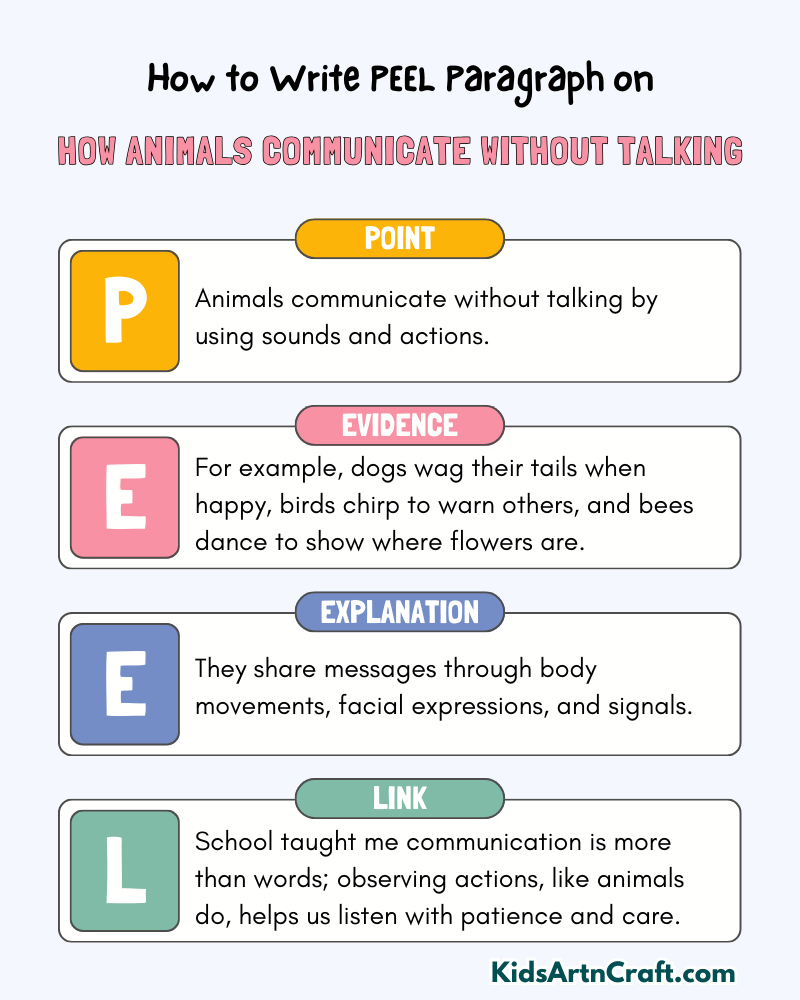

Point: Animals communicate without talking by using sounds and actions.
Evidence: For example, dogs wag their tails when happy, birds chirp to warn others, and bees dance to show where flowers are.
Explanation: They share messages through body movements, facial expressions, and signals.
Link: School taught me communication is more than words; observing actions, like animals do, helps us listen with patience and care.
2. How Animals Communicate Without Talking Paragraph Writing with TEEL Method
TEEL Method (Topic, Evidence, Explanation, Link)
Topic: Animals use different ways to communicate without speaking.
Evidence: In school, I learned that cats purr to show comfort and snakes hiss to show danger.
Explanation: They use sounds, body language, and movements to share feelings and warnings.
Link: This lesson taught me that good communication means understanding signs, not just words. School helps us learn to observe carefully and respect all living beings. These skills are important in life and help us treat animals and people with kindness.
3. How Animals Communicate Without Talking Paragraph Writing with TEXAS Method
TEXAS Method (Topic, Example, Explanation, Analysis, Summary/Significance)
Topic: Animals communicate in silent but meaningful ways.
Example: For example, birds sing, dogs bark, and ants leave scent trails to guide others.
Explanation: They use actions, sounds, and signals instead of words.
Analysis: These actions help animals stay safe and work together.
Summary: School has taught me that communication is about understanding, not speaking. This life lesson helps me listen better and respect how others share their feelings, even without words.
4. How Animals Communicate Without Talking Paragraph Writing with Hamburger Method
Hamburger Method (Top Bun, The Fillings, Bottom Bun)
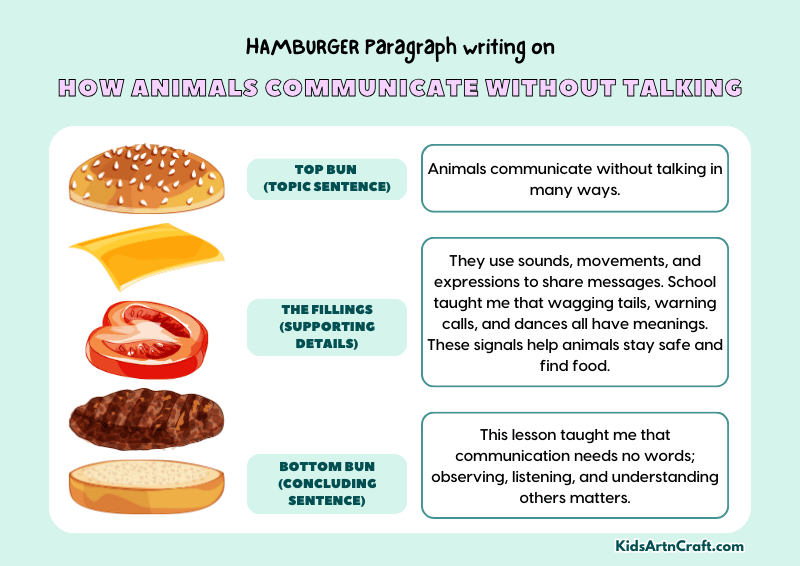

Top Bun (Topic Sentence):
Animals communicate without talking in many ways.
The Fillings (Supporting Details):
They use sounds, movements, and expressions to share messages. School taught me that wagging tails, warning calls, and dances all have meanings. These signals help animals stay safe and find food.
Bottom Bun (Concluding Sentence):
This lesson taught me that communication needs no words; observing, listening, and understanding others matter.
Importance of Animal Communication
- Animals communicate without talking using body language, scents, and gestures. [Source: ASPCA – Animal Communication]
- Birds and insects use sounds and dances to share information and warn others. [Source: National Geographic – Animal Communication]
Additional Facts About Animal Signals
- Mammals like dogs and elephants use touch and scent to show affection and group identity. [Source: Scientific American – Animal Communication]
- Primates use facial expressions and gestures similar to human non-verbal cues. [Source: American Psychological Association]
- Birds sing to mark territory, attract mates, and signal danger. [Source: Audubon Society – How Birds Communicate]
- Bees perform dances to share food locations with their hive. [Source: Bee Culture – Dance Language of Bees]
Hope you liked these paragraphs on ‘How Animals Communicate Without Talking’. Don’t forget to join the Telegram group for FREE Printables.