Science Experiments
CD Generator Wheel Science Project For Students

Have you ever wondered how electricity can be made just by spinning something? In this fun STEM project, we build a mini hand-powered generator using a CD, a string, and a small motor. When the wheel spins, it produces electricity that can light up a tiny LED bulb!
It’s a simple experiment that shows how movement can turn into electrical energy.

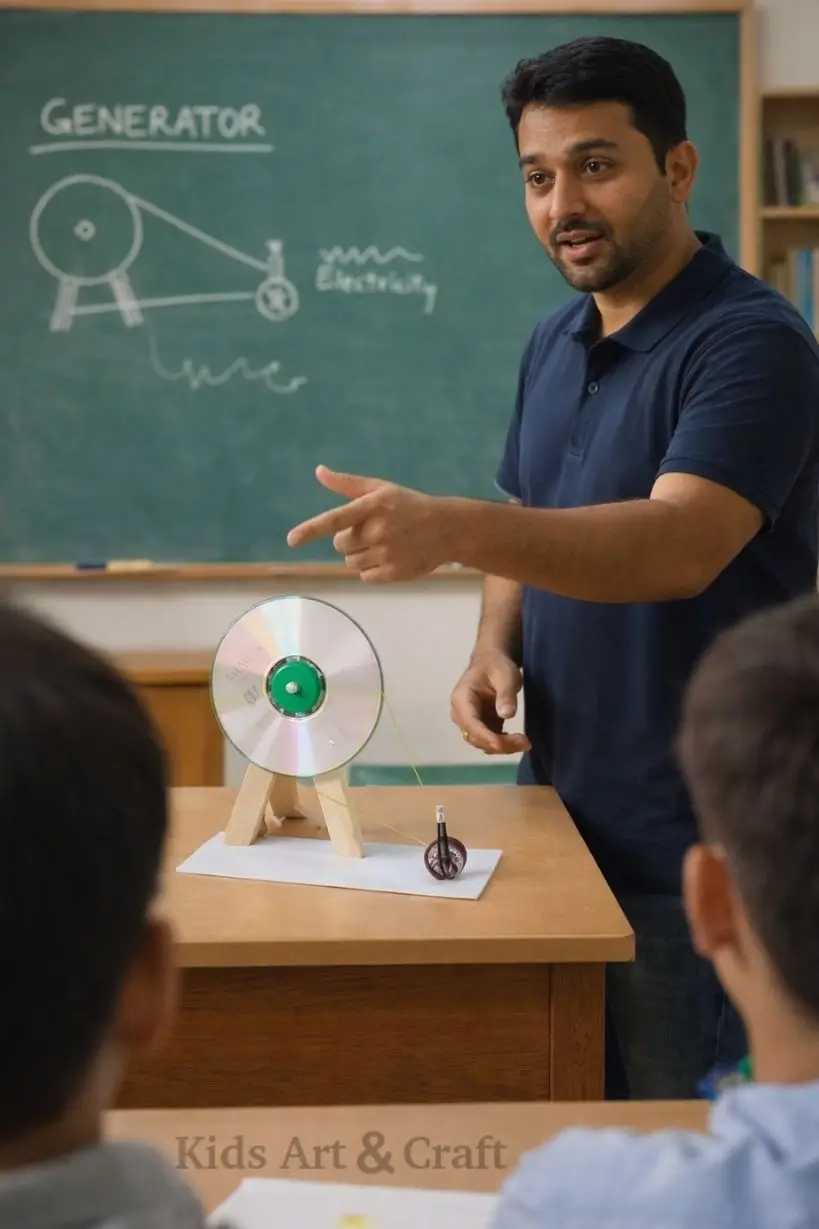
Demonstration of manual electricity generation using a simple rotating generator model
STEM Generator Project Overview for Kids
This project demonstrates energy conversion.
Here’s the simple idea:
- When you pull the string, the CD spins quickly.
- The spinning CD rotates a small DC motor.
- A motor can also work in reverse as a generator.
- The spinning motor creates electricity.
- The electricity lights up the LED bulb.
So the energy changes like this:
Hand Energy ➜ Spinning Motion ➜ Electrical Energy ➜ Light
This is similar to how power plants generate electricity!
Materials for CD Generator Science Project
- Old CD or DVD
- Popsicle sticks or wooden craft sticks
- Strong thread or string
- Small DC motor (toy motor)
- LED light
- Cardboard base
- Bottle cap or small wheel hub
- Glue gun or strong glue
- Scissors
Step-by-Step Generator Model Instructions
Step 1: Build the Stand
Glue popsicle sticks onto a cardboard base to create a support stand for the CD wheel.
Step 2: Attach the CD Wheel
Fix the CD to a bottle cap or hub so it can spin easily on the stand.
Step 3: Connect the String
Wrap a string around the CD hub. This string will be used to pull and spin the wheel.
Step 4: Connect the Motor
Place a small DC motor near the CD so that the spinning motion turns the motor.
Step 5: Attach the LED
Connect the two wires from the motor to the LED bulb.
Step 6: Pull the String
Now pull the string quickly!
- The CD spins
- The motor rotates
- Electricity is generated
- The LED lights up
What Kids Learn
- How electricity can be generated
- Understanding energy conversion
- How motors and generators work
- Basic engineering and design
- Building skills and creativity
Real-Life Applications
This experiment is similar to technologies used in real life:
- Hydroelectric dams (water spins turbines)
- Wind turbines
- Bicycle dynamos
- Power plants
- Hand-crank flashlights
All of these use motion to generate electricity!
Safety Tips
- Be careful when using hot glue.
- Do not spin the wheel too fast near your face.
- Make sure wires are properly connected.
- Ask an adult for help when using tools.
Why This Project Is Great for Kids
- Uses simple recycled materials
- Demonstrates real-world physics
- Encourages hands-on learning
- Makes science fun and visual
- Perfect for school science fairs
Kids love seeing the LED light up from their own effort!
Extension Ideas
- Try Different Wheel Sizes: Use bigger or smaller CDs and see how it affects electricity generation.
- Add a Gear System: Use gears to make the motor spin even faster.
- Power More LEDs: Try connecting 2–3 LEDs and see how much energy you can generate.
A hand-crank electric generator is a reliable, eco-friendly power solution for emergencies, outdoor activities, and off-grid use. Its portability, durability, and sustainable energy production make it an essential device for anyone seeking dependable backup electricity anytime, anywhere in modern life. Keep in touch via our Telegram group and explore art and craft tutorials on our YouTube & Facebook pages.