School Crafts
DIY Conveyor Belt Working Model for School


Have you ever seen how factories move products from one place to another? They often use conveyor belts! In this fun STEM project, kids build a mini conveyor belt machine that can move small objects like cups or toys from one side to another using a hand crank and rotating wheels. This experiment shows how simple machines help move things easily and efficiently.
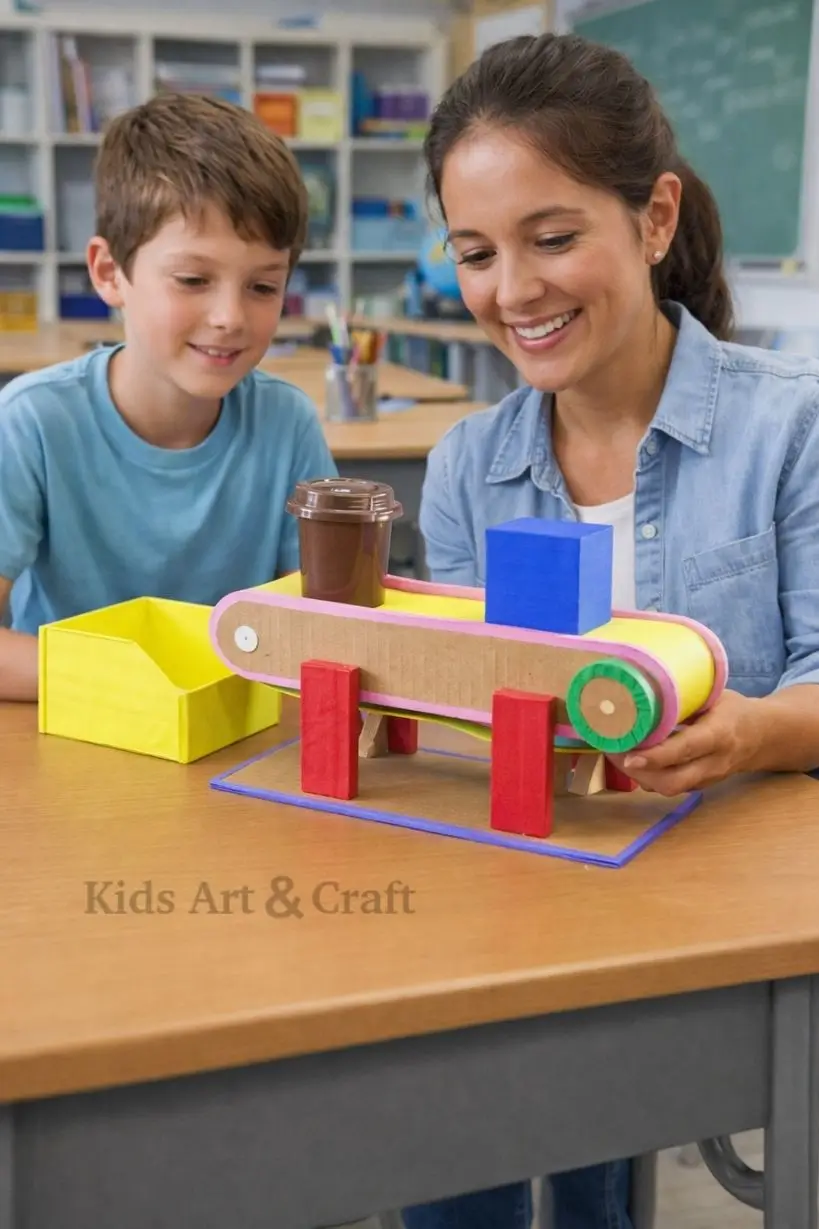
The conveyor belt system moves items continuously using rotating rollers and a belt loop.
The Science Behind Conveyor Belt Motion
This project demonstrates how mechanical motion works. When you turn the wheel (crank), it rotates a set of rollers connected by a belt. As the rollers spin, the belt moves forward, carrying objects placed on it.
Key ideas involved:
- Rotation – Turning a wheel creates motion.
- Energy Transfer – Your hand movement transfers energy to the wheels.
- Friction & Grip – The belt grips the rollers so it moves instead of slipping.
- Simple Machines – Wheels and axles help move objects with less effort.
In real life, this same principle moves luggage in airports and packages in factories!
Supplies Needed for the Conveyor Belt Project
- Cardboard or foam board (for the base)
- Two wooden sticks or dowels (rollers)
- Rubber bands or a wide elastic belt (conveyor belt)
- Cardboard pieces for support stands
- Small wheel or circular cardboard piece (hand crank)
- Hot glue or strong glue
- Scissors
- Small cup or toy object (to transport)
Easy Steps to Build Your Conveyor Belt Model
Step 1. Build the Base
Attach a flat cardboard sheet to create the platform of the machine.
Step 2. Create Support Stands
Glue two raised cardboard supports on each side to hold the rollers.
Step 3. Install the Rollers
Insert wooden sticks through the supports so they can rotate freely.
Step 4. Add the Conveyor Belt
Wrap a rubber band or elastic belt around the two rollers.
Step 5. Attach the Hand Wheel
Fix a circular cardboard wheel to one roller so it acts as a crank.
Step 6. Turn the Wheel
When you rotate the wheel with your hand, the roller spins.
Step 7. Watch the Belt Move!
The belt starts moving and carries objects placed on top toward the other end.
Important STEM Concepts Kids Will Learn
- How simple machines work
- How rotational motion creates movement
- How energy moves from your hand to the machine
- Basic engineering design and building skills
- Problem-solving and creativity
Everyday Examples of Conveyor Belt Systems
Conveyor belts are used in many places:
- Factories to move products
- Airports to carry luggage
- Food industries to transport items
- Warehouses for sorting packages
- Supermarket checkouts
Your small project works exactly like these big systems!
Simple Safety Rules to Follow
- Use scissors carefully.
- If using hot glue, ask an adult for help.
- Keep fingers away from the moving rollers while turning the crank.
Why This STEM Activity Is Perfect for Kids
- Easy to build with simple materials
- Teaches engineering and physics concepts
- Encourages hands-on learning
- Helps kids understand how machines work in real life
- Fun to test with different objects!
Creative Ways to Upgrade the Conveyor Belt Model
- Add a Motor: Replace the hand crank with a small battery motor to create an automatic conveyor belt.
- Build a Sorting System: Add small barriers or ramps so objects move into different boxes.
- Experiment with Speed: Try different belt materials or bigger wheels to see how speed changes.
This DIY Conveyor Belt Working Model is a fun and practical way for students to understand how machines move objects efficiently. It helps kids learn important STEM concepts like motion, energy transfer, and simple machines through hands-on creativity. Explore fresh creative ideas every day in our Telegram community! Follow us on YouTube & Facebook for fun crafts, DIY hacks, art tips, and more!