Science Experiments
Automatic Street Light Project with LDR For Student

Have you ever noticed that street lights turn on automatically when it gets dark? This cool science project shows how that happens!
In this model, we build a mini street with LED lights that turn on at night and turn off during the day automatically. The secret behind it is a tiny electronic sensor called an LDR (Light Dependent Resistor).
This project is a fun way to learn how smart lighting systems work in real cities.

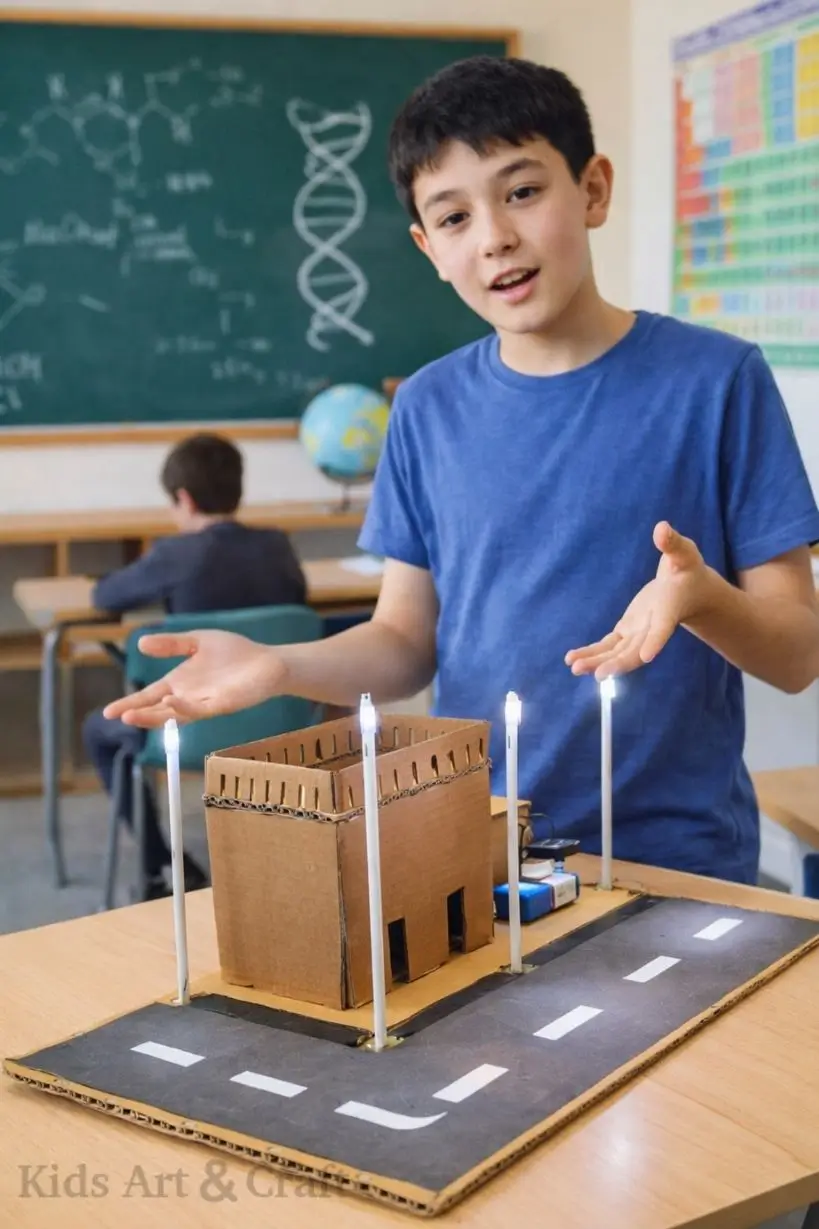
Street lights turn on automatically in darkness using light-dependent resistor technology.
Science Concept: Light Sensing with LDR
- The main science idea in this project is light sensing.
- An LDR (Light Dependent Resistor) is a special component that reacts to light.
- When there is bright light → the LDR reduces electricity flow to the LEDs → lights stay OFF
- When it becomes dark → the LDR allows electricity to flow → LEDs turn ON
- So the LDR acts like a tiny automatic light switch that detects day and night.
- This is similar to how real street lights automatically turn on after sunset.
Materials Needed for LDR Street Light Model
- Cardboard base (for the road and building)
- Small cardboard box (for the house/building)
- LED lights
- LDR (Light Dependent Resistor)
- Transistor
- Resistors
- Battery (9V or small battery pack)
- Connecting wires
- Breadboard or simple circuit board
- Black chart paper (for road)
- White tape or paint (for road lines)
- Glue or tape
- Small sticks or straws (for lamp posts)
Step-by-Step Guide to Build a Street Light Model
Step 1: Build the Model Street
- Use cardboard as the base platform.
- Create a road using black paper.
- Add white road markings.
- Make a small building using a cardboard box.
Step 2: Create the Street Lights
- Attach LEDs to sticks or straws to look like lamp posts.
- Fix them along the sides of the road.
Step 3: Connect the Circuit
Connect the following components:
- Battery → transistor → LEDs
- LDR and resistor → control the transistor
The LDR detects the light around it.
Step 4; How It Works
- When light falls on the LDR → LEDs stay OFF
- When you cover the LDR or make it dark → LEDs turn ON
Try this:
- Shine a flashlight on the LDR
- Cover it with your hand
You will see the street lights switch automatically!
What Kids Learn
This project helps kids understand:
- How automatic street lights work
- Basic electronic circuits
- How sensors detect light and darkness
- How technology helps make smart cities
- Creativity through model building
Real-Life Uses of Automatic Street Lights
This technology is used in many places:
- Automatic street lights
- Garden lights
- Outdoor home lighting
- School and campus lighting
- Energy-saving smart lighting systems
These systems save electricity because lights turn on only when needed.
Safety Guidelines for School Projects
- Use low-voltage batteries only.
- Do not connect directly to the wall electricity.
- Ask an adult for help when building the circuit.
- Handle LEDs and wires carefully.
Benefits of This STEM Science Project
- Easy and fun to build
- Teaches science + electronics together
- Shows real-world technology in action
- Improves problem-solving and creativity
- Perfect for science fairs and STEM learning
Creative Extension Ideas for Students
- Solar Street Light Model: Add a small solar panel so the battery charges during the day.
- Motion Sensor Street Light: Add a motion sensor so lights turn on only when someone passes by.
- Smart City Model: Build a complete city model with traffic lights, houses, and automatic street lights.
In conclusion, an automatic street light using an LDR sensor is a smart, energy-efficient solution for modern cities. It reduces electricity waste, lowers maintenance costs, and supports sustainable living while improving road safety through reliable, automatic night-time illumination systems today. Join our Telegram channel and follow us on YouTube & Facebook for inspiring art and craft tutorials.