

Paragraph Writing
Paragraph on A Conversation Between the Sun and the Moon


Explore a creative paragraph on ‘A Conversation Between the Sun and the Moon,’ showcasing imagination, dialogue writing, and personification to enhance storytelling and creative writing skills for students. Sharpen your paragraph-writing skills in four styles—Expository, Persuasive, Descriptive, and Narrative—while effectively organizing your ideas using structures with PEEL, TEEL, TEXAS, and the Hamburger Model.
Read This Article in Other Languages
- सूरज और चाँद के बीच बातचीत पर अनुच्छेद (Hindi / हिंदी)
- Párrafo sobre una conversación entre el Sol y la Luna (Spanish / Español)
- Paragraphe sur une conversation entre le Soleil et la Lune (French / Français)
- Absatz über ein Gespräch zwischen Sonne und Mond (German / Deutsch)
- فقرة عن محادثة بين الشمس والقمر (Arabic / العربية)
- সূর্য ও চাঁদের মধ্যে কথোপকথন সম্পর্কে অনুচ্ছেদ (Bengali / বাংলা)
- சூரியன் மற்றும் சந்திரனா இடையிலான உரையாடல் பற்றி பத்தி (Tamil / தமிழ்)
- సూర్యుడితో చంద్రుడి మధ్య సంభాషణపై పేరా (Telugu / తెలుగు)
- സൂര്യനും ചന്ദ്രനും തമ്മിലുള്ള സംഭാഷണത്തെക്കുറിച്ചുള്ള പാരഗ്രാഫ് (Malayalam / മലയാളം)
- سورج اور چاند کے مابین گفتگو پر پیراگراف (Urdu / اردو)
- Parágrafo sobre uma conversa entre o Sol e a Lua (Portuguese / Português)
Translation Disclaimer: These links use Google Translate, an automated translation service. Translations may vary in accuracy and are provided for convenience only.
Different Styles of Paragraphs on ‘A Conversation Between the Sun and the Moon’
1. Expository Paragraph on A Conversation Between the Sun and the Moon (Explains with Facts)
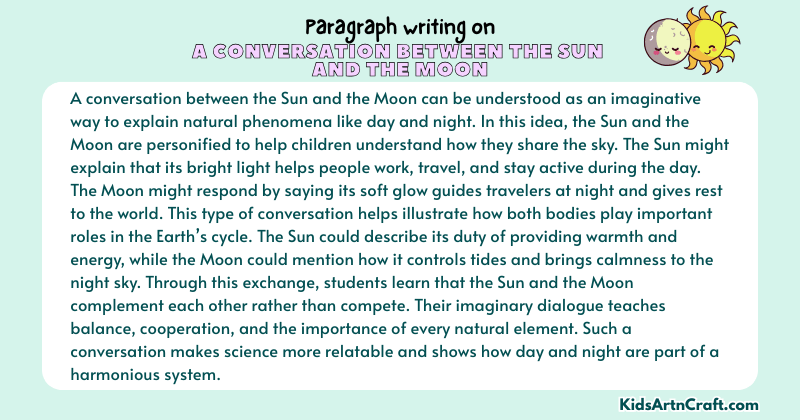
A conversation between the Sun and the Moon can be understood as an imaginative way to explain natural phenomena like day and night. In this idea, the Sun and the Moon are personified to help children understand how they share the sky. The Sun might explain that its bright light helps people work, travel, and stay active during the day. The Moon might respond by saying its soft glow guides travelers at night and gives rest to the world. This type of conversation helps illustrate how both bodies play important roles in the Earth’s cycle. The Sun could describe its duty of providing warmth and energy, while the Moon could mention how it controls tides and brings calmness to the night sky. Through this exchange, students learn that the Sun and the Moon complement each other rather than compete. Their imaginary dialogue teaches balance, cooperation, and the importance of every natural element. Such a conversation makes science more relatable and shows how day and night are part of a harmonious system.
2. Persuasive Paragraph on A Conversation Between the Sun and the Moon (Tries to Convince You)
A conversation between the Sun and the Moon can convince us that both celestial bodies are equally important, even though they shine differently. Imagine the Sun proudly saying it brings light, warmth, and life to Earth, while the Moon gently explains how its cool glow brings peace and helps people rest at night. The Sun may argue that without it, plants could not grow and humans would live in darkness. However, the Moon could persuade us that night is just as essential, giving people time to recover and dream. The Moon also controls the ocean tides, supports nocturnal animals, and brings beauty through phases like the crescent and full moon. When these two speak, we realize that choosing one over the other is unfair because both contribute to Earth’s balance. Their conversation becomes a reminder that everything in nature serves a purpose. By listening to them, we can be persuaded to appreciate both daytime and nighttime as equally valuable parts of our world.
3. Descriptive Paragraph on A Conversation Between the Sun and the Moon (Paints a Picture with Words)
In a quiet sky painted with shades of gold and silver, the Sun and the Moon begin a gentle conversation. The Sun, glowing like a ball of fire, speaks with a warm and confident tone. Its bright rays stretch across the horizon, filling the sky with dazzling colours. The Moon, soft and calm, shines like a silver pearl against the deep blue backdrop. Its voice is cool and soothing, floating like a whisper through the evening air. As day fades into night, their words blend like a beautiful melody. The Sun talks about lighting up the world with warmth and energy, while the Moon describes the peaceful nights it watches over. Stars twinkle around them like tiny listeners enjoying their friendly chat. The scene feels magical, as if the sky itself is alive. Their conversation creates an atmosphere full of harmony, beauty, and wonder, reminding us of the quiet balance between day and night.
4. Narrative Paragraph on A Conversation Between the Sun and the Moon (Tells a Story)
One evening, as the sky turned orange, the Sun was slowly sinking when it noticed the Moon rising on the opposite side. “You’re early today,” the Sun said with a bright smile. The Moon, shimmering softly, replied, “I thought you might like some company before you rest.” The two shared the sky for a few peaceful moments, watching the colours change around them. The Sun spoke proudly about the busy day it had—helping flowers bloom, waking people up, and giving warmth to the world. The Moon listened kindly and then shared its own plans for the night: guiding travellers, calming the oceans with its pull, and lighting the quiet paths of animals. As the Sun dipped lower, it said, “Take care of the world while I’m gone.” The Moon nodded and whispered, “Rest well, my friend.” With that, the Sun disappeared, and the Moon began its soft journey across the sky, continuing the timeless cycle they shared.
‘A Conversation Between the Sun and the Moon’ Paragraphs in Different Structured Methods
1. A Conversation Between the Sun and the Moon Paragraph Writing with PEEL Method
PEEL Method (Point, Evidence, Explanation, Link)

Point: The Sun and the Moon can have a friendly conversation in the sky.
Evidence: The Sun says it shines brightly to help people work and play, while the Moon explains that its soft light helps everyone rest peacefully at night.
Explanation: They meet at sunrise and sunset and talk about their important jobs.
Link: Their conversation shows that both day and night are important and that the Sun and the Moon work together to take care of the Earth.
2. A Conversation Between the Sun and the Moon Paragraph Writing with the TEEL Method
TEEL Method (Topic, Evidence, Explanation, Link)
Topic: The Sun and the Moon have a special conversation whenever they meet in the sky.
Evidence: The Moon quietly shares how it lights the night, controls the tides, and watches over sleeping animals.
Explanation: The Sun proudly talks about giving warmth and energy during the day.
Link: Their talk reminds us that both of them are valuable and make the world balanced and beautiful.
3. A Conversation Between the Sun and the Moon Paragraph Writing with the TEXAS Method
TEXAS Method (Topic, Example, Explanation, Analysis, Summary/Significance)
Topic: A conversation between the Sun and the Moon shows how they share the sky.
Example: The Moon responds by saying it helps travellers at night and brings calm with its cool glow.
Explanation: The Sun tells the Moon about helping plants grow and waking people up.
Analysis: Their friendly exchange helps us understand why day and night are equally important.
Summary: Together, they make the Earth happy by taking turns in the sky.
4. A Conversation Between the Sun and the Moon Paragraph Writing with Hamburger Method
Hamburger Method (Top Bun, The Fillings, Bottom Bun)
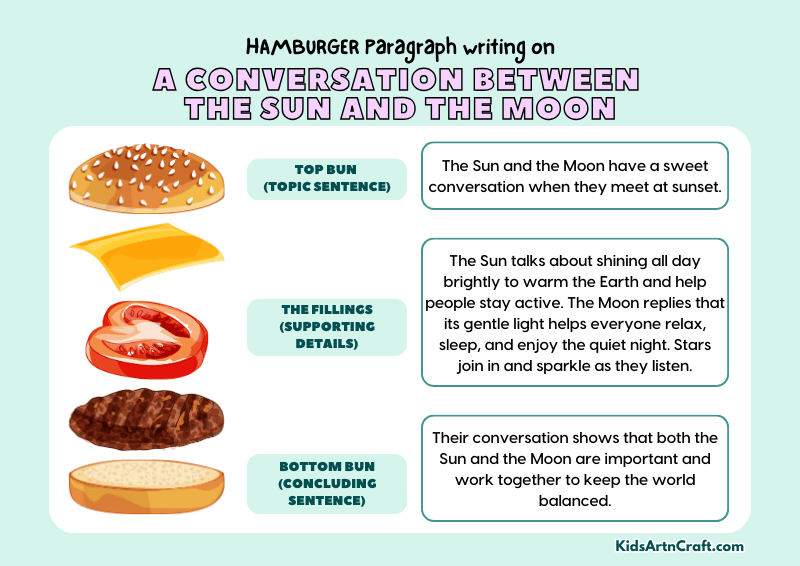
Top Bun (Topic Sentence):
The Sun and the Moon have a sweet conversation when they meet at sunset.
The Fillings (Supporting Details):
The Sun talks about shining all day brightly to warm the Earth and help people stay active. The Moon replies that its gentle light helps everyone relax, sleep, and enjoy the quiet night. Stars join in and sparkle as they listen.
Bottom Bun (Concluding Sentence):
Their conversation shows that both the Sun and the Moon are important and work together to keep the world balanced.
Importance of Sun and Moon
- The Sun gives light and warmth, and the Moon’s gravity creates ocean tides. [Source: Britannica]
- Moonlight is sunlight reflected from the Moon’s surface. [Source: NASA]
- Solar eclipses happen when the Moon blocks the Sun’s light from Earth. [Source: NASA HEAT]
Additional Facts
- Eclipses occur only when the Sun, Earth, and Moon are perfectly aligned. [Source: NASA Science]
- The Sun looks the same size as the Moon from Earth because it is 400 times wider and 400 times farther away. [Source: NASA Science]
- The Moon’s tilted orbit means eclipses don’t happen every month. [Source: NASA Science]
Hope you liked these paragraphs on ‘A Conversation Between the Sun and the Moon’. Don’t forget to join the Telegram group for FREE Printables.
Check this article to create DIY cardboard sun making ideas.