






Paragraph Writing
Paragraph on How Computers Work


Computers work by processing data using their hardware and software. They take input, perform calculations, and give output, helping us complete tasks quickly and efficiently. Gain useful guidance on writing paragraphs about the “How Computers Work” in four styles—Expository, Persuasive, Descriptive, and Narrative—while structuring your ideas effectively with PEEL, TEEL, TEXAS, and the Hamburger Model.
Read This Article in Other Languages
- कंप्यूटर कैसे काम करते हैं पर अनुच्छेद (Hindi / हिंदी)
- Párrafo sobre cómo funcionan las computadoras (Spanish / Español)
- Paragraphe sur le fonctionnement des ordinateurs (French / Français)
- Absatz darüber, wie Computer funktionieren (German / Deutsch)
- فقرة عن كيفية عمل أجهزة الكمبيوتر (Arabic / العربية)
- কম্পিউটার কীভাবে কাজ করে সম্পর্কে অনুচ্ছেদ (Bengali / বাংলা)
- கணினிகள் எப்படி வேலை செய்கின்றன பற்றி பத்தி (Tamil / தமிழ்)
- కంప్యూటర్లు ఎలా పనిచేస్తాయో గురించి పేరాగ్రాఫ్ (Telugu / తెలుగు)
- കമ്പ്യൂട്ടറുകൾ എങ്ങനെ പ്രവർത്തിക്കുന്നു എന്നതിനെക്കുറിച്ചുള്ള പാരഗ്രാഫ് (Malayalam / മലയാളം)
- کمپیوٹر کیسے کام کرتے ہیں پر پیراگراف (Urdu / اردو)
- Parágrafo sobre como os computadores funcionam (Portuguese / Português)
Translation Disclaimer: These links use Google Translate, an automated translation service. Translations may vary in accuracy and are provided for convenience only.
Different Styles of Paragraphs on ‘How Computers Work’
1. Expository Paragraph on How Computers Work (Explains with Facts)
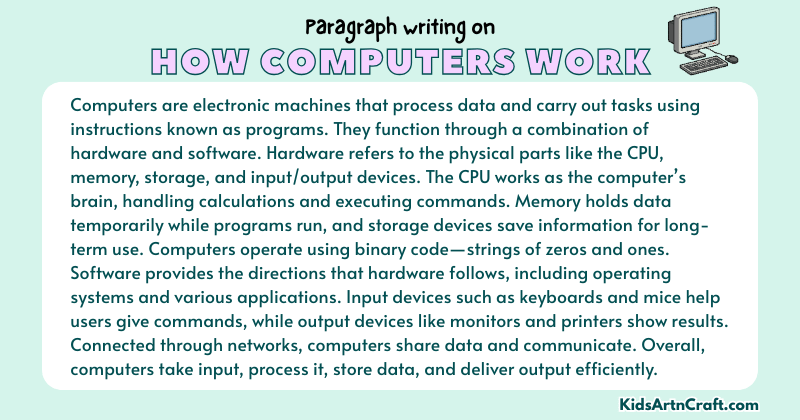
Computers are electronic machines that process data and carry out tasks using instructions known as programs. They function through a combination of hardware and software. Hardware refers to the physical parts, like the CPU, memory, storage, and input/output devices. The CPU works as the computer’s brain, handling calculations and executing commands. Memory holds data temporarily while programs run, and storage devices save information for long-term use. Computers operate using binary code—strings of zeros and ones. Software provides the directions that hardware follows, including operating systems and various applications. Input devices such as keyboards and mice help users give commands, while output devices like monitors and printers show results. Connected through networks, computers share data and communicate. Overall, computers take input, process it, store data, and deliver output efficiently.
2. Persuasive Paragraph on How Computers Work (Tries to Convince You)
Computers are essential tools that everyone should embrace because of the incredible efficiency and convenience they provide. They make complex calculations, data storage, and communication faster than any manual process. Imagine trying to calculate huge numbers or organize thousands of files without a computer—it would be nearly impossible. Computers allow people to access information instantly, communicate globally, and even automate repetitive tasks, saving time and effort. Using computers also enhances learning, creativity, and productivity, whether in schools, offices, or homes. Moreover, understanding how computers work empowers individuals to use them safely and effectively, opening doors to numerous opportunities in technology and science. Critics may argue that computers lead to over-reliance, but the benefits far outweigh the drawbacks when used responsibly. By learning how computers operate—from their hardware components like the CPU and memory to software that drives their functions—people can harness their full potential. In today’s world, computers are no longer optional; they are a necessity that enhances our personal and professional lives. Everyone should embrace computer literacy to succeed in a technology-driven society.
3. Descriptive Paragraph on How Computers Work (Paints a Picture with Words)
A computer is a fascinating machine, a blend of sleek hardware and complex software working together in harmony. The CPU, often called the brain, hums quietly as it processes countless instructions in an instant. The keyboard clacks with each keystroke, sending signals to the processor, while the monitor glows with vivid colors, displaying words, images, and videos. Inside, circuits and chips sparkle with unseen electricity, transferring information in a rapid rhythm. The hard drive quietly spins, storing vast amounts of data, while memory chips flash with activity as programs open and close. The mouse glides smoothly, guiding the cursor across the screen, and speakers fill the room with sound as the computer responds to commands. Every component, from the cooling fan whispering softly to the network cables linking computers worldwide, contributes to a symphony of technology. Observing a computer in action is like watching an invisible world of logic, speed, and precision come alive, turning simple input into meaningful output. It is a marvel of modern engineering, blending power and elegance in one box of possibilities.
4. Narrative Paragraph on How Computers Work (Tells a Story)
Last week, I sat at my desk, eager to complete my school project, and my computer became my trusted companion. As I turned it on, the screen lit up, and the soft hum of the CPU filled the room. I typed my ideas on the keyboard, and the words appeared almost magically on the monitor. I remembered my teacher explaining how the computer takes input, processes it, and gives output, but seeing it in action made me truly appreciate it. My fingers clicked the mouse to open a drawing program, and instantly, colors and shapes came alive on the screen. While the hard drive whirred silently, saving my work, I realized how the CPU, memory, and software worked together seamlessly to bring my ideas to life. Later, I shared my project online, amazed at how computers connect people across the world in seconds. That day, I felt like I wasn’t just using a machine—I was collaborating with a powerful tool capable of endless possibilities. Computers aren’t just machines; they are silent partners in creativity, learning, and discovery.
‘How Computers Work’ Paragraphs in Different Structured Methods
1. How Computers Work Paragraph Writing with PEEL Method
PEEL Method (Point, Evidence, Explanation, Link)
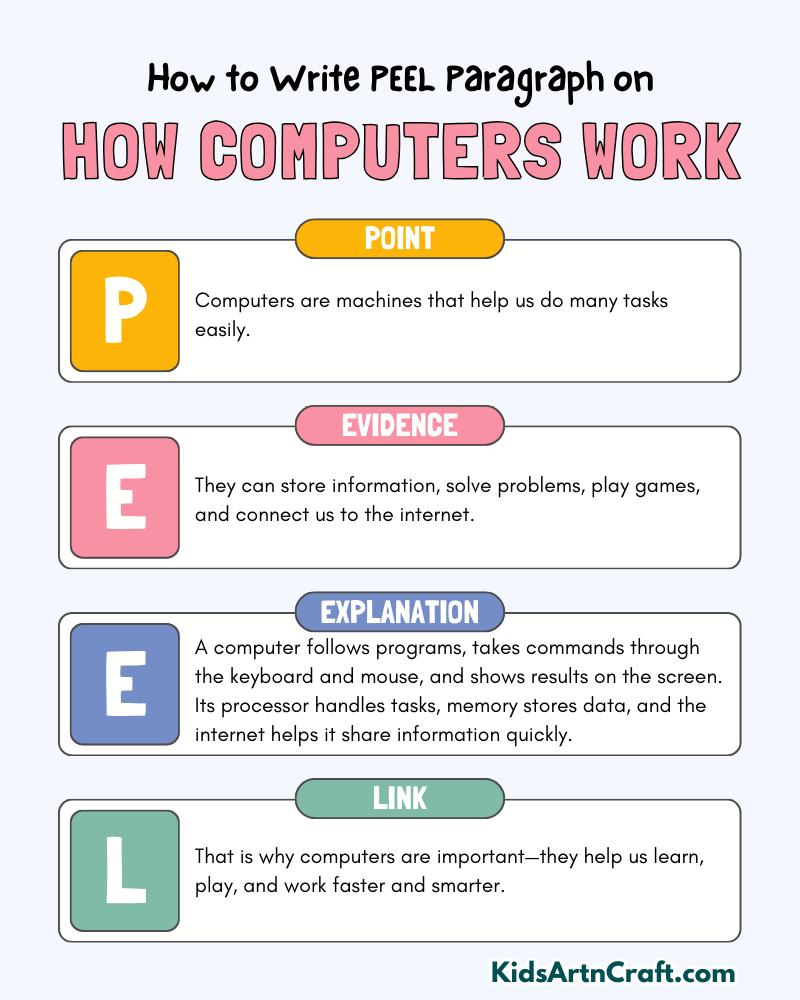
Point: Computers are machines that help us do many tasks easily.
Evidence: They can store information, solve problems, play games, and connect us to the internet.
Explanation: A computer follows programs, takes commands through the keyboard and mouse, and shows results on the screen. Its processor handles tasks, memory stores data, and the internet helps it share information quickly.
Link: That is why computers are important—they help us learn, play, and work faster and smarter.
2. How Computers Work Paragraph Writing with TEEL Method
TEEL Method (Topic, Evidence, Explanation, Link)
Topic: Computers are useful machines that work using programs and parts.
Evidence: For example, when we type a story, the keyboard gives input, the processor arranges the words, and the screen displays the story instantly.
Explanation: They follow instructions to perform tasks and show results on the screen.
Link: This shows that computers work by combining hardware and software to make our work easier.
3. How Computers Work Paragraph Writing with the TEXAS Method
TEXAS Method (Topic, Example, Explanation, Analysis, Summary/Significance)
Topic: Computers work by using instructions and hardware to complete tasks.
Example: When I play a game, I press buttons, the computer processes the commands, and I see the results on the screen immediately.
Explanation: Programs tell the computer what to do, while parts like the keyboard, processor, and screen help it function.
Analysis: This shows that computers are fast and accurate because every part works together.
Summary: Computers work by following instructions and using their parts to help us learn, play, and work.
4. How Computers Work Paragraph Writing with Hamburger Method
Hamburger Method (Top Bun, The Fillings, Bottom Bun)
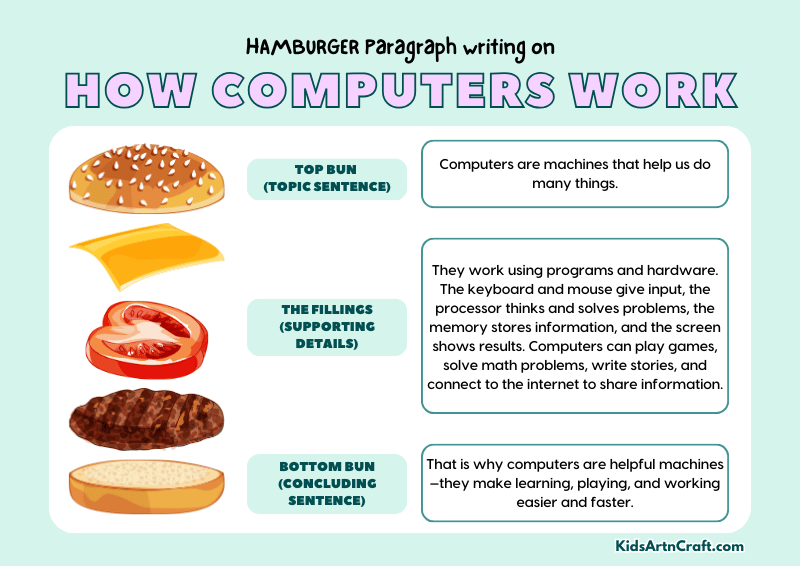
Top Bun (Topic Sentence):
Computers are machines that help us do many things.
The Fillings (Supporting Details):
They work using programs and hardware. The keyboard and mouse give input, the processor thinks and solves problems, the memory stores information, and the screen shows results. Computers can play games, solve math problems, write stories, and connect to the internet to share information.
Bottom Bun (Concluding Sentence):
That is why computers are helpful machines—they make learning, playing, and working easier and faster.
Importance of Computers
- Computers use binary (0s and 1s) to process all data and instructions. [Source: Britannica]
- The CPU performs the “fetch‑decode‑execute” cycle to run programs. [Source: Britannica]
- Memory hierarchy (cache, RAM, storage) helps computers work faster. [Source: Britannica]
Additional Facts about Computers
- Modern computers follow the stored-program model, storing both data and instructions in memory. [Source: Britannica]
- Logical operations inside computers use Boolean algebra via logic gates. [Source: Britannica]
- CPU registers track programs and instructions for smooth processing. [Source: Wikipedia]
- Computer science courses teach these basics, helping students understand how computers work. [Source: Harvard CS50]
Hope you liked these paragraphs on ‘How Computers Work’. Don’t forget to join the Telegram group for FREE Printables.
Check this article to write a paragraph on Computers.