Paragraph Writing
Paragraph on Impact of Mobile Phones on Students

Mobile phones have both positive and negative effects on students. They help with learning, research, and communication, but too much use can cause distraction and reduce study time. Using mobile phones wisely helps students stay safe, informed, and focused. You will learn how to write paragraphs on the “Impact of Mobile Phones on Students” in four styles—Expository, Persuasive, Descriptive, and Narrative—while organizing your ideas using structures PEEL, TEEL, TEXAS, and the Hamburger Model.
Read This Article in Other Languages
- छात्रों पर मोबाइल फोन के प्रभाव पर अनुच्छेद (Hindi / हिंदी)
- Párrafo sobre el impacto de los teléfonos móviles en los estudiantes (Spanish / Español)
- Paragraphe sur l’impact des téléphones portables sur les étudiants (French / Français)
- Absatz über die Auswirkungen von Mobiltelefonen auf Schüler (German / Deutsch)
- فقرة عن تأثير الهواتف المحمولة على الطلاب (Arabic / العربية)
- ছাত্রদের উপর মোবাইল ফোনের প্রভাব সম্পর্কে অনুচ্ছেদ (Bengali / বাংলা)
- மாணவர்களுக்கான மொபைல் ஃபோன்களின் தாக்கம் பற்றிய பத்தி (Tamil / தமிழ்)
- విద్యార్థులపై మొబైల్ ఫోన్ల ప్రభావం పై పేరా (Telugu / తెలుగు)
- വിദ്യാർത്ഥികളിലെ മൊബൈൽ ഫോണുകളുടെ സ്വാധീനം സംബന്ധിച്ച പാരഗ്രാഫ് (Malayalam / മലയാളം)
- طلباء پر موبائل فونز کے اثرات پر پیراگراف (Urdu / اردو)
- Parágrafo sobre o impacto dos telefones celulares nos alunos (Portuguese / Português)
Translation Disclaimer: These links use Google Translate, an automated translation service. Translations may vary in accuracy and are provided for convenience only.
Different Styles of Paragraphs on ‘Impact of Mobile Phones on Students’
1. Expository Paragraph on Impact of Mobile Phones on Students (Explains with Facts)

Mobile phones have become an integral part of students’ lives, influencing both their academic and personal experiences. On the positive side, smartphones provide easy access to educational resources, such as e-books, online tutorials, and interactive learning apps, which can enhance understanding and support self-study. They also enable students to communicate with teachers and peers, facilitating group projects and collaborative learning. However, mobile phones can also be a source of distraction. Social media, games, and entertainment apps often divert students’ attention from their studies, leading to reduced productivity and poor time management. Excessive phone usage may also affect sleep patterns and mental health, causing stress or anxiety. In addition, reliance on mobile devices for quick answers may hinder critical thinking and problem-solving skills. Therefore, while mobile phones can be valuable educational tools, students must learn to use them responsibly to balance learning and leisure effectively.
2. Persuasive Paragraph on Impact of Mobile Phones on Students (Tries to Convince You)
Students should limit their use of mobile phones because excessive screen time can harm both their studies and health. While smartphones offer convenience, they often distract students from focusing on lessons and completing homework. Constant notifications, social media updates, and online games can reduce concentration and lower academic performance. Moreover, prolonged mobile use can lead to eye strain, poor posture, and sleep disturbances, affecting overall well-being. By setting boundaries, such as designated study hours without phone access, students can improve focus and productivity. Parents and schools should also encourage responsible phone usage and educate students about its potential dangers. Mobile phones are not inherently bad, but when used without discipline, they can negatively impact learning and health. Students who learn to control their phone habits will not only perform better academically but also enjoy a healthier and more balanced lifestyle.
3. Descriptive Paragraph on Impact of Mobile Phones on Students (Paints a Picture with Words)
In many classrooms today, mobile phones are a constant presence in students’ hands. Bright screens glow in dim study corners, displaying social media feeds, educational apps, or group chat notifications. Some students scroll endlessly, their eyes fixed on tiny displays, while others quickly switch between apps to find study material. The sound of message alerts often interrupts the quiet hum of libraries, breaking concentration and focus. At times, phones seem like windows to another world, offering fun, information, and connection all at once. But they can also cast shadows—students who spend hours glued to their screens appear tense, tired, and distracted. Despite the convenience and knowledge mobile phones provide, they carry a dual impact, blending learning opportunities with potential distractions. The presence of a phone in a student’s hand is both a beacon of possibility and a source of constant temptation.
4. Narrative Paragraph on Impact of Mobile Phones on Students (Tells a Story)
Last year, I realized how much my mobile phone affected my studies. I used to check social media constantly between classes and while doing homework. At first, it felt harmless, but soon I noticed my grades slipping. I spent more time on my phone than on textbooks, and my sleep became irregular because I stayed up late scrolling. One day, my teacher asked me a question in class, and I couldn’t answer it because I had been distracted by my phone. That moment made me rethink my habits. I decided to limit phone use during study hours and focus more on learning. Slowly, my concentration improved, and my grades got better. Now, I still use my phone for research and educational apps, but I make sure it does not distract me. This experience taught me that mobile phones can either help or harm students—it all depends on how we use them.
‘Impact of Mobile Phones on Students‘ Paragraphs in Different Structured Methods
1. Impact of Mobile Phones on Students Paragraph Writing with PEEL Method
PEEL Method (Point, Evidence, Explanation, Link)
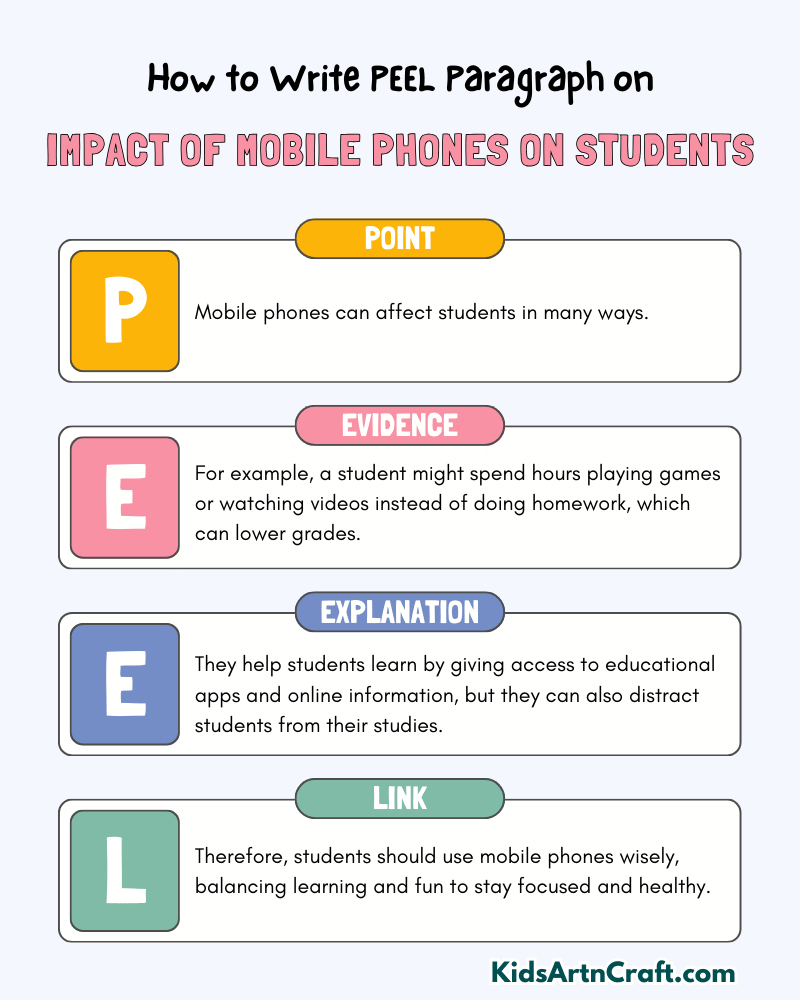

Point: Mobile phones can affect students in many ways.
Evidence: For example, a student might spend hours playing games or watching videos instead of doing homework, which can lower grades.
Explanation: They help students learn by giving access to educational apps and online information, but they can also distract students from their studies.
Link: Therefore, students should use mobile phones wisely, balancing learning and fun to stay focused and healthy.
2. Impact of Mobile Phones on Students Paragraph Writing with TEEL Method
TEEL Method (Topic, Evidence, Explanation, Link)
Topic: Mobile phones have both positive and negative effects on students.
Evidence: Many students check social media or play games during study time, which makes them tired and less productive.
Explanation: Phones can help students research topics and talk to teachers, but they can also take attention away from studies.
Link: By using phones carefully, students can enjoy their benefits while avoiding distractions.
3. Impact of Mobile Phones on Students Paragraph Writing with the TEXAS Method
TEXAS Method (Topic, Example, Explanation, Analysis, Summary/Significance)
Topic: Mobile phones impact students’ learning and daily life.
Example: A student may watch videos or chat online instead of finishing homework, affecting grades.
Explanation: They provide easy access to learning tools but can cause distractions.
Analyze: Too much screen time can also make students tired and affect their sleep.
Summary: If students use phones responsibly, they can learn effectively and stay healthy.
4. Impact of Mobile Phones on Students Paragraph Writing with Hamburger Method
Hamburger Method (Top Bun, The Fillings, Bottom Bun)
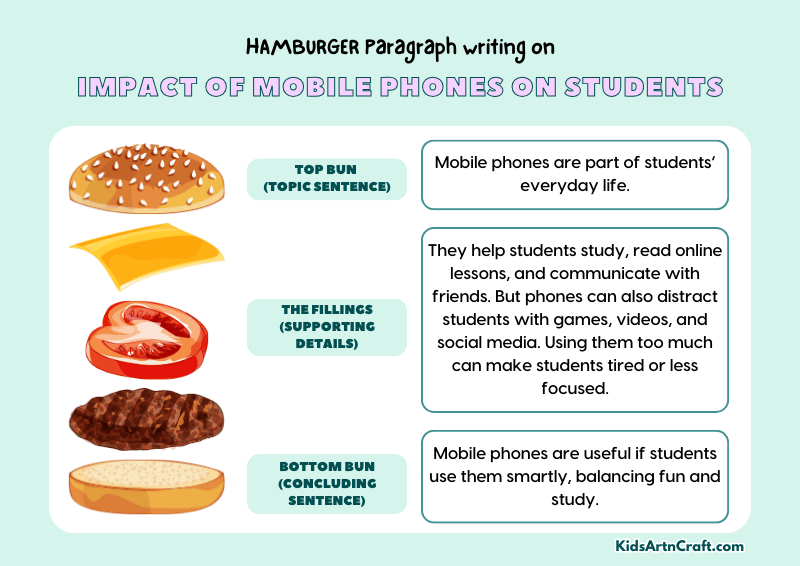

Top Bun (Topic Sentence):
Mobile phones are part of students’ everyday life.
The Fillings (Supporting Details):
They help students study, read online lessons, and communicate with friends. But phones can also distract students with games, videos, and social media. Using them too much can make students tired or less focused.
Bottom Bun (Concluding Sentence):
Mobile phones are useful if students use them smartly, balancing fun and study.
Positive Impact of Mobile Phones on Students
- Mobile phones provide access to educational apps, online resources, and videos, enhancing learning opportunities. [Source: Edutopia]
- Using phones responsibly can improve digital literacy, an essential skill for the 21st century. [Source: UNESCO]
Challenges of Mobile Phone Use
- Excessive phone use can reduce attention, affect academic performance, and interfere with sleep quality. [Source: Cambridge University Press]
- Social media use may impact emotional well-being, causing anxiety or stress depending on usage patterns. [Source: World Health Organization]
- Nighttime phone use can disrupt sleep, affecting memory, focus, and learning efficiency. [Source: Sleep Foundation]
Hope you liked these paragraphs on ‘Impact of Mobile Phones on Students’. Don’t forget to join the Telegram group for FREE Printables.
Check this article to create homemade mobile phone holder crafts with popsicle stick crafts.