

Paragraph Writing
Paragraph on Internet vs. Books


The internet is fast and gives instant information, while books provide detailed knowledge and a deeper understanding. Both are useful, but reading books builds focus and imagination. Master the art of writing paragraphs on “Internet vs. Books” in four styles—Expository, Persuasive, Descriptive, and Narrative—while organizing your ideas clearly using structures with PEEL, TEEL, TEXAS, and the Hamburger Model.
Read This Article in Other Languages
- इंटरनेट बनाम किताबों पर अनुच्छेद (Hindi / हिंदी)
- Párrafo sobre Internet vs libros (Spanish / Español)
- Paragraphe sur Internet vs livres (French / Français)
- Absatz über Internet vs. Bücher (German / Deutsch)
- فقرة عن الإنترنت مقابل الكتب (Arabic / العربية)
- ইন্টারনেট বনাম বই সম্পর্কে অনুচ্ছেদ (Bengali / বাংলা)
- இணையம் vs புத்தகங்கள் பற்றி பத்தி (Tamil / தமிழ்)
- ఇంటర్నెట్ vs పుస్తకాలు గురించి పేరా (Telugu / తెలుగు)
- ഇന്റർനെറ്റ് vs പുസ്തകങ്ങളേയ്ക്കുള്ള പാരഗ്രാഫ് (Malayalam / മലയാളം)
- انٹرنیٹ بمقابلہ کتابوں پر پیراگراف (Urdu / اردو)
- Parágrafo sobre Internet vs livros (Portuguese / Português)
Translation Disclaimer: These links use Google Translate, an automated translation service. Translations may vary in accuracy and are provided for convenience only.
Different Styles of Paragraphs on ‘Internet vs. Books’
1. Expository Paragraph on Internet vs. Books (Explains with Facts)
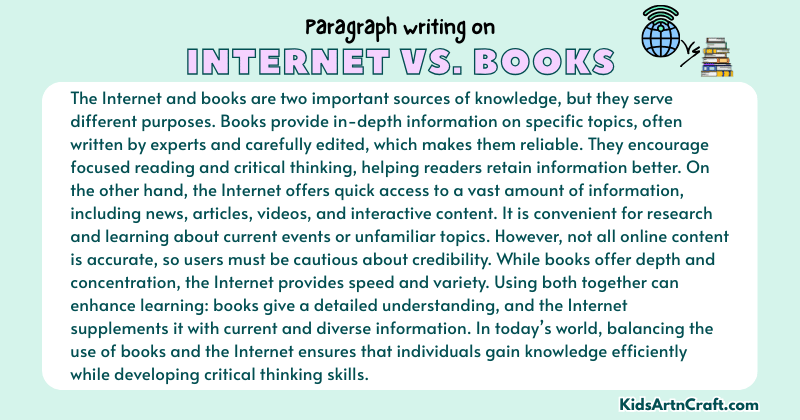
The Internet and books are two important sources of knowledge, but they serve different purposes. Books provide in-depth information on specific topics, often written by experts and carefully edited, which makes them reliable. They encourage focused reading and critical thinking, helping readers retain information better. On the other hand, the Internet offers quick access to a vast amount of information, including news, articles, videos, and interactive content. It is convenient for research and learning about current events or unfamiliar topics. However, not all online content is accurate, so users must be cautious about credibility. While books offer depth and concentration, the Internet provides speed and variety. Using both together can enhance learning: books give a detailed understanding, and the Internet supplements it with current and diverse information. In today’s world, balancing the use of books and the Internet ensures that individuals gain knowledge efficiently while developing critical thinking skills.
2. Persuasive Paragraph on Internet vs. Books (Tries to Convince You)
Books are better than the Internet when it comes to learning and understanding deeply. Unlike online sources, books are carefully researched, edited, and trustworthy, ensuring that readers get accurate information. Reading books improves concentration, imagination, and memory, while the Internet often encourages distractions due to pop-ups, social media, and ads. Although the Internet provides quick access to information, it cannot replace the depth of knowledge found in books. Students and learners should prioritize reading books to develop a strong foundation of understanding and critical thinking. The Internet should be used only to support learning, not replace it. By choosing books over solely relying on the Internet, people can gain meaningful knowledge, expand their vocabulary, and strengthen their minds. Books are timeless tools of education, while the Internet is just a fast but sometimes unreliable source. Therefore, for true learning, books remain the superior choice.
3. Descriptive Paragraph on Internet vs. Books (Paints a Picture with Words)
Books have a comforting presence: the smell of pages, the feel of paper under fingertips, and the quiet rustle as you turn each page. Each book invites the reader into a world of knowledge and imagination. The Internet, in contrast, is a glowing screen filled with endless information, buzzing notifications, and hyperlinks leading to more discoveries. Books allow slow, thoughtful reading in peaceful surroundings, letting ideas sink in deeply. The Internet, however, offers instant answers, images, and videos, providing learning that is fast and interactive. While the Internet is bright and dynamic, books are calm and steady, giving a sense of focus and satisfaction. One can imagine sitting under a tree, immersed in a story, compared to scrolling endlessly on a tablet. Together, the warmth of books and the convenience of the Internet create a rich landscape of knowledge and learning experiences.
4. Narrative Paragraph on Internet vs. Books (Tells a Story)
Last week, I was preparing for a history project and had to choose between using the Internet and books. I first opened my laptop, finding hundreds of websites with information, videos, and images. It was exciting, but I quickly got distracted by notifications and pop-ups. Frustrated, I decided to go to the library. Picking up a book on the same topic, I felt calmer and more focused. The words on the pages explained events in detail, and the illustrations made it easy to understand. By the end of the day, I had finished reading a chapter and had all the notes I needed. That experience taught me that while the Internet is fast and full of information, books provide a focused and reliable learning experience that the Internet cannot always offer.
‘Internet vs. Books’ Paragraphs in Different Structured Methods
1. Internet vs. Books Paragraph Writing with PEEL Method
PEEL Method (Point, Evidence, Explanation, Link)
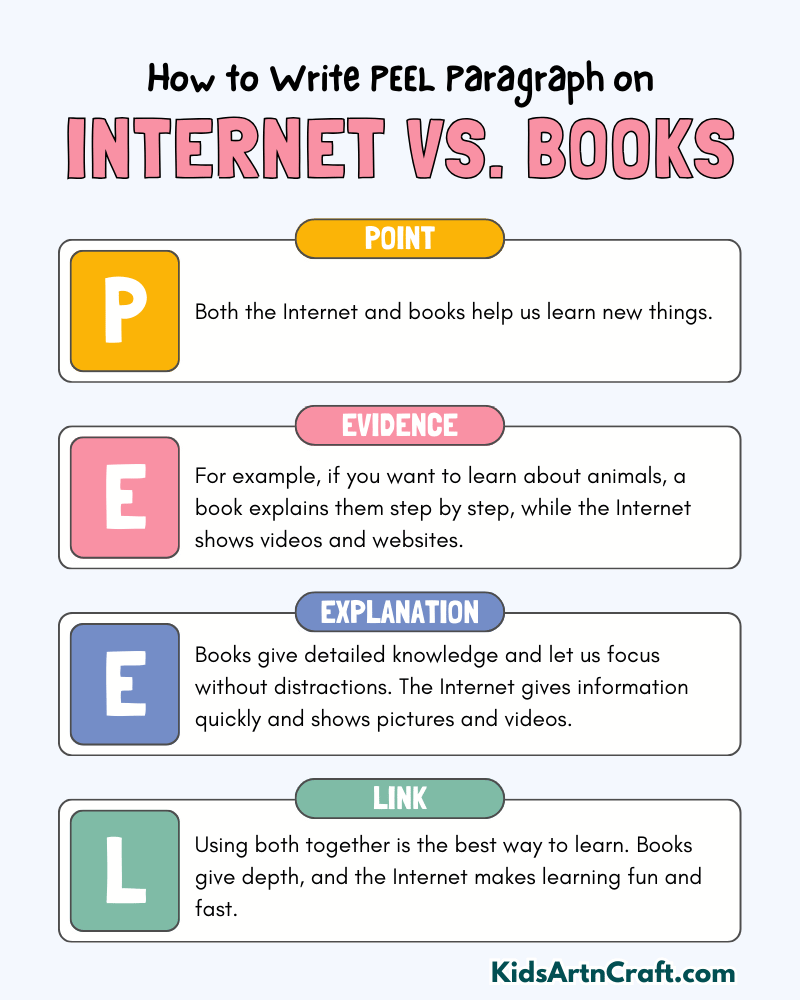
Point: Both the Internet and books help us learn new things.
Evidence: For example, if you want to learn about animals, a book explains them step by step, while the Internet shows videos and websites.
Explanation: Books give detailed knowledge and let us focus without distractions. The Internet gives information quickly and shows pictures and videos.
Link: Using both together is the best way to learn. Books give depth, and the Internet makes learning fun and fast.
2. Internet vs. Books Paragraph Writing with TEEL Method
TEEL Method (Topic, Evidence, Explanation, Link)
Topic: Learning from books and the Internet has different advantages.
Evidence: For instance, reading a science book teaches detailed facts, and watching videos online makes learning interactive.
Explanation: Books help us understand things slowly and carefully, while the Internet gives quick answers.
Link: So, both books and the Internet are useful, and using them together helps us learn better.
3. Internet vs. Books Paragraph Writing with the TEXAS Method
TEXAS Method (Topic, Example, Explanation, Analysis, Summary/Significance)
Topic sentence: Books and the Internet are great ways to learn.
Example: Reading a storybook improves imagination, and online videos show how things work in real life.
Explanation: Books are calm and reliable, while the Internet is fast and fun.
Analysis: Books give deep knowledge, but the Internet makes learning exciting.
Summary: Combining books and the Internet helps us become smart and creative.
4. Internet vs. Books Paragraph Writing with Hamburger Method
Hamburger Method (Top Bun, The Fillings, Bottom Bun)
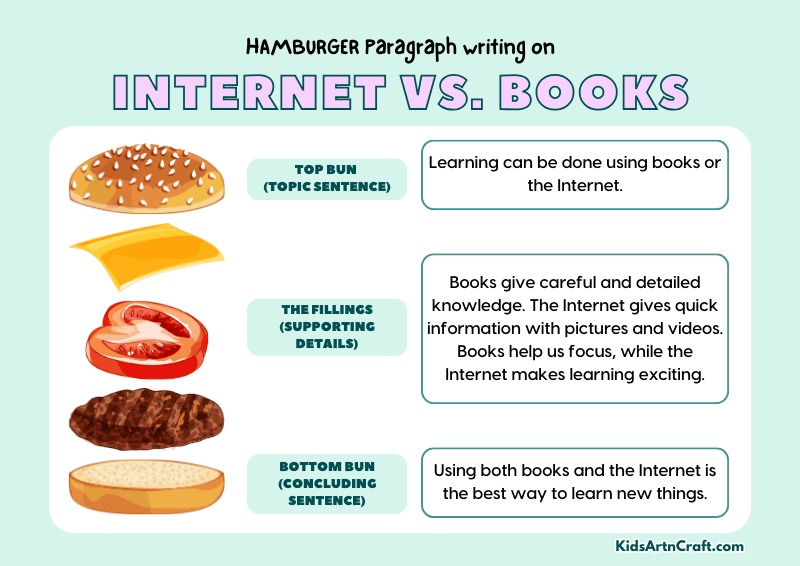
Top Bun (Topic Sentence):
Learning can be done using books or the Internet.
The Fillings (Supporting Details):
Books give careful and detailed knowledge. The Internet gives quick information with pictures and videos. Books help us focus, while the Internet makes learning exciting.
Bottom Bun (Concluding Sentence):
Using both books and the Internet is the best way to learn new things.
Importance of Books and Internet
- Books give deep and reliable information because experts write and review them. [Source: IELTS Mentor]
- The internet gives quick access to many topics and updated information anytime. [Source: Teachers Institute]
Additional Facts About Internet vs Books
- Reading books improves focus and understanding. [Source: Oklahoma Education Journal]
- Books can be used anywhere without electricity or internet. [Source: Basmo]
- The internet provides interactive tools like videos and e‑books for learning. [Source: UNESCO]
- Always check online sources to make sure information is correct. [Source: IELTStution]
Hope you liked these paragraphs on ‘Internet vs. Books’. Don’t forget to join the Telegram group for FREE Printables.
Check this article to write a paragraph on my favourite book.