Paragraph Writing
Paragraph on Learning a New Skill

Learning a new skill is exciting and rewarding. It helps improve abilities, builds confidence, and opens opportunities, allowing us to grow personally and achieve new goals. Refine your writing skills by exploring “Learning a New Skill” in four styles—Expository, Persuasive, Descriptive, and Narrative—while structuring your ideas effectively with PEEL, TEEL, TEXAS, and the Hamburger Model.
Read This Article in Other Languages
- नई कौशल सीखने पर अनुच्छेद (Hindi / हिंदी)
- Párrafo sobre aprender una nueva habilidad (Spanish / Español)
- Paragraphe sur l’apprentissage d’une nouvelle compétence (French / Français)
- Absatz über das Erlernen einer neuen Fähigkeit (German / Deutsch)
- فقرة عن تعلم مهارة جديدة (Arabic / العربية)
- নতুন দক্ষতা শেখার উপর অনুচ্ছেদ (Bengali / বাংলা)
- புதிய திறமை கற்க பற்றி பத்தி (Tamil / தமிழ்)
- కొత్త నైపుణ్యం నేర్చుకోవడం గురించి పేరా (Telugu / తెలుగు)
- ഒരു പുതിയ കഴിവ് പഠിക്കുന്നതിനെക്കുറിച്ചുള്ള പാരഗ്രാഫ് (Malayalam / മലയാളം)
- ایک نئی مہارت سیکھنے پر پیراگراف (Urdu / اردو)
- Parágrafo sobre aprender uma nova habilidade (Portuguese / Português)
Translation Disclaimer: These links use Google Translate, an automated translation service. Translations may vary in accuracy and are provided for convenience only.
Different Styles of Paragraphs on ‘Learning a New Skill’
1. Expository Paragraph on Learning a New Skill (Explains with Facts)

Learning a new skill is an essential part of personal growth and development. When we acquire new abilities, we not only enhance our knowledge but also improve our problem-solving and decision-making skills. For example, learning to play a musical instrument strengthens concentration and memory, while mastering a sport promotes physical fitness and teamwork. The process of learning involves understanding concepts, practicing regularly, and gradually overcoming challenges. Additionally, gaining new skills can open doors to better career opportunities and hobbies that make life more fulfilling. In today’s fast-changing world, being adaptable and versatile is crucial, and learning new skills equips us to face these changes with confidence. Moreover, acquiring a new skill often boosts self-esteem and motivation, as it gives a sense of accomplishment. Whether it is coding, painting, or cooking, every new skill contributes to overall personal development. Therefore, investing time and effort into learning something new is always valuable and beneficial for long-term growth.
2. Persuasive Paragraph on Learning a New Skill (Tries to Convince You)
Everyone should make an effort to learn a new skill, as it brings countless benefits to life. Learning something new not only enhances knowledge but also increases confidence and self-esteem. For instance, when someone learns to speak a foreign language, they can communicate with more people and explore new cultures. Similarly, acquiring skills like cooking, coding, or painting can make daily life more enjoyable and productive. Some may feel that learning is difficult or time-consuming, but the rewards outweigh the effort. A new skill can even open up career opportunities and provide a competitive edge in the professional world. Furthermore, learning new abilities keeps the mind active and reduces boredom, making life more exciting. Therefore, everyone should embrace challenges, practice consistently, and never hesitate to try something unfamiliar. The sooner a person starts learning a new skill, the sooner they will experience the joy of accomplishment and the advantages it brings in both personal and professional life.
3. Descriptive Paragraph on Learning a New Skill (Paints a Picture with Words)
Learning a new skill is like opening a door to a world full of possibilities. At first, there is curiosity mixed with nervousness as you attempt something unfamiliar. You watch tutorials, read instructions, and carefully follow each step. Slowly, your hands begin to move with confidence, whether it is painting a vibrant picture, playing a melody on a piano, or coding a simple program. The feeling of progress is thrilling—every small success sparks joy and motivates you to try more. You notice your concentration sharpening, your patience growing, and your excitement increasing with each new achievement. The room around you seems brighter as your mind fills with creativity and knowledge. Even the mistakes along the way feel like gentle teachers guiding you toward mastery. Learning a new skill is not just an activity; it is an emotional journey filled with discovery, pride, and satisfaction, making every effort truly worthwhile.
4. Narrative Paragraph on Learning a New Skill (Tells a Story)
Last summer, I decided to learn how to bake cakes, even though I had never cooked anything before. At first, it was very challenging. I struggled to measure ingredients correctly, and my first cake was flat and burnt. But I didn’t give up. Each day, I watched videos, read recipes carefully, and practiced mixing and baking with more precision. Slowly, my cakes started looking better, and the taste improved. One evening, I baked a chocolate cake for my family, and everyone loved it. Their smiles and compliments filled me with pride and happiness. That experience taught me that learning a new skill requires patience, determination, and practice. It was not just about baking—it was about believing in myself and never giving up, no matter how difficult something might seem at first. From that day, I realized that trying new things can bring immense joy and satisfaction.
‘Learning a New Skill’ Paragraphs in Different Structured Methods
1. Learning a New Skill Paragraph Writing with PEEL Method
PEEL Method (Point, Evidence, Explanation, Link)
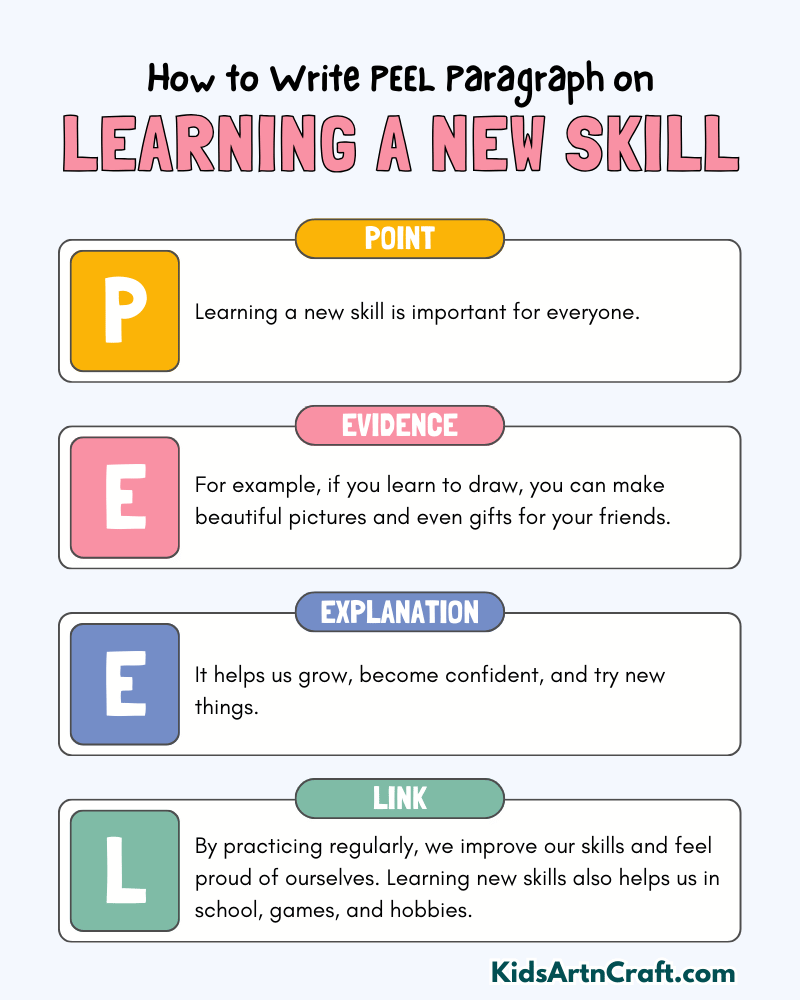

Point: Learning a new skill is important for everyone.
Evidence: For example, if you learn to draw, you can make beautiful pictures and even gifts for your friends.
Explanation: It helps us grow, become confident, and try new things.
Link: By practicing regularly, we improve our skills and feel proud of ourselves. Learning new skills also helps us in school, games, and hobbies.
2. Learning a New Skill Paragraph Writing with TEEL Method
TEEL Method (Topic, Evidence, Explanation, Link)
Topic: Learning a new skill can make life exciting.
Evidence: For instance, when I learned to ride a bicycle, I kept trying even after falling, and now I can ride fast without fear
Explanation: It teaches us patience and helps our brains grow stronger.
.
Link: This shows that practicing new skills makes us confident and happy, and we can enjoy many activities.
3. Learning a New Skill Paragraph Writing with the TEXAS Method
TEXAS Method (Topic, Example, Explanation, Analysis, Summary/Significance)
Topic: Learning a new skill is fun and useful.
Example: For example, learning to swim kept me safe in water and gave me joy while playing in the pool.
Explanation: It helps us explore new things and gain confidence.
Analysis: Every new skill makes us smarter and teaches us patience.
Summary: So, trying new skills is always a good idea because it makes life more fun and exciting.
4. Learning a New Skill Paragraph Writing with Hamburger Method
Hamburger Method (Top Bun, The Fillings, Bottom Bun)
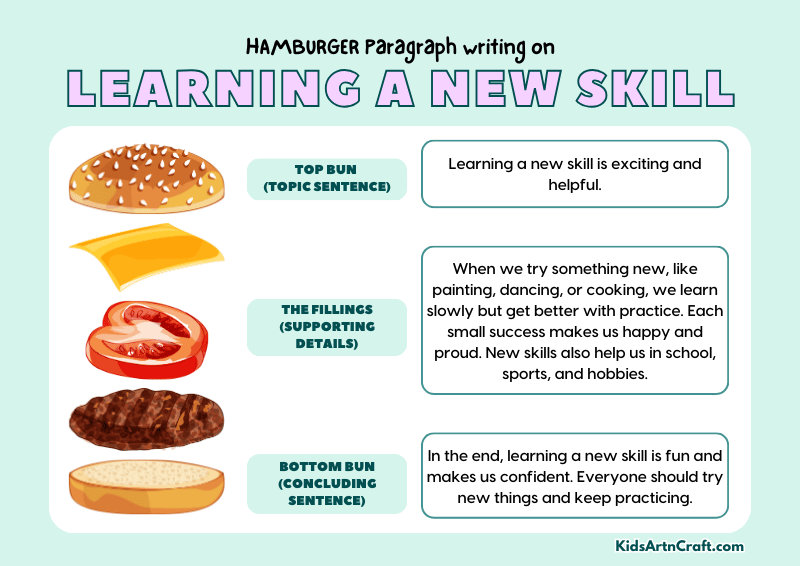

Top Bun (Topic Sentence):
Learning a new skill is exciting and helpful.
The Fillings (Supporting Details):
When we try something new, like painting, dancing, or cooking, we learn slowly but get better with practice. Each small success makes us happy and proud. New skills also help us in school, sports, and hobbies.
Bottom Bun (Concluding Sentence):
In the end, learning a new skill is fun and makes us confident. Everyone should try new things and keep practicing.
Learning a New Skill
- Learning new skills boosts brain function and forms new neural connections. [Source: Harvard Health Publishing]
- New skills improve confidence and self-esteem. [Source: PositivePsychology.com]
- Skill development enhances problem-solving and critical thinking. [Source: Frontiers in Psychology]
- Learning keeps students curious and promotes lifelong learning. [Source: United Nations]
Additional Facts
- Practicing new skills improves memory and concentration. [Source: NIH]
- Activities like art, music, or sports build discipline and patience. [Source: Encyclopedia on Early Childhood Development]
- Learning new skills helps in future school or career success. [Source: BLS]
- Trying something new improves motivation and reduces boredom. [Source: APA]
Hope you liked these paragraphs on ‘Learning a New Skill’. Don’t forget to join the Telegram group for FREE Printables.