Paragraph Writing
Paragraph on Online Learning

Online learning allows students to study using the internet from home or anywhere. It offers flexibility, access to many resources, and interactive lessons, making education more convenient and effective. In this lesson, you will learn how to write paragraphs on “Online Learning” in four styles—Expository, Persuasive, Descriptive, and Narrative—and organize your ideas using structures with PEEL, TEEL, TEXAS, and the Hamburger Model.
Read This Article in Other Languages
- ऑनलाइन शिक्षा पर अनुच्छेद (Hindi / हिंदी)
- Párrafo sobre el aprendizaje en línea (Spanish / Español)
- Paragraphe sur l’apprentissage en ligne (French / Français)
- Absatz über Online-Lernen (German / Deutsch)
- فقرة عن التعلم عبر الإنترنت (Arabic / العربية)
- অনলাইন শিক্ষার উপর অনুচ্ছেদ (Bengali / বাংলা)
- ஆன்லைன் கற்றல் பற்றிய பத்தி (Tamil / தமிழ்)
- ఆన్లైన్ లెర్నింగ్ గురించి పేరా (Telugu / తెలుగు)
- ഓൺലൈൻ പഠനത്തെക്കുറിച്ചുള്ള പാരഗ്രാഫ് (Malayalam / മലയാളം)
- آن لائن تعلیم پر پیراگراف (Urdu / اردو)
- Parágrafo sobre aprendizado online (Portuguese / Português)
Translation Disclaimer: These links use Google Translate, an automated translation service. Translations may vary in accuracy and are provided for convenience only.
Different Styles of Paragraphs on ‘Online Learning’
1. Expository Paragraph on Online Learning (Explains with Facts)

Online learning has become an important part of modern education, providing students with flexible and accessible ways to study. It allows learners to attend classes from anywhere using digital devices such as laptops, tablets, or mobile phones. This method of learning includes recorded lessons, live classes, interactive quizzes, and online discussions that help students understand topics at their own pace. One major advantage of online learning is convenience, as students can choose when and where to study, making it especially useful for those with busy schedules. It also offers a wide variety of resources like videos, e-books, and educational apps. However, online learning requires strong self-discipline and time management skills because students must stay focused without the physical presence of teachers. Reliable internet and digital skills are also necessary to participate effectively. Despite these challenges, online learning continues to grow and prove its value in providing quality education to a large number of students across the world.
2. Persuasive Paragraph on Online Learning (Tries to Convince You)
Online learning is one of the most effective and beneficial ways for students to gain knowledge today, and it should be encouraged in all schools. It gives students the freedom to learn at their own speed, which helps slow learners understand better and allows fast learners to move ahead confidently. Online platforms provide a wide variety of learning materials, such as videos, animations, games, and interactive tools, that make lessons more interesting than traditional textbooks. Students can revisit recorded classes anytime, which helps them revise difficult topics easily. Furthermore, online learning reduces travel time and saves money spent on transport or extra school materials. It also helps students become more independent and tech-savvy, skills that are essential for future careers. While some argue that online learning lacks personal interaction, modern tools like live chats and virtual classrooms fill this gap effectively. Therefore, schools and parents should support online learning because it offers flexibility, creativity, and equal opportunities for all students.
3. Descriptive Paragraph on Online Learning (Paints a Picture with Words)
Online learning feels like stepping into a virtual classroom filled with colorful lessons, engaging videos, and interactive activities. As students log in, the screen lights up with neatly arranged tabs, each leading to exciting learning tools. The digital classroom often includes a cheerful teacher speaking through the camera, guiding students with clear explanations and warm smiles. Soft notification sounds announce new assignments, while animated quizzes and bright illustrations make learning lively and enjoyable. Students can sit comfortably at their desks or even in a quiet corner of their homes, creating a cozy and personalized learning environment. The virtual space is calm, free from the usual noise of crowded classrooms, allowing learners to focus deeply. With just a click, they can explore libraries of e-books, replay lessons, or join group discussions. Online learning, with its blend of comfort, creativity, and modern technology, creates a unique educational world that feels both inviting and inspiring.
4. Narrative Paragraph on Online Learning (Tells a Story)
The first day Riya started online learning, she felt both excited and nervous as she opened her laptop and joined her virtual classroom. A gentle musical chime welcomed her into the meeting, and soon she saw her classmates’ faces appear in small boxes across the screen. Her teacher greeted everyone with a bright smile and began explaining the day’s lesson using colorful slides and short videos. Riya quickly realized that she could pause the recorded parts to understand better, something she couldn’t do in her regular classes. As days passed, she grew more confident navigating the platform, submitting assignments, and participating in chats. One day, during a science class, she even answered a difficult question correctly, earning applause emojis from her friends. By the end of the month, Riya felt proud of how much she had learned. Online learning, she discovered, was not just convenient but also filled with new and exciting ways to explore knowledge.
‘Online Learning‘ Paragraphs in Different Structured Methods
1. Online Learning Paragraph Writing with PEEL Method
PEEL Method (Point, Evidence, Explanation, Link)
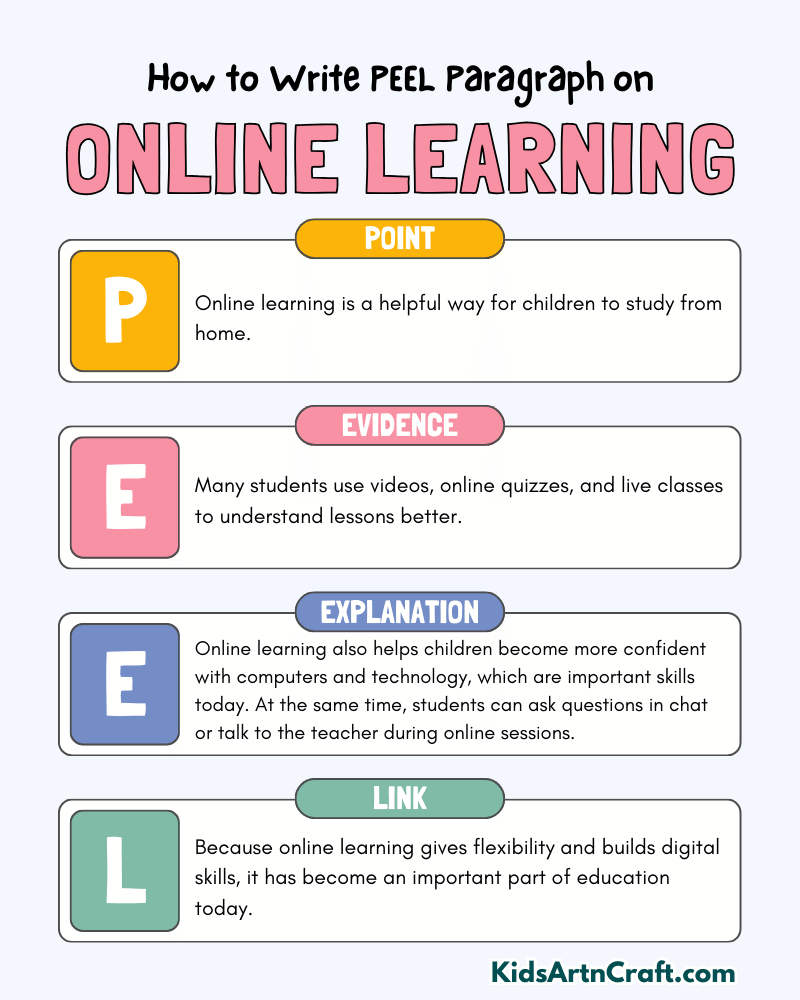

Point: Online learning is a helpful way for children to study from home.
Evidence: Many students use videos, online quizzes, and live classes to understand lessons better.
Explanation: Online learning also helps children become more confident with computers and technology, which are important skills today. At the same time, students can ask questions in chat or talk to the teacher during online sessions.
Link: Because online learning gives flexibility and builds digital skills, it has become an important part of education today.
2. Online Learning Paragraph Writing with TEEL Method
TEEL Method (Topic, Evidence, Explanation, Link)
Topic: Online learning is becoming a popular way for kids to study.
Evidence: For example, a child can replay a recorded lesson if they did not understand it the first time. They can also complete tasks online and get quick feedback from teachers.
Explanation: Many online lessons include videos, games, and activities that help children understand topics easily.
Link: This makes learning comfortable and interesting. Online learning connects students and teachers even when they are far apart, helping education continue smoothly.
3. Online Learning Paragraph Writing with the TEXAS Method
TEXAS Method (Topic, Example, Explanation, Analysis, Summary/Significance)
Topic: Online learning is a new and exciting way for kids to study.
Example: For example, children can join live classes, complete worksheets online, or watch short lesson clips.
Explanation: It allows students to learn from home while using videos and digital tools.
Analysis: Online learning also teaches important tech skills, such as using apps, typing, and uploading homework. It makes learning flexible and comfortable.
Summary: Overall, online learning supports students by giving them many ways to learn and understand lessons clearly.
4. Online Learning Paragraph Writing with the Hamburger Method
Hamburger Method (Top Bun, The Fillings, Bottom Bun)
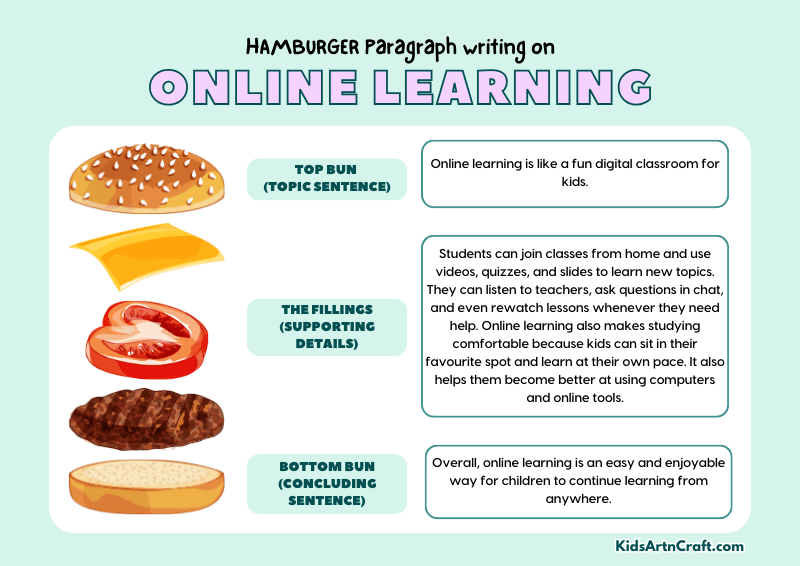

Top Bun (Topic Sentence):
Online learning is like a fun digital classroom for kids.
The Fillings (Supporting Details):
Students can join classes from home and use videos, quizzes, and slides to learn new topics. They can listen to teachers, ask questions in chat, and even rewatch lessons whenever they need help. Online learning also makes studying comfortable because kids can sit in their favourite spot and learn at their own pace. It also helps them become better at using computers and online tools.
Bottom Bun (Concluding Sentence):
Overall, online learning is an easy and enjoyable way for children to continue learning from anywhere.
Importance of Online Learning
- Online learning increases access to education and allows students to learn at their own pace. [Source: UNESCO]
- Blended learning (online + in-person) improves understanding and academic outcomes. [Source: Edutopia
Additional Facts of Online Learning
- Online learning fosters self-directed learning skills, helping students manage time and set goals. [Source: ERIC]
- E-learning enables personalized learning, allowing content to match each student’s pace and ability. [Source: Frontiers in Education]
- It also enhances digital literacy, preparing students for modern workforce demands. [Source: World Economic Forum]
Hope you liked these paragraphs on ‘Online Learning’. Don’t forget to join the Telegram group for FREE Printables.