



Paragraph Writing
Paragraph on Renewable vs Non-Renewable Resources


Renewable resources, like sunlight and wind, can be used again, while non-renewable resources, like coal and oil, are limited. Understanding them helps us protect the environment and use energy wisely. Develop skills to write effective paragraphs on “Renewable vs Non-Renewable Resources” in four styles—Expository, Persuasive, Descriptive, and Narrative—while structuring your ideas using PEEL, TEEL, TEXAS, and the Hamburger Model.
Read This Article in Other Languages
- नवीकरणीय बनाम गैर-नवीकरणीय संसाधनों पर अनुच्छेद (Hindi / हिंदी)
- Párrafo sobre recursos renovables vs no renovables (Spanish / Español)
- Paragraphe sur les ressources renouvelables vs non renouvelables (French / Français)
- Absatz über erneuerbare vs nicht erneuerbare Ressourcen (German / Deutsch)
- فقرة عن الموارد المتجددة مقابل غير المتجددة (Arabic / العربية)
- নবায়নযোগ্য বনাম নবায়নযোগ্য নয় সংস্থানের উপর অনুচ্ছেদ (Bengali / বাংলা)
- நுண்ணுயிர் vs மறுநயமற்ற வளங்கள் பற்றி பத்தி (Tamil / தமிழ்)
- పునరుత్పాదక వనరులు vs అసమర్థ వనరులు పై పేరా (Telugu / తెలుగు)
- പുനരുത്പാദകരും അപ്രത്യക്ഷവുമായ സമ്പത്തുകൾക്കുറിച്ചുള്ള പാരഗ്രാഫ് (Malayalam / മലയാളം)
- قابل تجدید بمقابل غیر قابل تجدید وسائل پر پیراگراف (Urdu / اردو)
- Parágrafo sobre recursos renováveis vs não renováveis (Portuguese / Português)
Translation Disclaimer: These links use Google Translate, an automated translation service. Translations may vary in accuracy and are provided for convenience only.
Different Styles of Paragraphs on ‘ Renewable vs Non-Renewable Resources’
1. Expository Paragraph on Renewable vs Non-Renewable Resources (Explains with Facts)
Renewable and non-renewable resources are two major categories of natural resources that support human life and economic development. Renewable resources, such as solar energy, wind power, hydropower, and biomass, can naturally replenish over time. They are considered sustainable because they do not run out if managed wisely. In contrast, non-renewable resources like coal, oil, natural gas, and minerals exist in limited quantities. Once used, they cannot be replaced within a human lifetime. Renewable resources are generally cleaner and produce less pollution, making them better for the environment. Non-renewable resources, although efficient and widely used, contribute significantly to air pollution, climate change, and resource depletion. Today, many countries are shifting toward renewable energy to reduce dependence on fossil fuels and protect the planet. Understanding the differences between these resources helps us make informed choices. By promoting renewable energy and conserving non-renewable resources, society can ensure a more sustainable future for generations to come.
2. Persuasive Paragraph on Renewable vs Non-Renewable Resources (Tries to Convince You)
We must shift from non-renewable to renewable resources if we want a cleaner, safer, and more sustainable world. Non-renewable resources like coal and oil are running out quickly, and their continuous use harms our environment through pollution and greenhouse gas emissions. Renewable resources, including solar, wind, and hydropower, offer a powerful solution that benefits both people and the planet. They are abundant, cleaner, and do not deplete over time. By investing in renewable energy, we can reduce our dependence on fossil fuels, lower energy costs in the long run, and combat climate change. Some may argue that renewable energy requires expensive technology, but the cost is decreasing every year, and the long-term advantages far outweigh the initial investment. Choosing renewables means choosing healthier air, stable energy supplies, and a brighter future for our children. It is time for individuals, communities, and governments to take bold steps and prioritise renewable resources for the sake of our planet and future generations.
3. Descriptive Paragraph on Renewable vs Non-Renewable Resources (Paints a Picture with Words)
Renewable and non-renewable resources create two distinct pictures of how our planet provides energy. Renewable resources feel alive and ever-flowing, like sunlight that paints the earth with warmth each morning, or wind that dances across fields turning turbines gracefully. Hydropower rushes through rivers with a steady rhythm, and biomass carries the scent of natural growth. These resources seem fresh, clean, and endlessly available. In contrast, non-renewable resources present a heavier, darker image. Coal lies deep within the earth, black and dusty, while oil glistens thick and dark beneath layers of rock. Natural gas hides in tight pockets, waiting to be extracted with great effort. These resources, though powerful, give the sense of something finite and slowly fading. As we imagine the bright glow of solar panels and the steady rise of windmills, we can clearly see the difference between resources that renew themselves and those that diminish with every use. The contrast between them paints a vivid picture of our energy choices.
4. Narrative Paragraph on Renewable vs Non-Renewable Resources (Tells a Story)
When Aarav visited his grandfather’s farm one summer, he discovered the difference between renewable and non-renewable resources in a memorable way. Each morning, he watched sunlight power the solar panels on the barn roof, bringing light and energy without costing a single rupee. The windmill nearby spun freely, pumping water from the well. His grandfather explained that these renewable resources never run out and keep the farm running sustainably. Later that evening, during a power cut, the old diesel generator rumbled loudly, filling the air with smoke. Aarav noticed how much fuel it consumed and how unpleasant the fumes were. His grandfather pointed out that diesel, like coal and oil, is a non-renewable resource—limited, costly, and harmful to the environment. As they sat outside under the starry sky, Aarav realised how important renewable resources are for the future. The contrast between the peaceful solar-powered days and the noisy generator made him appreciate clean energy more than ever.
‘ Renewable vs Non-Renewable Resources’ Paragraphs in Different Structured Methods
1. Renewable vs Non-Renewable Resources Paragraph Writing with PEEL Method
PEEL Method (Point, Evidence, Explanation, Link)
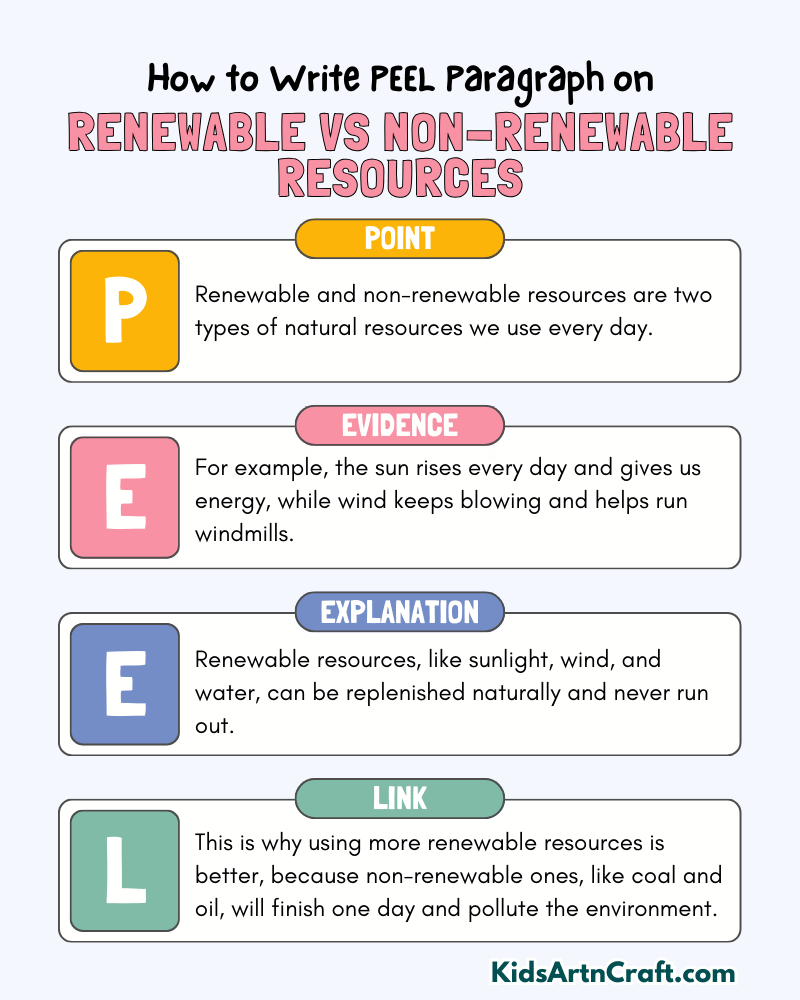
Point: Renewable and non-renewable resources are two types of natural resources we use every day.
Evidence: For example, the sun rises every day and gives us energy, while wind keeps blowing and helps run windmills.
Explanation: Renewable resources, like sunlight, wind, and water, can be replenished naturally and never run out.
Link: This is why using more renewable resources is better, because non-renewable ones, like coal and oil, will finish one day and pollute the environment.
2. Renewable vs Non-Renewable Resources Paragraph Writing with TEEL Method
TEEL Method (Topic, Evidence, Explanation, Link)
Topic: Renewable and non-renewable resources are important for how we get energy.
Evidence: Sunlight and wind come again and again, but coal and oil take millions of years to form and can be used up quickly.
Explanation: Renewable resources can refill themselves, but non-renewable resources exist in limited amounts.
Link: Understanding this helps us choose cleaner energy that protects the Earth for future generations.
3. Renewable vs Non-Renewable Resources Paragraph Writing with the TEXAS Method
TEXAS Method (Topic, Example, Explanation, Analysis, Summary/Significance)
Topic: Renewable and non-renewable resources provide energy in different ways.
Example: Solar panels use sunlight, a renewable resource, but cars that use petrol depend on non-renewable oil.
Explanation: Renewable resources last longer because nature replaces them, while non-renewable ones can disappear.
Analysis: This means renewable energy is better for the planet and keeps the air cleaner.
Summary: So, choosing renewable resources helps protect Earth and saves limited fuels for essential needs.
4. Renewable vs Non-Renewable Resources Paragraph Writing with Hamburger Method
Hamburger Method (Top Bun, The Fillings, Bottom Bun)

Top Bun (Topic Sentence):
Renewable and non-renewable resources are two groups of energy sources we use daily.
The Fillings (Supporting Details):
Renewable resources like sunlight, wind, and moving water keep coming back naturally. Non-renewable resources, such as coal, oil, and natural gas, can run out and cause more pollution. Renewable energy is cleaner and safer for the environment, while non-renewable energy can harm the air and land.
Bottom Bun (Concluding Sentence):
That’s why learning about these resources helps us make smarter choices to protect our planet.
Renewable and Non-Renewable Resources
- Renewable resources come from nature and are replaced naturally, such as solar, wind, and water energy. [Source: Britannica – Renewable Resource]
- Non-renewable resources like coal, oil, and natural gas take millions of years to form and can run out.
[Source: U.S. Energy Information Administration (EIA)] - Renewable energy produces less pollution and fewer greenhouse gases. [Source: United Nations – Renewable Energy]
- Non-renewable energy causes air pollution and contributes to climate change. [Source: U.S. Environmental Protection Agency (EPA)]
Additional Facts
- Renewable energy helps reduce the use of limited fossil fuels. [Source: International Renewable Energy Agency (IRENA)]
- Solar and wind energy are becoming cheaper and more common worldwide. [Source: IRENA – Renewable Energy Costs]
- Renewable energy creates jobs and supports economic growth. [Source: United Nations – Renewable Energy Fast Facts]
- Using renewable resources helps protect air, water, and ecosystems. [Source: World Wildlife Fund (WWF)]
Hope you liked these paragraphs on ‘Renewable vs Non-Renewable Resources’. Don’t forget to join the Telegram group for FREE Printables.