






Paragraph Writing
Paragraph on Should Social Media Have Age Limits?


The question of whether social media should have age limits is important for online safety. This paragraph explains its impact on children, digital responsibility, security, and safe internet use. You can become skilled at writing about “Should Social Media Have Age Limits?” by using four key styles—Expository, Persuasive, Descriptive, and Narrative—and organizing your ideas effectively with structures like PEEL, TEEL, TEXAS, and the Hamburger method.
Read This Article in Other Languages
- क्या सोशल मीडिया में आयु सीमा होनी चाहिए पर अनुच्छेद (Hindi / हिंदी)
- Párrafo sobre si las redes sociales deberían tener límites de edad (Spanish / Español)
- Paragraphe sur si les réseaux sociaux devraient avoir des limites d’âge (French / Français)
- Absatz darüber, ob soziale Medien Altersbeschränkungen haben sollten (German / Deutsch)
- فقرة عن ما إذا كان يجب أن يكون لوسائل التواصل الاجتماعي حدود عمرية (Arabic / العربية)
- সোশ্যাল মিডিয়ায় কি বয়স সিমা থাকা উচিত – অনুচ্ছেদ (Bengali / বাংলা)
- சோஷியல் மீடியாவுக்கு வயது வரம்பு இருக்க வேண்டுமா பற்றிப் பத்தி (Tamil / தமிழ்)
- సోషల్ మీడియాకు వయస్సు పరిమితులు ఉండాలా గురించి పేరా (Telugu / తెలుగు)
- സോഷ്യൽ മീഡിയയ്ക്ക് പ്രായപരിധി ഉണ്ടായിരിക്കണോ എന്ന് പാരഗ്രാഫ് (Malayalam / മലയാളം)
- کیا سوشل میڈیا پر عمر کی حد ہونی چاہئے پر پیراگراف (Urdu / اردو)
- Parágrafo sobre se as redes sociais deveriam ter limites de idade (Portuguese / Português)
Translation Disclaimer: These links use Google Translate, an automated translation service. Translations may vary in accuracy and are provided for convenience only.
Different Styles of Paragraphs on ‘Should Social Media Have Age Limits?’
1. Expository Paragraph on Should Social Media Have Age Limits? (Explains with Facts)

Social media has become a major part of daily life, but it also brings risks, especially for children. Studies show that young users can be exposed to harmful content, cyberbullying, and privacy issues. Age limits on social media platforms can protect children from these dangers while allowing them to grow safely online. Experts suggest that children under 13 may not have the emotional maturity to understand privacy settings or handle online interactions responsibly. Age limits also encourage responsible digital habits and prevent addiction. Some platforms already enforce age restrictions, but enforcement is often weak, making it easy for children to bypass them. By implementing stricter age limits and verifying ages effectively, social media companies can create a safer environment for young users. Overall, age limits are an important step in protecting children’s mental health, promoting safe online behavior, and ensuring that social media is used responsibly.
2. Persuasive Paragraph on Should Social Media Have Age Limits? (Tries to Convince You)
Social media platforms must have strict age limits to protect children from harm. Young users are vulnerable to cyberbullying, inappropriate content, and online predators. Without age restrictions, children may develop unhealthy habits, spend too much time online, and face mental health issues like anxiety and depression. Platforms that enforce age limits encourage safer use, allowing children to grow and learn before entering complex online spaces. Parents and educators can support age limits by guiding children toward responsible digital behavior. By setting the minimum age at 13, social media companies can create a safer environment and prevent children from facing dangers they are not ready to handle. Age limits are not restrictions but protections, ensuring that children experience the benefits of social media—such as learning, communication, and creativity—without the risks. Strong enforcement of age rules is essential because it safeguards young users while fostering responsible digital habits. Social media should prioritize safety over unrestricted access, making age limits a necessary step for a healthier online world.
3. Descriptive Paragraph on Should Social Media Have Age Limits? (Paints a Picture with Words)
Imagine a world where children can freely explore social media without any rules. Bright screens light up their faces as they scroll endlessly through videos, posts, and messages. Some posts make them laugh, while others can confuse or scare them. Comments from strangers appear like whispers in a crowded room, sometimes friendly but sometimes harmful. Without age limits, this online space feels overwhelming and chaotic, a maze that young minds cannot fully understand. Age limits act like a guiding hand, showing children the boundaries of safe exploration. They allow children to enjoy fun, educational content while avoiding the shadows of cyberbullying, scams, and negative influences. The online world becomes a garden rather than a jungle, where young users can play, learn, and connect safely. Screens glow, laughter spreads, and minds grow, all within the protective walls of age-appropriate access. Age limits turn social media from a risky playground into a nurturing space, where children can enjoy the wonders of technology without danger.
4. Narrative Paragraph on Should Social Media Have Age Limits? (Tells a Story)
Last year, my younger cousin tried to create a social media account even though she was only ten. At first, it seemed fun—she was sending messages, sharing pictures, and following her friends. But soon, she encountered mean comments from strangers and saw content that scared her. My family realized she was too young to navigate these dangers alone. We talked to her about online safety and decided she should wait until she was older. This experience showed me why social media needs age limits. Children under 13 often lack the skills to protect themselves online, and exposure to harmful content can affect their mental health. Age limits give them time to mature and understand responsibility before entering the digital world. Today, my cousin still uses social media, but only under guidance, and she appreciates the rules that keep her safe. Her story highlights that age limits are not just rules—they are a shield, protecting young users while helping them enjoy social media safely when they are ready.
‘Should Social Media Have Age Limits?’ Paragraphs in Different Structured Methods
1. Should Social Media Have Age Limits? Paragraph Writing with PEEL Method
PEEL Method (Point, Evidence, Explanation, Link)
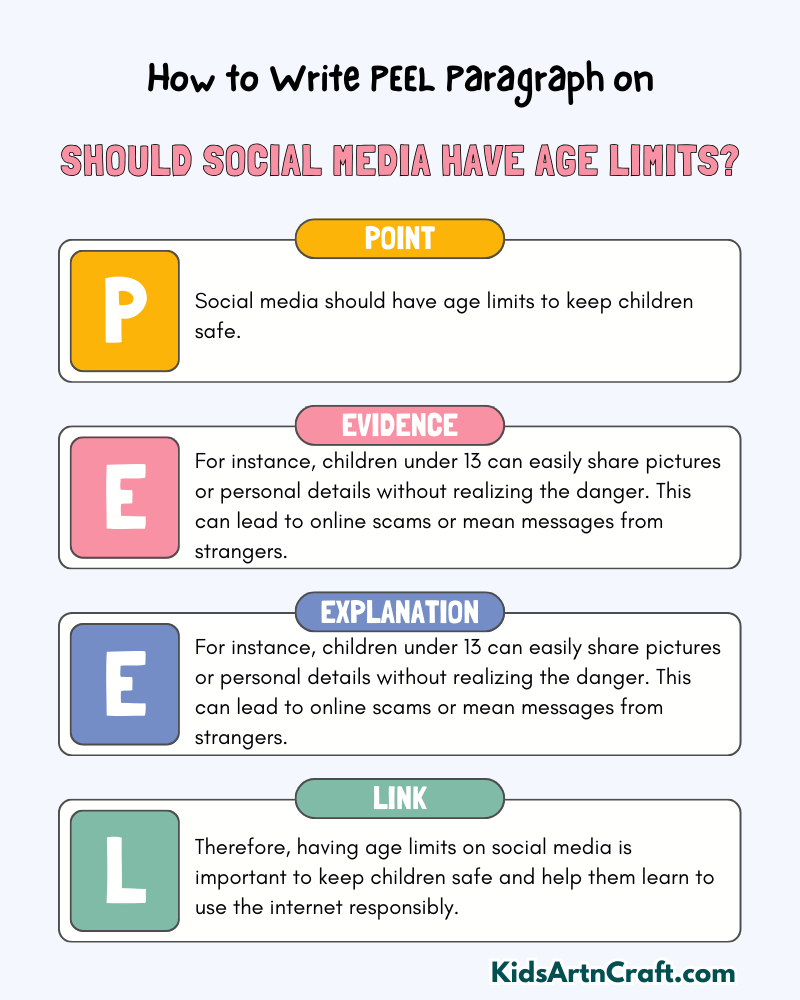
Point: Social media should have age limits to keep children safe.
Evidence: For instance, children under 13 can easily share pictures or personal details without realizing the danger. This can lead to online scams or mean messages from strangers.
Explanation: Many children face risks online, such as cyberbullying and seeing inappropriate content. They may not understand how to protect their personal information.
Link: Therefore, having age limits on social media is important to keep children safe and help them learn to use the internet responsibly.
2. Should Social Media Have Age Limits? Paragraph Writing with TEEL Method
TEEL Method (Topic, Evidence, Explanation, Link)
Topic: Social media must have age limits for children’s safety.
Evidence: Studies show that children under 13 are more likely to be upset by negative posts or contact from strangers.
Explanation: Young users can face online bullying, see harmful content, or share private information unknowingly.
Link: By setting age limits, social media becomes a safer space. Kids can enjoy games, videos, and learning online while staying protected. Age rules teach children responsibility and help them grow safely in a digital world.
3. Should Social Media Have Age Limits? Paragraph Writing with the TEXAS Method
TEXAS Method (Topic, Example, Explanation, Analysis, Summary/Significance)
Topic: Social media should have age limits to protect young children.
Example: A 10-year-old posting pictures without knowing that strangers can view them might face online bullying.
Explanation: Children may not understand the dangers online. They can see harmful videos or share private details.
Analysis: Age limits help children wait until they are ready to use social media safely.
Summary: With rules, children can explore, learn, and have fun online without harm. Age limits are not strict barriers but shields to keep kids safe.
4. Should Social Media Have Age Limits? Paragraph Writing with Hamburger Method
Hamburger Method (Top Bun, The Fillings, Bottom Bun)
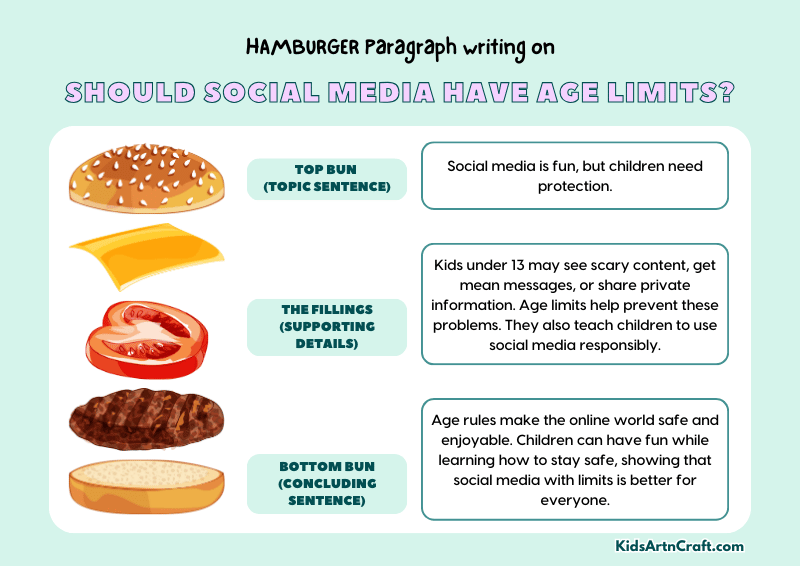
Top Bun (Topic Sentence):
Social media is fun, but children need protection.
The Fillings (Supporting Details):
Kids under 13 may see scary content, get mean messages, or share private information. Age limits help prevent these problems. They also teach children to use social media responsibly.
Bottom Bun (Concluding Sentence):
Age rules make the online world safe and enjoyable. Children can have fun while learning how to stay safe, showing that social media with limits is better for everyone.
Importance of Social Media Age Limits
- Children’s brains are still developing, so they are more sensitive to social media pressure. [Source: EU Joint Research Centre]
- Heavy social media use is linked to higher stress, anxiety, and sadness in teens. [Source: NCBI]
Additional Facts About Social Media Age Limits
- Experts suggest age rules can help protect children’s mental health online. [Source: Phys.org]
- Some countries are setting minimum ages to keep children safer on social media. [Source: People.com]
- The common age limit of 13 comes from old privacy laws, not child development science. [Source: EDFA]
- Social media can be helpful, but experts recommend balance and adult guidance. [Source: Kids Mental Health Foundation]
Hope you liked these paragraphs on ‘Should Social Media Have Age Limits?’. Don’t forget to join the Telegram group for FREE Printables.
Check this article to write a paragraph on social media.