



Paragraph Writing
Paragraph on Simple Machines


Simple machines, like levers, pulleys, and wheels, make work easier. They help us lift, move, or cut objects efficiently, showing how science makes everyday tasks simpler. Explore techniques for writing clear paragraphs on “Simple Machines” in four styles—Expository, Persuasive, Descriptive, and Narrative—while organizing your ideas using structures with PEEL, TEEL, TEXAS, and the Hamburger Model.
Read This Article in Other Languages
- सरल मशीनों पर अनुच्छेद (Hindi / हिंदी)
- Párrafo sobre máquinas simples (Spanish / Español)
- Paragraphe sur les machines simples (French / Français)
- Absatz über einfache Maschinen (German / Deutsch)
- فقرة عن الآلات البسيطة (Arabic / العربية)
- সরল মেশিনগুলি সম্পর্কে অনুচ্ছেদ (Bengali / বাংলা)
- எளிய இயந்திரங்கள் பற்றி பத்தி (Tamil / தமிழ்)
- సాధారణ యంత్రాలపై పేరా (Telugu / తెలుగు)
- സിമ്പിൾ മെഷീനുകൾക്ക 관한 പാരഗ്രാഫ് (Malayalam / മലയാളം)
- سادہ مشینوں پر پیراگراف (Urdu / اردو)
- Parágrafo sobre máquinas simples (Portuguese / Português)
Translation Disclaimer: These links use Google Translate, an automated translation service. Translations may vary in accuracy and are provided for convenience only.
Different Styles of Paragraphs on ‘Simple Machines’
1. Expository Paragraph on Simple Machines (Explains with Facts)

Simple machines are basic tools that help us do work more easily by reducing the effort needed to move or lift objects. There are six main types: lever, wheel and axle, pulley, inclined plane, wedge, and screw. Each one helps us complete everyday tasks in different ways. A lever, like a seesaw, uses a fulcrum to lift heavy loads with less force. Pulleys change the direction of force, making them useful for lifting objects in cranes and flagpoles. Inclined planes, such as ramps, allow heavy items to be moved upward gradually. Wedges are used for cutting or splitting, while screws help hold materials together or raise objects. Though simple in design, these machines appear everywhere and make difficult tasks easier. Understanding them helps students appreciate how basic tools support human progress.
2. Persuasive Paragraph on Simple Machines (Tries to Convince You)
Simple machines may appear basic, but they are essential tools that everyone should understand and appreciate. Learning about simple machines is not just a school lesson—it is a life skill that helps us work smarter. Think about how often we rely on them in daily life. When you use a ramp to move a heavy box, a pulley to lift a bucket, or a screwdriver to fix something, you are using simple machines that save time, energy, and effort. This is why simple machines should be taught more clearly and used more frequently in practical tasks. They empower students to solve problems efficiently and encourage creativity in building and designing. Without simple machines, many of the tools we depend on—bicycles, scissors, doorknobs, and even cars—would not function properly. Understanding these tools also inspires young minds to explore engineering and innovation. Therefore, it is important for schools, parents, and students to value simple machines. By learning how they work and applying them in daily life, we can make tasks easier and develop a strong foundation for future scientific learning. Simple machines truly make our world better, one task at a time.
3. Descriptive Paragraph on Simple Machines (Paints a Picture with Words)
Simple machines are all around us, quietly working to make life easier. Imagine entering a workshop filled with tools: a shiny metal lever resting against a wall, a smooth wooden wheel spinning gently on its axle, and a pulley hanging gracefully from the ceiling like a loop of promise. The inclined plane stretches out like a long pathway, inviting objects to glide upward with less effort. Nearby, a sharp wedge gleams under the light, ready to split wood with a single strike. A screw twists firmly into place, its spiraling thread gripping tightly as if embracing the material it holds. Each simple machine has its own beauty and function. Their shapes, textures, and movements tell stories of balance, force, and direction. They transform heavy work into manageable tasks with quiet elegance. Whether lifting, cutting, rolling, tightening, or moving objects, simple machines perform their tasks with precision and grace. In everyday life—on playgrounds, in homes, and in construction sites—the presence of these machines adds both convenience and wonder. Though small and often overlooked, simple machines create a world where tasks feel lighter and work becomes smoother.
4. Narrative Paragraph on Simple Machines (Tells a Story)
One sunny afternoon, Riya visited her grandfather’s workshop, a place she loved for its smell of wood and metal. As she entered, she noticed a large crate that needed moving. “Let’s use a simple machine,” her grandfather said with a smile. He showed her a long wooden plank—a lever—placed over a small block. Together, they pushed down, and the heavy crate lifted easily. Riya’s eyes widened. Next, he pulled a rope through a pulley hanging from the ceiling. “Try lifting this bucket now,” he encouraged. With one gentle pull, the bucket rose, as if weightless. They used an inclined plane to slide boxes upward and a wedge to split firewood for the stove. Finally, he handed her a screw and screwdriver, teaching her how a twisting motion could hold two pieces of wood together securely. By the end of the afternoon, Riya felt like she had discovered a world of hidden helpers. The simple machines made every task feel like magic, and she realized how important they were in everyday life. Her grandfather chuckled, “Tools may be small, but they make us stronger.” Riya knew she would never look at objects the same way again.
‘Simple Machines’ Paragraphs in Different Structured Methods
1. Simple Machines Paragraph Writing with PEEL Method
PEEL Method (Point, Evidence, Explanation, Link)
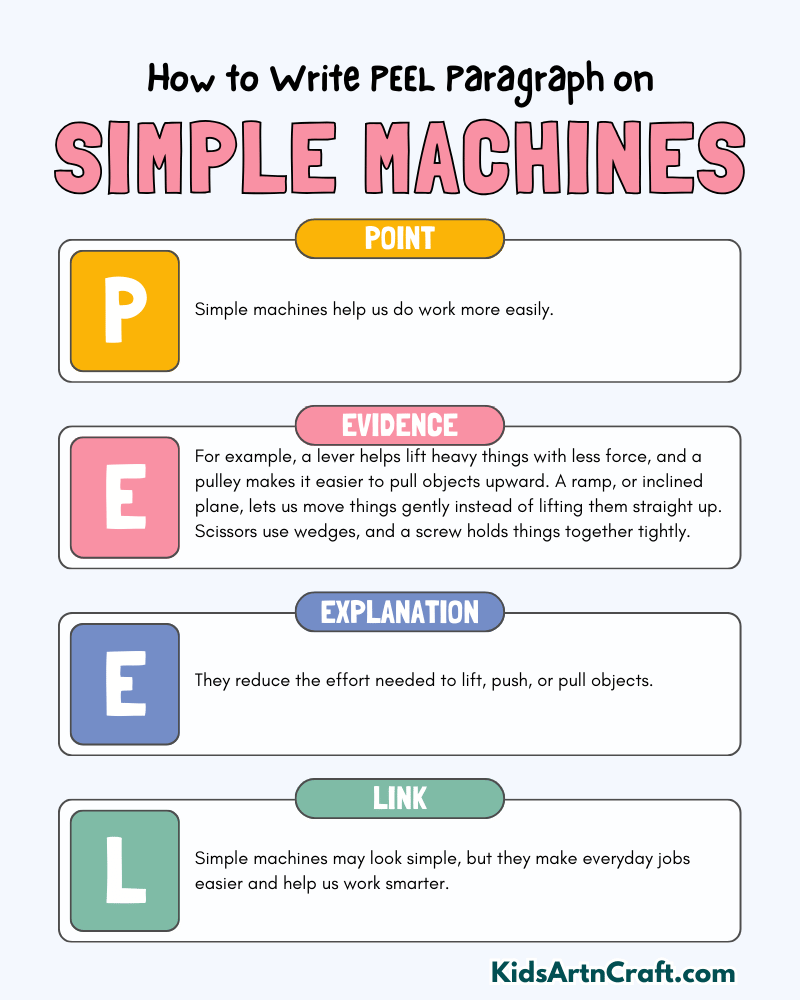
Point: Simple machines help us do work more easily.
Evidence: For example, a lever helps lift heavy things with less force, and a pulley makes it easier to pull objects upward. A ramp, or inclined plane, lets us move things gently instead of lifting them straight up. Scissors use wedges, and a screw holds things together tightly.
Explanation: They reduce the effort needed to lift, push, or pull objects.
Link: Simple machines may look simple, but they make everyday jobs easier and help us work smarter.
2. Simple Machines Paragraph Writing with TEEL Method
TEEL Method (Topic, Evidence, Explanation, Link)
Topic: Simple machines are basic tools that help us complete tasks with less effort.
Evidence: A wheel and axle help a bicycle move smoothly. A wedge helps cut fruits and vegetables. A pulley helps lift the school flag every morning. A screw helps keep furniture parts connected.
Explanation: Each type of simple machine has a special job, like cutting, lifting, or moving objects.
Link: When we understand these machines, we can use them wisely in school, at home, and in daily life.
3. Simple Machines Paragraph Writing with the TEXAS Method
TEXAS Method (Topic, Example, Explanation, Analysis, Summary/Significance)
Topic: Simple machines make work easier for everyone.
Example: When you use a seesaw, you are using a lever. When you ride a scooter, the wheel and axle help it roll. When you use a ramp to move a box, that is an inclined plane.
Explanation: They change the amount or direction of force so we don’t have to work as hard.
Analysis: These simple tools help us save energy and finish tasks quickly.
Summary: Simple machines are helpful tools that make our everyday activities easier and faster.
4. Simple Machines Paragraph Writing with Hamburger Method
Hamburger Method (Top Bun, The Fillings, Bottom Bun)
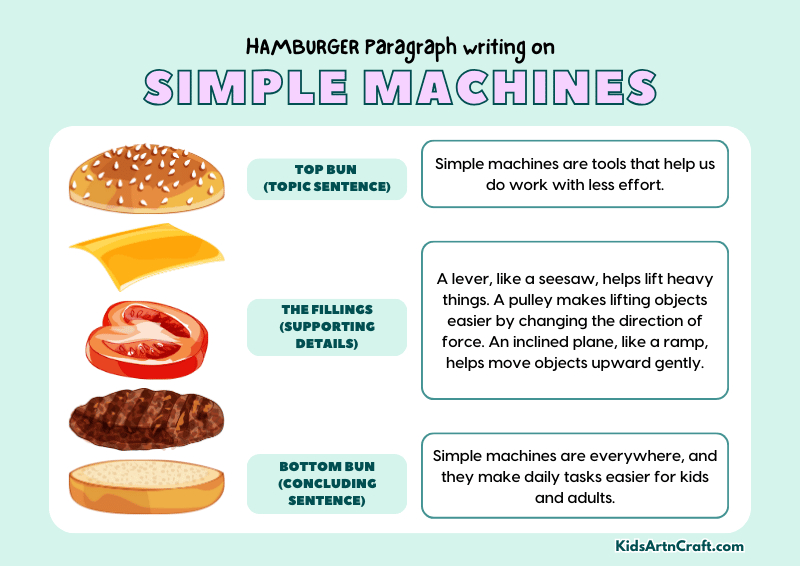
Top Bun (Topic Sentence):
Simple machines are tools that help us do work with less effort.
The Fillings (Supporting Details):
A lever, like a seesaw, helps lift heavy things. A pulley makes lifting objects easier by changing the direction of force. An inclined plane, like a ramp, helps move objects upward gently.
Bottom Bun (Concluding Sentence):
Simple machines are everywhere, and they make daily tasks easier for kids and adults.
Simple Machines
- Simple machines are basic tools that make work easier by changing force or direction. [Source: Britannica – Simple Machine]
- There are six simple machines: lever, wheel and axle, pulley, inclined plane, wedge, and screw. [Source: HowStuffWorks – Simple Machines]
- Simple machines are the building blocks of complex machines used daily. [Source: Explain That Stuff]
- Learning simple machines helps students understand physics and engineering basics. [Source: NASA – What Is Engineering?]
Additional Facts
- Simple machines reduce effort when lifting or moving objects. [Source: Britannica]
- Pulleys help lift heavy loads using less force. [Source: Explain That Stuff – Pulleys]
- Inclined planes allow heavy objects to move upward easily. [Source: HowStuffWorks]
- Levers use a fulcrum to lift or move objects efficiently. [Source: Explain That Stuff – Levers]
Hope you liked these paragraphs on ‘Simple Machines’. Don’t forget to join the Telegram group for FREE Printables.