Paragraph Writing
Paragraph on Self-Discipline


Self-discipline helps us stay focused, manage time, build good habits, and achieve goals. It teaches responsibility, self-control, and consistency, guiding us to make better choices in everyday life. We’ll explore how to write paragraphs on “Self-Discipline” using Expository, Persuasive, Descriptive, and Narrative styles, while organizing our ideas through PEEL, TEEL, TEXAS, and the Hamburger Model.
Most of our paragraphs are in 150 to 200 words. You can also find longer paragraphs (in 300 words) on ‘Self-Discipline’ or essays on the same topic on the web.
Read This Article in Other Languages
- आत्म‑अनुशासन पर अनुच्छेद (Hindi / हिंदी)
- Párrafo sobre la autodisciplina (Spanish / Español)
- Paragraphe sur l’autodiscipline (French / Français)
- Absatz über Selbstdisziplin (German / Deutsch)
- فقرة عن ضبط النفس (Arabic / العربية)
- আত্ম‑অনুশাসন সম্পর্কে অনুচ্ছেদ (Bengali / বাংলা)
- சுயக் கட்டுப்பாடு பற்றி பத்தி (Tamil / தமிழ்)
- స్వ‑అనుసరణపై పేరా (Telugu / తెలుగు)
- സ്വ‑ശിക്ഷണത്തെക്കുറിച്ചുള്ള പാരഗ്രാഫ് (Malayalam / മലയാളം)
- خود نظم پر پیراگراف (Urdu / اردو)
- Parágrafo sobre autodisciplina (Portuguese / Português)
Translation Disclaimer: These links use Google Translate, an automated translation service. Translations may vary in accuracy and are provided for convenience only.
Different Styles of Paragraphs on ‘Self-Discipline’
1. Expository Paragraph on Self-Discipline (Explains with Facts)
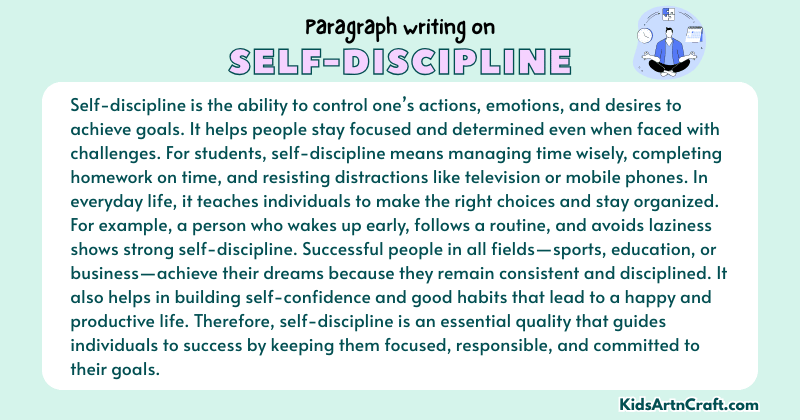
Self-discipline is the ability to control one’s actions, emotions, and desires to achieve goals. It helps people stay focused and determined even when faced with challenges. For students, self-discipline means managing time wisely, completing homework on time, and resisting distractions like television or mobile phones. In everyday life, it teaches individuals to make the right choices and stay organized. For example, a person who wakes up early, follows a routine, and avoids laziness shows strong self-discipline. Successful people in all fields—sports, education, or business—achieve their dreams because they remain consistent and disciplined. It also helps in building self-confidence and good habits that lead to a happy and productive life. Therefore, self-discipline is an essential quality that guides individuals to success by keeping them focused, responsible, and committed to their goals.
2. Persuasive Paragraph on Self-Discipline (Tries to Convince You)
Everyone should practice self-discipline because it is the key to success and personal growth. Without discipline, even the most talented people can fail to reach their potential. For example, a student who studies regularly performs better than one who studies only before exams. Self-discipline helps people make wise decisions, avoid bad habits, and stay positive during difficult times. It also improves mental strength and self-control. When we learn to delay pleasure and focus on long-term goals, we become more successful and confident. Think about athletes who train daily, regardless of the weather—they achieve greatness because of discipline, not just talent. Therefore, every person, especially students, must build self-discipline to manage time, stay healthy, and achieve dreams. It is not always easy, but the rewards are worth the effort.
3. Descriptive Paragraph on Self-Discipline (Paints a Picture with Words)
Self-discipline is like a quiet force that guides a person toward success. It appears in the calm morning when someone wakes up early, exercises, and begins their day with purpose. It shines in the student who studies instead of wasting time on distractions. The feeling of self-discipline is peaceful yet powerful—it gives a sense of control and confidence. A disciplined person has a tidy room, a well-planned schedule, and a focused mind. They don’t rush; instead, they move step by step toward their goals. Self-discipline also brings balance, helping people stay calm in stressful situations. It makes life more meaningful and productive. Whether in school, at home, or in sports, self-discipline shows itself through consistent effort, patience, and determination. It is the invisible strength that turns ordinary people into achievers.
4. Narrative Paragraph on Self-Discipline (Tells a Story)
Last year, I learned the true value of self-discipline. Before my final exams, I often delayed studying and spent hours watching videos. As the exams approached, I realized how unprepared I was. Determined to change, I created a strict study schedule and followed it every day. I woke up early, revised my lessons, and stayed away from distractions. At first, it was difficult, but soon I noticed the difference—my confidence grew, and I felt proud of my progress. On the exam day, I was calm and ready. When the results came, I had scored better than ever before. That success taught me that self-discipline is not about forcing oneself but about staying focused and consistent. From that moment, I promised to keep discipline in all areas of my life, and it has continued to guide me toward success.
‘Self-Discipline’ Paragraphs in Different Structured Methods
1. Self-Discipline Paragraph Writing with PEEL Method
PEEL Method (Point, Evidence, Explanation, Link)
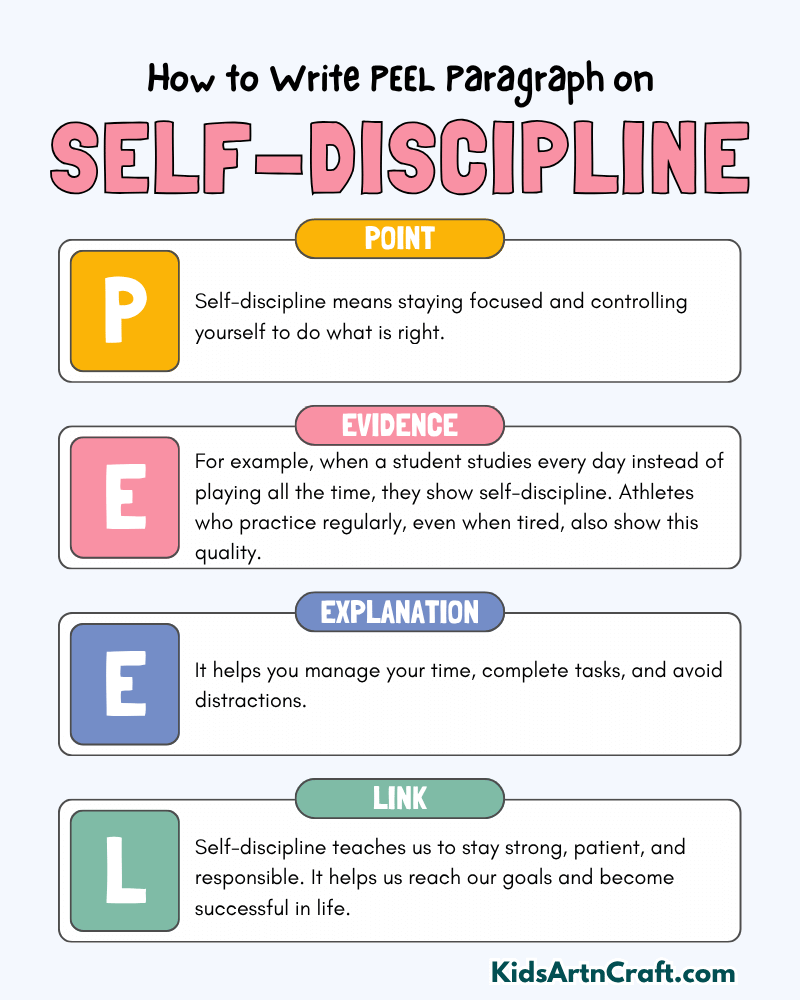
Point: Self-discipline means staying focused and controlling yourself to do what is right.
Evidence: For example, when a student studies every day instead of playing all the time, they show self-discipline. Athletes who practice regularly, even when tired, also show this quality.
Explanation: It helps you manage your time, complete tasks, and avoid distractions.
Link: Self-discipline teaches us to stay strong, patient, and responsible. It helps us reach our goals and become successful in life.
2. Self-Discipline Paragraph Writing with TEEL Method
TEEL Method (Topic, Evidence, Explanation, Link)
Topic: Self-discipline is one of the most important habits for success.
Evidence: For instance, students who study on time, complete homework, and follow routines perform better in school. Great leaders and athletes succeed because they practice discipline every day.
Explanation: It helps people control their actions and focus on their goals.
Link: Therefore, self-discipline builds character and guides us to achieve our dreams through effort and commitment.
3. Self-Discipline Paragraph Writing with the TEXAS Method
TEXAS Method (Topic, Example, Explanation, Analysis, Summary/Significance)
Topic: Self-discipline means doing what is right, even when you don’t feel like it.
Example: For example, a student who studies before playing games shows discipline. A sportsperson who trains daily shows it too.
Explanation: It teaches us to manage time, stay organized, and keep trying.
Analysis: Self-discipline makes people stronger, confident, and more focused on their goals. It helps us make good choices and avoid laziness.
Summary: In short, self-discipline is the key to success and a happy life.
4. Self-Discipline Paragraph Writing with Hamburger Method
Hamburger Method (Top Bun, The Fillings, Bottom Bun)
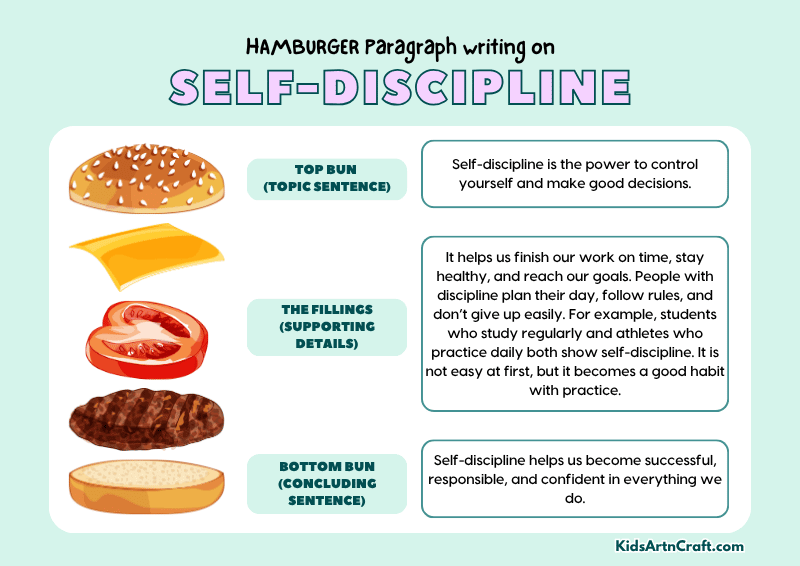
Top Bun (Topic Sentence):
Self-discipline is the power to control yourself and make good decisions.
The Fillings (Supporting Details):
It helps us finish our work on time, stay healthy, and reach our goals. People with discipline plan their day, follow rules, and don’t give up easily. For example, students who study regularly and athletes who practice daily both show self-discipline. It is not easy at first, but it becomes a good habit with practice.
Bottom Bun (Concluding Sentence):
Self-discipline helps us become successful, responsible, and confident in everything we do.
Importance of Self‑Discipline
- Self‑discipline helps children control their behavior and emotions. [Source: Cornell Cooperative Extension]
- It is linked to better learning and academic success. [Source: Scientific American]
Additional Facts About Self‑Discipline
- Children with self‑discipline can delay gratification, which supports future success. [Source: Scientific American]
- Self‑control predicts healthier habits and fewer risky behaviors later in life. [Source: PMC / NIH]
- It helps build good habits, manage time, and make responsible choices. [Source: Child Development Resource]
Hope you liked these paragraphs on ‘Self-Discipline’. Don’t forget to join the Telegram group for FREE Printables.