






Paragraph Writing
Paragraph on AI in Healthcare


Artificial intelligence in healthcare helps doctors and nurses provide better care by diagnosing diseases faster, predicting health issues, and supporting treatment with smart technology. Enhance your paragraph-writing skills in four styles—Expository, Persuasive, Descriptive, and Narrative—while structuring your ideas effectively using structures like PEEL, TEEL, TEXAS, and the Hamburger Model.
Read This Article in Other Languages
- स्वास्थ्य देखभाल में एआई पर अनुच्छेद (Hindi / हिंदी)
- Párrafo sobre IA en el cuidado de la salud (Spanish / Español)
- Paragraphe sur l’IA dans les soins de santé (French / Français)
- Absatz über KI im Gesundheitswesen (German / Deutsch)
- فقرة عن الذكاء الاصطناعي في الرعاية الصحية (Arabic / العربية)
- স্বাস্থ্যসেবায় এআই সম্পর্কে অনুচ্ছেদ (Bengali / বাংলা)
- மருத்துவ பராமரிப்பில் செயற்கை நுண்ணறிவு பற்றிய பத்தி (Tamil / தமிழ்)
- ఆరోగ్య పరిరక్షణలో AIపై పేరాగ్రాఫ్ (Telugu / తెలుగు)
- ആരോഗ്യ പരിചരത്തിൽ എഐയെക്കുറിച്ചുള്ള പാരഗ്രാഫ് (Malayalam / മലയാളം)
- صحت کی دیکھ بھال میں مصنوعی ذہانت پر پیراگراف (Urdu / اردو)
- Parágrafo sobre IA na saúde (Portuguese / Português)
Translation Disclaimer: These links use Google Translate, an automated translation service. Translations may vary in accuracy and are provided for convenience only.
Different Styles of Paragraphs on ‘AI in Healthcare’
1. Expository Paragraph on AI in Healthcare (Explains with Facts)
Artificial Intelligence (AI) is playing a big role in healthcare today. AI helps doctors, nurses, and hospitals provide better care for patients. It can analyze large amounts of medical data quickly and find patterns that humans might miss. For example, AI can detect diseases like cancer or heart problems early by examining scans and test results. AI-powered robots assist surgeons during complicated operations, making procedures safer and faster. Hospitals use AI to manage patient records, appointments, and treatments efficiently. Even wearable devices, like smartwatches, use AI to monitor heart rate, sleep, and daily activity. AI also helps in developing new medicines and vaccines by predicting which formulas will work best. By using AI, healthcare becomes faster, more accurate, and safer. While AI cannot replace doctors, it supports them in making better decisions. Overall, AI is improving patient care and making healthcare smarter and more effective.
2. Persuasive Paragraph on AI in Healthcare (Tries to Convince You)
AI should be widely used in healthcare because it saves lives and improves treatment. It can detect illnesses early, sometimes even before symptoms appear. For example, AI can examine X-rays, scans, and test results more quickly and accurately than humans. Hospitals benefit because AI helps manage patient data, schedules, and treatments efficiently. Wearable AI devices track health, remind patients to take medicines, and alert doctors in emergencies. AI also helps researchers develop new medicines and vaccines faster. By using AI, doctors can focus more on patients, while machines handle repetitive tasks. However, people should remember that AI is a tool and cannot replace human care and compassion. When used correctly, AI can make healthcare safer, faster, and more accessible to everyone. Therefore, hospitals and clinics should adopt AI to save more lives and improve the health of society.
3. Descriptive Paragraph on AI in Healthcare (Paints a Picture with Words)
AI in healthcare feels like a smart helper working quietly behind the scenes. In hospitals, AI examines scans and test results, highlighting problems that doctors might miss. Robots assist surgeons in precise operations, moving steadily and carefully. AI-powered devices track patients’ vital signs, alerting nurses if there is any danger. Electronic records are organized neatly, making it easier for doctors to check past treatments. AI apps remind patients to take medicines or attend appointments. Even wearable devices like smartwatches feel alive, monitoring heartbeats, sleep patterns, and activity levels. AI also helps researchers test medicines quickly in labs, speeding up treatments. The whole system becomes smooth, safe, and efficient. Patients feel secure, doctors feel supported, and hospitals run more effectively. AI adds intelligence, accuracy, and care to healthcare, making every visit or treatment better.
4. Narrative Paragraph on AI in Healthcare (Tells a Story)
Last month, Ravi went to the hospital for a heart check-up. The doctor used an AI-powered scanner that quickly analyzed his heart and identified a small problem that Ravi did not even feel. Later, a robot assisted the surgeon during a minor procedure, making it safer and faster. Ravi’s smartwatch, connected to an AI app, reminded him to take medicines and monitored his heartbeat at home. The hospital AI system also kept track of his medical history, making it easier for the doctor to plan treatment. Ravi realized that AI had helped him every step of the way, from diagnosis to recovery, making him feel safe and cared for. He understood that AI could not replace doctors but worked as a smart assistant, helping healthcare professionals give the best care. Ravi was amazed at how AI made hospitals more organized, precise, and efficient.
‘AI in Healthcare’ Paragraphs in Different Structured Methods
1. AI in Healthcare Paragraph Writing with PEEL Method
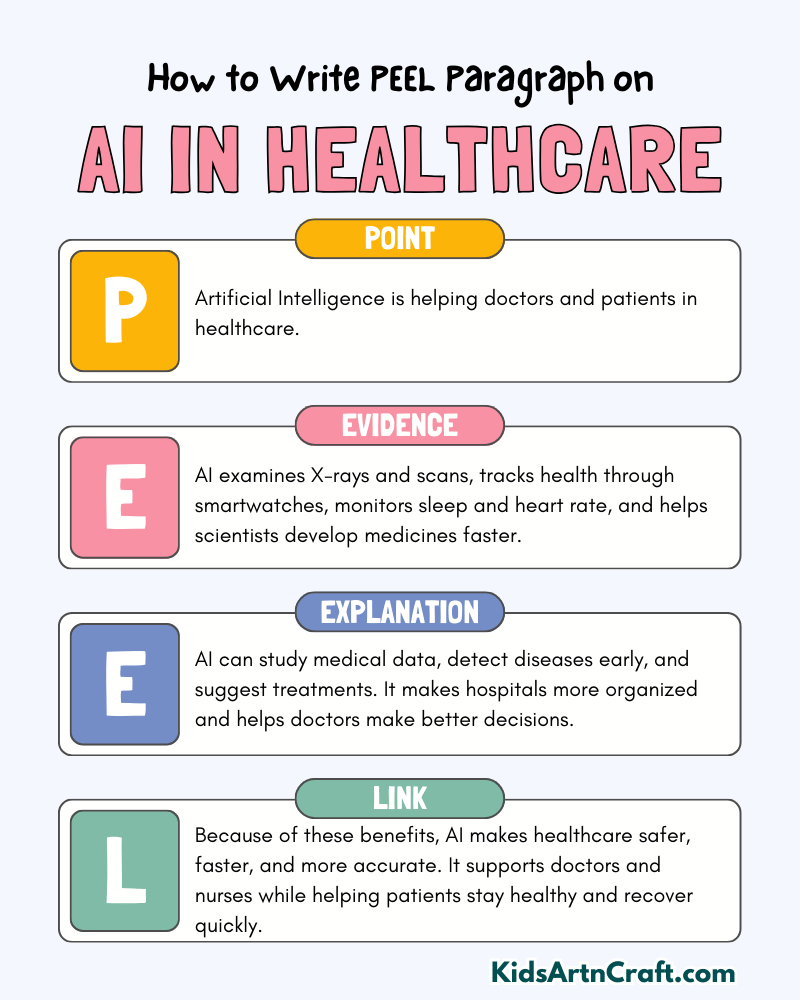
PEEL Method (Point, Evidence, Explanation, Link)
Point: Artificial Intelligence is helping doctors and patients in healthcare.
Evidence: AI examines X-rays and scans, tracks health through smartwatches, monitors sleep and heart rate, and helps scientists develop medicines faster.
Explanation: AI can study medical data, detect diseases early, and suggest treatments. It makes hospitals more organized and helps doctors make better decisions.
Link: Because of these benefits, AI makes healthcare safer, faster, and more accurate. It supports doctors and nurses while helping patients stay healthy and recover quickly.
2. AI in Healthcare Paragraph Writing with TEEL Method
TEEL Method (Topic, Evidence, Explanation, Link)
Topic: AI is changing healthcare and making it better for everyone.
Evidence: For instance, AI robots assist in surgeries, and wearable devices alert patients and doctors if there are health problems. AI also helps researchers create medicines and vaccines faster.
Explanation: AI helps doctors analyze patient data, detect diseases, and suggest treatments quickly. It also helps in hospitals to organize records and appointments.
Link: As a result, AI improves patient care and supports doctors in providing faster, safer, and smarter healthcare for all people.
3. AI in Healthcare Paragraph Writing with TEXAS Method
TEXAS Method (Topic, Example, Explanation, Analysis, Summary/Significance)
Topic: AI is very useful in modern healthcare.
Example: For example, AI can detect heart problems, cancer, and other illnesses early. Wearable devices also monitor health and send alerts.
Explanation: AI studies medical data and helps doctors find problems faster and more accurately.
Analysis: This makes treatments safer and helps patients recover faster. Doctors also save time and can focus more on patient care.
Summary: In short, AI helps hospitals, doctors, and patients by improving healthcare and making it more effective.
4. AI in Healthcare Paragraph Writing with Hamburger Method
Hamburger Method (Top Bun, The Fillings, Bottom Bun)
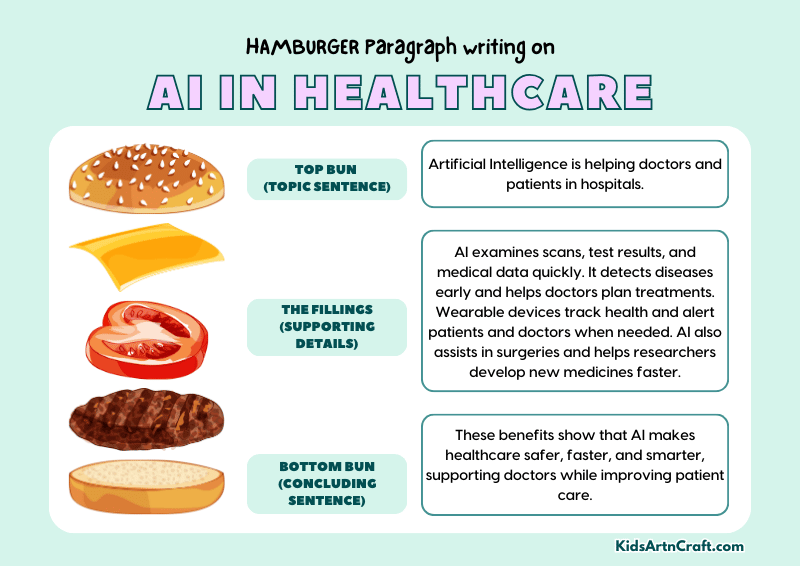
Top Bun (Topic Sentence):
Artificial Intelligence is helping doctors and patients in hospitals.
The Fillings (Supporting Details):
AI examines scans, test results, and medical data quickly. It detects diseases early and helps doctors plan treatments. Wearable devices track health and alert patients and doctors when needed. AI also assists in surgeries and helps researchers develop new medicines faster.
Bottom Bun (Concluding Sentence):
These benefits show that AI makes healthcare safer, faster, and smarter, supporting doctors while improving patient care.
Importance of AI in Healthcare
- Artificial Intelligence helps doctors diagnose diseases earlier and more accurately. [Source: PubMed]
- AI supports personalized treatment plans based on patient genetics and medical history. [Source: PubMed]
Additional Facts of AI in Healthcare
- Global health institutions develop standards to ensure safe AI use in medicine. [Source: ITU‑WHO Focus Group]
- Research centers like MIT Jameel Clinic drive AI innovations in disease detection and drug discovery. [Source: Wikipedia]
- NIH promotes responsible AI development to ensure safety and ethical use in healthcare. [Source: NIH]
- AI can improve healthcare delivery, but ethical, privacy, and bias issues must be managed. [Source: Brookings Institution]
Hope you liked these paragraphs on ‘AI in Healthcare’. Don’t forget to join the Telegram group for FREE Printables.