




Paragraph Writing
Paragraph on AI in Schools and Classrooms


Artificial intelligence in schools and classrooms helps teachers teach smarter and students learn faster using smart tools, personalized lessons, and interactive learning technology. Discover how to write strong paragraphs in four styles—Expository, Persuasive, Descriptive, and Narrative—while organizing your ideas clearly using structures like PEEL, TEEL, TEXAS, and the Hamburger Model.
Read This Article in Other Languages
- स्कूलों और कक्षाओं में एआई पर अनुच्छेद (Hindi / हिंदी)
- Párrafo sobre la IA en escuelas y aulas (Spanish / Español)
- Paragraphe sur l’IA dans les écoles et les salles de classe (French / Français)
- Absatz über KI in Schulen und Klassenzimmern (German / Deutsch)
- فقرة عن الذكاء الاصطناعي في المدارس والفصول الدراسية (Arabic / العربية)
- স্কুল ও শ্রেণিকক্ষে এআই সম্পর্কে অনুচ্ছেদ (Bengali / বাংলা)
- பள்ளிகள் மற்றும் வகுப்பறைகளில் செயற்கை நுண்ணறிவு பற்றிய பத்தி (Tamil / தமிழ்)
- పాఠశాలలు మరియు తరగతి గదుల్లో AIపై పేరాగ్రాఫ్ (Telugu / తెలుగు)
- സ്കൂളുകളിലും ക്ലാസ് മുറികളിലും എഐയെക്കുറിച്ചുള്ള പാരഗ്രാഫ് (Malayalam / മലയാളം)
- اسکولوں اور کلاس رومز میں مصنوعی ذہانت پر پیراگراف (Urdu / اردو)
- Parágrafo sobre IA em escolas e salas de aula (Portuguese / Português)
Translation Disclaimer: These links use Google Translate, an automated translation service. Translations may vary in accuracy and are provided for convenience only.
Different Styles of Paragraphs on ‘AI in Schools and Classrooms’
1. Expository Paragraph on AI in Schools and Classrooms (Explains with Facts)
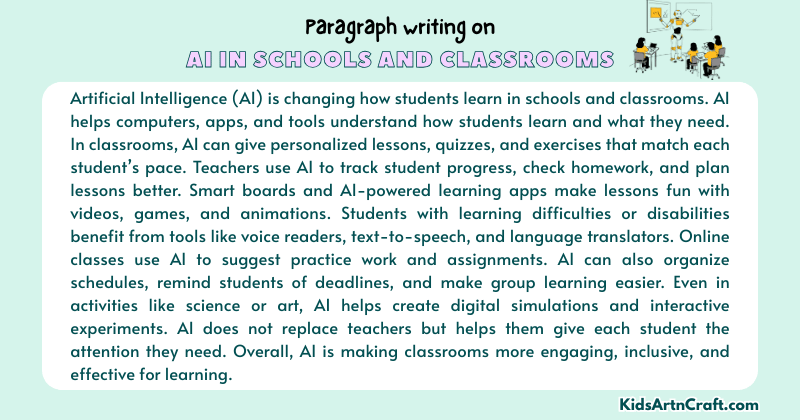
Artificial Intelligence (AI) is changing how students learn in schools and classrooms. AI helps computers, apps, and tools understand how students learn and what they need. In classrooms, AI can give personalized lessons, quizzes, and exercises that match each student’s pace. Teachers use AI to track student progress, check homework, and plan lessons better. Smart boards and AI-powered learning apps make lessons fun with videos, games, and animations. Students with learning difficulties or disabilities benefit from tools like voice readers, text-to-speech, and language translators. Online classes use AI to suggest practice work and assignments. AI can also organize schedules, remind students of deadlines, and make group learning easier. Even in activities like science or art, AI helps create digital simulations and interactive experiments. AI does not replace teachers but helps them give each student the attention they need. Overall, AI is making classrooms more engaging, inclusive, and effective for learning.
2. Persuasive Paragraph on AI in Schools and Classrooms (Tries to Convince You)
Schools should use Artificial Intelligence in classrooms because it improves learning for every student. Every child learns differently, and AI can adjust lessons to match their pace. Students who struggle in certain subjects get extra practice, while fast learners can move ahead. AI apps make lessons interactive and fun with games, quizzes, and videos. Teachers also benefit because AI checks homework quickly, tracks progress, and saves time for teaching. Students with disabilities get support through AI tools like voice readers, text-to-speech, and translation apps. AI also helps organize school work, reminds students about deadlines, and suggests study materials. By using AI responsibly, students gain confidence and learn more effectively. It also prepares them for future technology careers. However, AI should not replace teachers because they guide, inspire, and understand students personally. When AI and teachers work together, classrooms become more productive and enjoyable. Therefore, every school should include AI to help students achieve their best and make learning exciting.
3. Descriptive Paragraph on AI in Schools and Classrooms (Paints a Picture with Words)
AI in schools and classrooms feels like a helpful, invisible assistant working quietly in the background. Smart boards light up with colorful videos and animations while AI apps suggest lessons and exercises tailored for each student. When a child answers a question, AI gives instant feedback, showing which answers are right and which need more practice. Teachers see charts and reports that show how every student is doing. AI helps students with reading difficulties by reading texts aloud, translating languages, and explaining hard words. Online classrooms feel smooth as AI reminds students of assignments, deadlines, and tests. Even experiments and digital simulations become more interactive with AI tools. Classrooms feel organized, lively, and supportive because AI works silently to make learning easier and fun. It creates an environment where students feel confident, teachers can focus on teaching, and learning becomes exciting. AI adds convenience, creativity, and intelligence to every corner of school life.
4. Narrative Paragraph on AI in Schools and Classrooms (Tells a Story)
One day, Mia walked into her classroom and noticed her smart board had already prepared a personalized math lesson for her. As she solved questions, an AI app gave instant feedback and explained mistakes clearly. Her teacher used AI to check the class’s homework, saving time to help students individually. During English class, Mia used an AI voice reader to listen to a story she found difficult to read. In the afternoon, the AI app reminded her of a science project deadline and suggested resources to complete it. Even group activities felt smoother because AI organized teams based on strengths and learning needs. By the end of the day, Mia realized that AI had helped her learn faster, understand more, and feel confident. She also saw that it helped her teacher guide the class better. AI made school fun, interactive, and efficient, showing how technology could make classrooms smarter and more enjoyable for everyone.
‘AI in Schools and Classrooms’ Paragraphs in Different Structured Methods
1. AI in Schools and Classrooms Paragraph Writing with PEEL Method
PEEL Method (Point, Evidence, Explanation, Link)
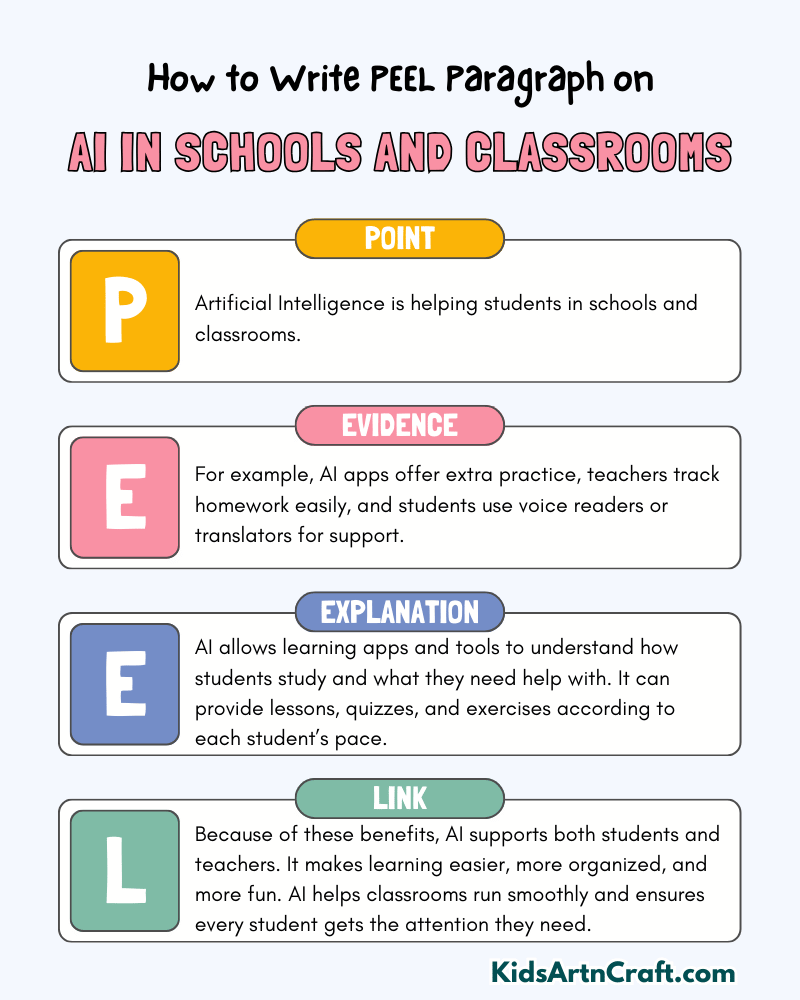
Point: Artificial Intelligence is helping students in schools and classrooms.
Evidence: For example, AI apps offer extra practice, teachers track homework easily, and students use voice readers or translators for support.
Explanation: AI allows learning apps and tools to understand how students study and what they need help with. It can provide lessons, quizzes, and exercises according to each student’s pace.
Link: Because of these benefits, AI supports both students and teachers. It makes learning easier, more organized, and more fun. AI helps classrooms run smoothly and ensures every student gets the attention they need.
2. AI in Schools and Classrooms Paragraph Writing with TEEL Method
TEEL Method (Topic, Evidence, Explanation, Link)
Topic: Artificial Intelligence is changing classrooms and schools for the better.
Evidence: For instance, students can use AI apps to practice math, reading, or science, while teachers use AI to plan lessons and manage homework. AI also helps students with learning difficulties through text-to-speech and translation tools.
Explanation: AI helps teachers and students by organizing lessons, tracking progress, and giving feedback instantly. It also personalizes learning for each child.
Link: As a result, classrooms become more interactive, supportive, and effective. AI improves learning for all students and helps teachers teach more efficiently.
3. AI in Schools and Classrooms Paragraph Writing with TEXAS Method
TEXAS Method (Topic, Example, Explanation, Analysis, Summary/Significance)
Topic: AI is a useful tool in modern classrooms.
Example: For example, AI apps suggest extra practice for weak areas and provide instant feedback. Teachers also use AI to check homework, track progress, and organize schedules.
Explanation: AI studies student learning patterns and adapts lessons accordingly.
Analysis: This saves time for teachers and helps students understand lessons better. AI also supports students with disabilities by reading texts aloud and translating languages.
Summary: In short, AI makes classrooms smarter, more organized, and enjoyable for both students and teachers.
4. AI in Schools and Classrooms Paragraph Writing with Hamburger Method
Hamburger Method (Top Bun, The Fillings, Bottom Bun)
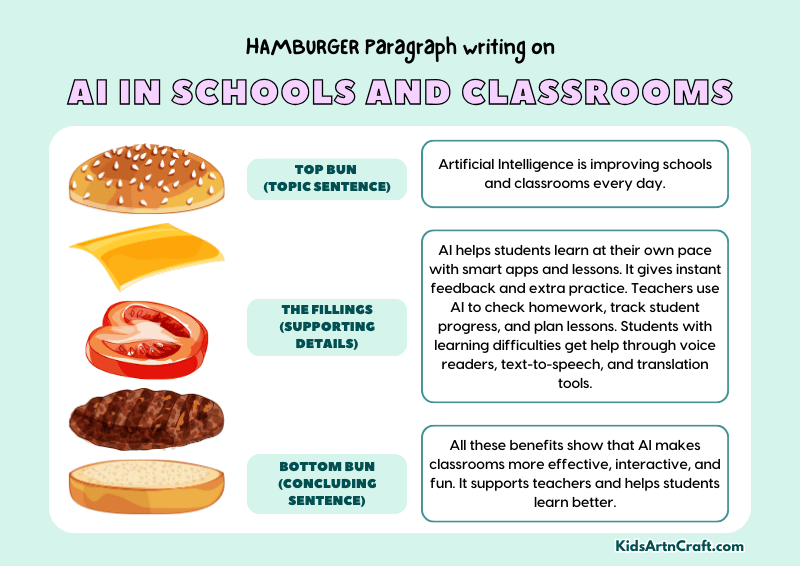
Top Bun (Topic Sentence):
Artificial Intelligence is improving schools and classrooms every day.
The Fillings (Supporting Details):
AI helps students learn at their own pace with smart apps and lessons. It gives instant feedback and extra practice. Teachers use AI to check homework, track student progress, and plan lessons. Students with learning difficulties get help through voice readers, text-to-speech, and translation tools.
Bottom Bun (Concluding Sentence):
All these benefits show that AI makes classrooms more effective, interactive, and fun. It supports teachers and helps students learn better.
Importance of AI in Schools and Classrooms
- Artificial Intelligence enables personalized learning by adapting lessons to each student’s pace and learning needs. [Source: Springer]
- AI helps teachers identify learning gaps early and provide timely support to students. [Source: International Journal of AI for Society]
Additional Facts of AI in Schools and Classrooms
- AI reduces teacher workload by automating tasks like grading and progress tracking. [Source: ERIC – U.S. Department of Education]
- AI supports inclusive education by adapting content for diverse learning needs. [Source: MDPI – Education Sciences]
- Experts emphasize ethical use of AI with strong teacher oversight in classrooms. [Source: MDPI – Education Sciences]
Hope you liked these paragraphs on ‘AI in Schools and Classrooms’. Don’t forget to join the Telegram group for FREE Printables.