

Paragraph Writing
Paragraph on Environment and Science


A Paragraph on Environment & Science explains how nature, technology, sustainability, ecology, and scientific advancements work together to protect our planet and support a healthier, smarter future. Let’s practice writing a paragraph on the topic “Environment and Science” in different styles — Expository, Persuasive, Descriptive, and Narrative. We’ll also learn how to organize our writing effectively using simple paragraph structures such as PEEL, TEEL, TEXAS, and the Hamburger Method.
Most of our paragraphs are in 150 to 200 words. You can also find longer paragraphs (in 300 words) on ‘Environment & Science’ or essays on the same topic on the web.
Read This Article in Other Languages
- पर्यावरण विज्ञान पर अनुच्छेद (Hindi / हिंदी)
- Párrafo sobre ciencia ambiental (Spanish / Español)
- Paragraphe sur les sciences de l’environnement (French / Français)
- Absatz über Umweltwissenschaft (German / Deutsch)
- فقرة عن علم البيئة (Arabic / العربية)
- পরিবেশ বিজ্ঞান সম্পর্কে অনুচ্ছেদ (Bengali / বাংলা)
- சுற்றுச்சூழல் அறிவியல் பற்றி பத்தி (Tamil / தமிழ்)
- పర్యావరణ శాస్త్రంపై పేరాగ్రాఫ్ (Telugu / తెలుగు)
- പരിസ്ഥിതിവിജ്ഞാനത്തെക്കുറിച്ചുള്ള പാരഗ്രാഫ് (Malayalam / മലയാളം)
- ماحولیاتی سائنس پر پیراگراف (Urdu / اردو)
- Parágrafo sobre ciência ambiental (Portuguese / Português)
Translation Disclaimer: These links use Google Translate, an automated translation service. Translations may vary in accuracy and are provided for convenience only.
Different Styles of Paragraphs on ‘Environment & Science’
1. Expository Paragraph on Environment & Science (Explains with Facts)
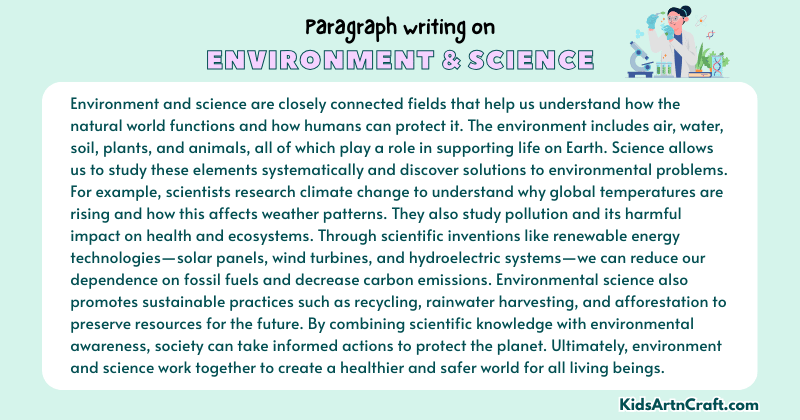
Environment and science are closely connected fields that help us understand how the natural world functions and how humans can protect it. The environment includes air, water, soil, plants, and animals, all of which play a role in supporting life on Earth. Science allows us to study these elements systematically and discover solutions to environmental problems. For example, scientists research climate change to understand why global temperatures are rising and how this affects weather patterns. They also study pollution and its harmful impact on health and ecosystems. Through scientific inventions like renewable energy technologies—solar panels, wind turbines, and hydroelectric systems—we can reduce our dependence on fossil fuels and decrease carbon emissions. Environmental science also promotes sustainable practices such as recycling, rainwater harvesting, and afforestation to preserve resources for the future. By combining scientific knowledge with environmental awareness, society can take informed actions to protect the planet. Ultimately, environment and science work together to create a healthier and safer world for all living beings.
2. Persuasive Paragraph on Environment & Science (Tries to Convince You)
We must take immediate action to protect our environment, and science gives us the tools to do so effectively. Every day, pollution increases, forests shrink, and climate change worsens, putting our future at risk. But scientific research clearly shows that we can reverse much of this damage if we act now. Scientists have proven that renewable energy reduces air pollution and slows global warming. They have shown that planting more trees improves air quality, controls soil erosion, and supports wildlife. If we ignore this knowledge, we will face extreme weather, water shortages, and loss of biodiversity. Therefore, it is our responsibility to follow scientific recommendations and adopt sustainable habits. We must reduce plastic use, conserve water and electricity, support eco-friendly technologies, and encourage others to do the same. Schools, communities, and governments must also invest in scientific innovations to make our lives greener and healthier. Protecting the environment is not a choice—it is a necessity. Science has already given us the answers; now we must follow them.
3. Descriptive Paragraph on Environment & Science (Paints a Picture with Words)
The environment is a beautiful blend of living and non-living elements, and science reveals the hidden wonders behind each of them. When we walk through a forest, the rustling leaves, fresh air, and sunlight filtering through tall trees create a calming scene. Science tells us that these trees release oxygen, store carbon, and support countless species of insects, birds, and animals. A flowing river not only looks peaceful but also acts as a lifeline for ecosystems. Through scientific study, we learn how rivers form, how water cycles through evaporation and rainfall, and how pollution can disturb this balance. Even the colorful flowers we admire have scientific secrets—pollination, photosynthesis, and biodiversity. The environment becomes even more fascinating when science explains how everything is interconnected. From the buzzing of bees to the blowing of the wind, every natural event has a scientific reason. This combination of beauty and knowledge makes the environment a wonderful classroom filled with endless discoveries.
4. Narrative Paragraph on Environment & Science (Tells a Story)
Last summer, I visited a nature science camp that completely changed the way I viewed the environment. On the first day, our guide took us to a quiet forest where we observed different plants and insects. He explained the science behind their survival, like how leaves make food through photosynthesis and how insects help pollinate flowers. Later, we tested river water using scientific tools to check its purity. I was amazed to see how even small amounts of pollution could affect aquatic life. One evening, we conducted an experiment using solar panels to power small LED lights, and it showed me how renewable energy can protect the environment. At night, we sat around a campfire and listened to stories of how climate change is affecting forests around the world. By the time the camp ended, I realized that science is not just a subject in school—it is a powerful way to understand and save our environment. That experience inspired me to adopt eco-friendly habits and encourage others to do the same.
‘Environment & Science‘ Paragraphs in Different Structured Methods
1. Environment & Science Paragraph Writing with PEEL Method
PEEL Method (Point, Evidence, Explanation, Link)
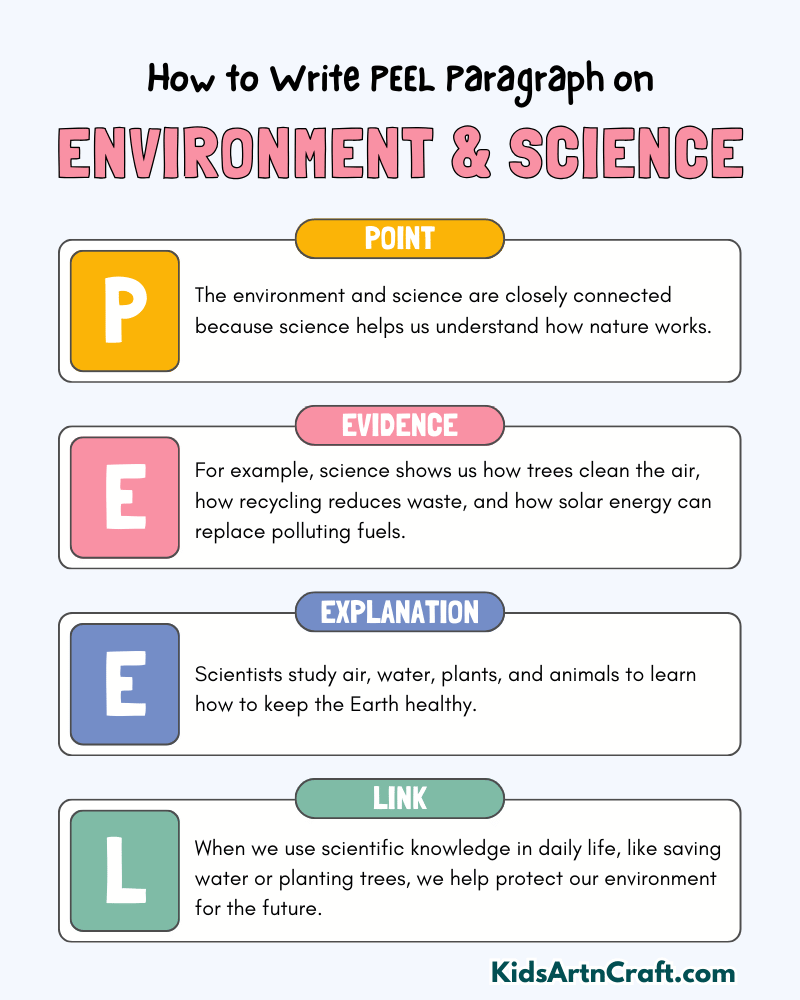
Point: The environment and science are closely connected because science helps us understand how nature works.
Evidence: For example, science shows us how trees clean the air, how recycling reduces waste, and how solar energy can replace polluting fuels.
Explanation: Scientists study air, water, plants, and animals to learn how to keep the Earth healthy.
Link: When we use scientific knowledge in daily life, like saving water or planting trees, we help protect our environment for the future.
2. Environment & Science Paragraph Writing with TEEL Method
TEEL Method (Topic, Evidence, Explanation, Link)
Topic: Environment and science work together to keep our planet safe.
Evidence: Research shows that renewable energy like solar and wind power reduces harmful gases, and recycling helps save natural resources.
Explanation: Science helps us understand problems like pollution and climate change.
Link: By following what science teaches us, kids can take small steps—such as using less plastic or caring for plants—to make the environment cleaner and greener.
3. Environment & Science Paragraph Writing with the TEXAS Method
TEXAS Method (Topic, Example, Explanation, Analysis, Summary/Significance)
Topic: Science helps us learn the best ways to protect the environment.
Example: For instance, scientists discovered that pollution harms plants and animals, so they encourage people to use eco-friendly methods.
Explanation: It explains how things in nature work, such as the water cycle, plant growth, and weather changes.
Analysis: This means that simple actions like recycling or saving electricity can make a big difference.
Summary: When kids use scientific ideas to care for nature, the environment becomes healthier for everyone.
4. Environment & Science Paragraph Writing with Hamburger Method
Hamburger Method (Top Bun, The Fillings, Bottom Bun)
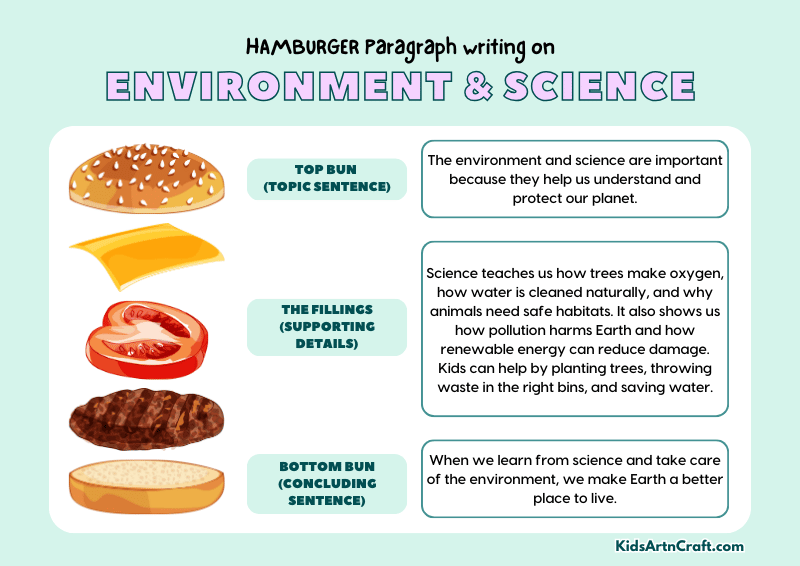
Top Bun (Topic Sentence):
The environment and science are important because they help us understand and protect our planet.
The Fillings (Supporting Details):
Science teaches us how trees make oxygen, how water is cleaned naturally, and why animals need safe habitats. It also shows us how pollution harms Earth and how renewable energy can reduce damage. Kids can help by planting trees, throwing waste in the right bins, and saving water.
Bottom Bun (Concluding Sentence):
When we learn from science and take care of the environment, we make Earth a better place to live.
Importance of Environmental Science
- Environmental science studies how humans interact with nature. [Source: Encyclopaedia Britannica]
- It combines biology, chemistry, geology, and social sciences to solve environmental problems. [Source: Encyclopaedia Britannica]
- Scientists track changes like pollution, climate shifts, and biodiversity loss to protect life. [Source: United Nations]
Additional Facts About Environmental Science
- Human activities raise greenhouse gases, causing global warming and climate change. [Source: NASA]
- It promotes solutions like renewable energy, conservation, and sustainable practices. [Source: United Nations]
- Healthy ecosystems provide clean air, water, food, and climate regulation. [Source: World Wildlife Fund]
Hope you liked these paragraphs on ‘Environment & Science’. Don’t forget to join the Telegram group for FREE Printables.
Check this article to write a paragraph on science.