

Paragraph Writing
Paragraph on Frog


A frog is a small amphibian with smooth, moist skin, strong legs for jumping, and the ability to live both in water and on land, eating insects and other small animals. Enhance your paragraph-writing skills by exploring ‘Frog’ in four styles—Expository, Persuasive, Descriptive, and Narrative—using structures like PEEL, TEEL, TEXAS, and the Hamburger Model.
Read This Article in Other Languages
- मेंढक पर अनुच्छेद (Hindi / हिंदी)
- Párrafo sobre la rana (Spanish / Español)
- Paragraphe sur la grenouille (French / Français)
- Absatz über den Frosch (German / Deutsch)
- فقرة عن الضفدع (Arabic / العربية)
- ব্যাঙ সম্পর্কে অনুচ্ছেদ (Bengali / বাংলা)
- எருவம் பற்றிய பத்தி (Tamil / தமிழ்)
- నాకు సంబంధించిన పేరాగ్రాఫ్ (Telugu / తెలుగు)
- തവളയെക്കുറിച്ചുള്ള പാരഗ്രാഫ് (Malayalam / മലയാളം)
- مینڈک پر پیراگراف (Urdu / اردو)
- Parágrafo sobre o sapo (Portuguese / Português)
Translation Disclaimer: These links use Google Translate, an automated translation service. Translations may vary in accuracy and are provided for convenience only.
Different Styles of Paragraphs on ‘Frog’
1. Expository Paragraph on Frog (Explains with Facts)
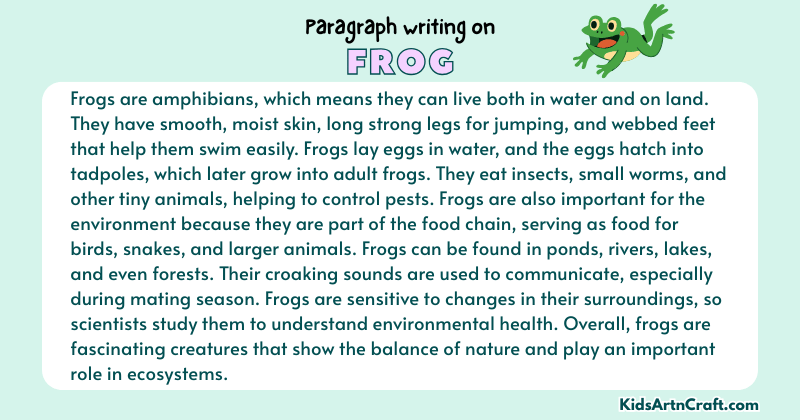
Frogs are amphibians, which means they can live both in water and on land. They have smooth, moist skin, long strong legs for jumping, and webbed feet that help them swim easily. Frogs lay eggs in water, and the eggs hatch into tadpoles, which later grow into adult frogs. They eat insects, small worms, and other tiny animals, helping to control pests. Frogs are also important for the environment because they are part of the food chain, serving as food for birds, snakes, and larger animals. Frogs can be found in ponds, rivers, lakes, and even forests. Their croaking sounds are used to communicate, especially during mating season. Frogs are sensitive to changes in their surroundings, so scientists study them to understand environmental health. Overall, frogs are fascinating creatures that show the balance of nature and play an important role in ecosystems.
2. Persuasive Paragraph on Frog (Tries to Convince You)
Frogs are amazing creatures that should be protected. Many people do not realize how important they are to the environment. Frogs eat insects like mosquitoes, keeping our surroundings safe from pests. They are also an important food source for birds, snakes, and other animals. Unfortunately, pollution, pesticides, and habitat destruction are reducing frog populations worldwide. Protecting ponds, lakes, and wetlands can help frogs survive. Schools can teach children about frogs and why they matter. People can plant small water gardens and avoid using harmful chemicals to create safe habitats for frogs. By protecting frogs, we help maintain the balance of nature and prevent problems like too many insects or loss of food for other animals. Frogs may be small, but their role in the environment is huge. Everyone can take steps to save frogs and enjoy watching these interesting creatures thrive.
3. Descriptive Paragraph on Frog (Paints a Picture with Words)
A frog is a small, green amphibian with smooth, moist skin and big, round eyes that shine in the sunlight. Its long, strong legs help it jump far distances, and webbed feet make swimming easy. Frogs can be green, brown, yellow, or even spotted, depending on their species. They live near ponds, rivers, and lakes, often hiding among grass and leaves. Frogs have soft croaking voices that fill the air, especially during the rainy season. Their tongue is long and sticky, perfect for catching insects. Tadpoles, the baby frogs, swim in water before growing legs and lungs to live on land. Watching frogs move, jump, and swim is fascinating because they are quick, agile, and very lively. Frogs are tiny but full of life and wonder.
4. Narrative Paragraph on Frog (Tells a Story)
One rainy morning, I went to a pond near my house and saw a green frog sitting on a lily pad. It looked at me with big, shiny eyes and then leaped gracefully into the water with a splash. I watched as it swam smoothly, using its webbed feet, and then climbed onto a rock to sun itself. Suddenly, a tiny tadpole swam past, and I remembered learning that frogs begin life in water before growing legs to jump on land. I saw the frog catch a small insect with its long, sticky tongue, and I was amazed at how fast it was. The croaking sound of other frogs echoed around the pond, making it feel alive. Watching the frog that day made me appreciate how amazing and important frogs are in nature. I left the pond feeling happy and inspired to protect their homes.
‘Frog’ Paragraphs in Different Structured Methods
1. Frog Paragraph Writing with PEEL Method
PEEL Method (Point, Evidence, Explanation, Link)
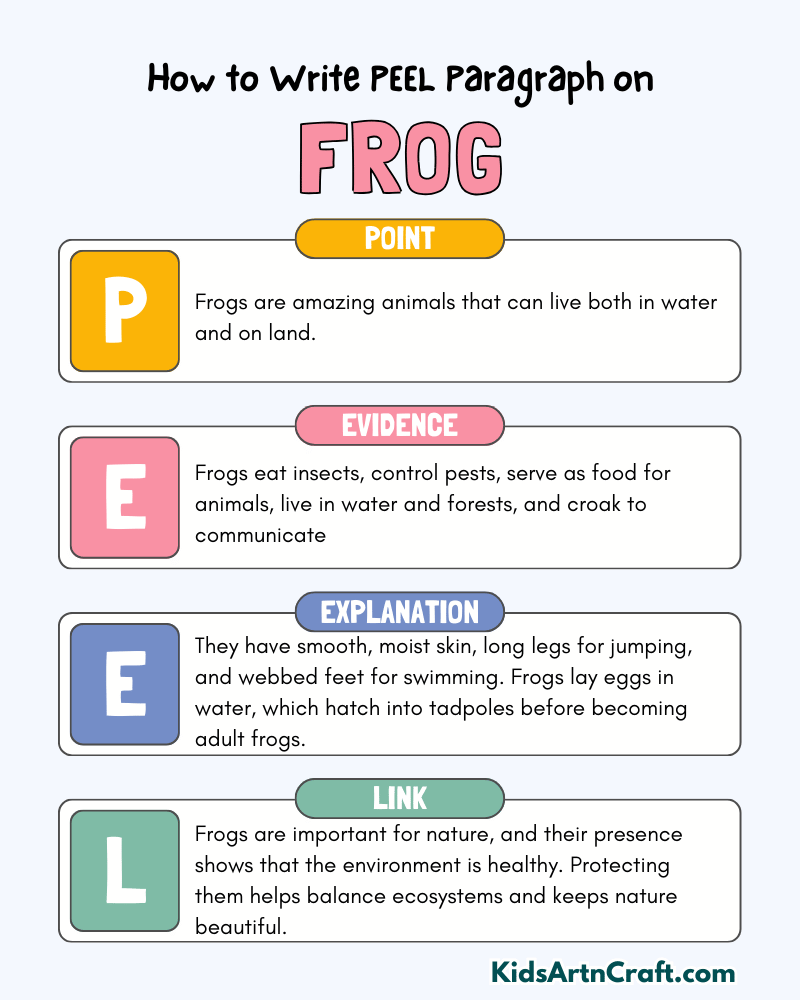
Point: Frogs are amazing animals that can live both in water and on land.
Evidence: Frogs eat insects, control pests, serve as food for animals, live in water and forests, and croak to communicate
Explanation: They have smooth, moist skin, long legs for jumping, and webbed feet for swimming. Frogs lay eggs in water, which hatch into tadpoles before becoming adult frogs.
Link: Frogs are important for nature, and their presence shows that the environment is healthy. Protecting them helps balance ecosystems and keeps nature beautiful.
2. Frog Paragraph Writing with TEEL Method
TEEL Method (Topic, Evidence, Explanation, Link)
Topic: Frogs are interesting amphibians that live in water and on land.
Evidence: Frogs lay eggs that hatch into tadpoles. They eat insects, which helps control pests, and they are food for many other animals. Frogs croak to communicate with other frogs.
Explanation: They have long legs, webbed feet, and smooth skin.
Link: These qualities make frogs important and fascinating animals that play a key role in nature.
3. Frog Paragraph Writing with TEXAS Method
TEXAS Method (Topic, Example, Explanation, Analysis, Summary/Significance)
Topic: Frogs are small but important animals.
Example: Frogs eat insects and help keep the environment clean. Tadpoles grow into adult frogs, and frogs serve as food for birds and snakes.
Explanation: They live in water and on land, and have long legs for jumping.
Analysis: Their role in nature helps plants and other animals survive.
Summary: Overall, frogs are fascinating amphibians that are very helpful in keeping nature balanced.
4. Frog Paragraph Writing with Hamburger Method
Hamburger Method (Top Bun, The Fillings, Bottom Bun)
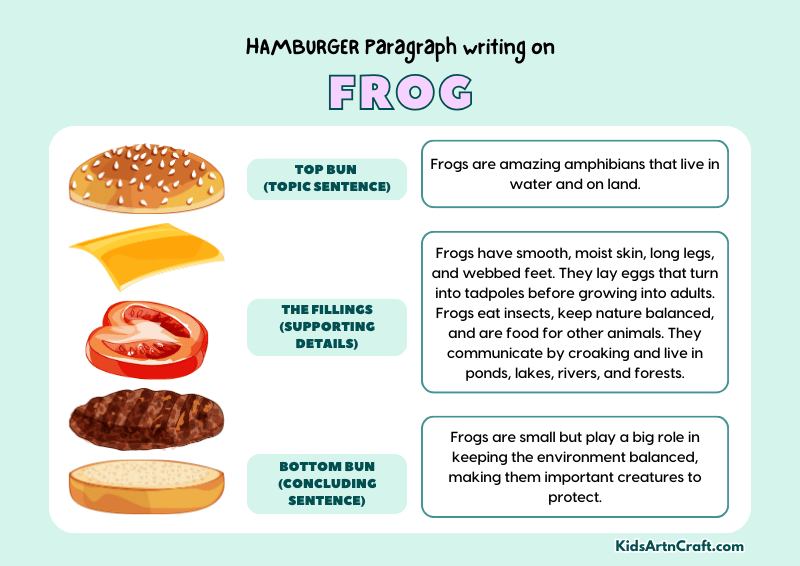
Top Bun (Topic Sentence):
Frogs are amazing amphibians that live in water and on land.
The Fillings (Supporting Details):
Frogs have smooth, moist skin, long legs, and webbed feet. They lay eggs that turn into tadpoles before growing into adults. Frogs eat insects, keep nature balanced, and are food for other animals. They communicate by croaking and live in ponds, lakes, rivers, and forests.
Bottom Bun (Concluding Sentence):
Frogs are small but play a big role in keeping the environment balanced, making them important creatures to protect.
Importance of Frogs
- Frogs control insect populations and help maintain healthy ecosystems. [Source: Environmental Literacy Council]
- They are an important part of the food web, serving as prey for birds, fish, snakes, and mammals. [Source: Institute for Environmental Research & Education]
Additional Facts About Frogs
- Frogs are bioindicators, showing scientists how pollution or habitat loss affects the environment. [Source: Environmental Literacy Council]
- Tadpoles help improve water quality by feeding on algae and balancing aquatic ecosystems. [Source: Environmental Literacy Council]
- Frogs contribute to nutrient cycling by returning nutrients to soil and water through feeding and decomposition. [Source: MAWEB.org]
- Many frog species are declining due to habitat loss, pollution, and climate change, highlighting the need for conservation. [Source: US Geological Survey]
Hope you liked these paragraphs on ‘Frog’. Don’t forget to join the Telegram group for FREE Printables.