





Paragraph Writing
Paragraph on Can Talent Be Learned?


Talent can be developed through practice, dedication, and learning. Even natural abilities improve with effort, discipline, and guidance, showing that hard work can create or enhance skills. Write stronger paragraphs by studying in four styles—Expository, Persuasive, Descriptive, and Narrative—using structures like PEEL, TEEL, TEXAS, and the Hamburger Model.
Read This Article in Other Languages
- क्या प्रतिभा सीखी जा सकती है (Hindi / हिंदी)
- ¿Se puede aprender el talento (Spanish / Español)
- Le talent peut-il s’apprendre (French / Français)
- Kann Talent erlernt werden (German / Deutsch)
- هل يمكن تعلم الموهبة (Arabic / العربية)
- প্রতিভা কি শেখা যায় (Bengali / বাংলা)
- प्रतिभை கற்க முடிகிறதா (Tamil / தமிழ்)
- తెలెంట్ను నేర్చుకోవచ్చా (Telugu / తెలుగు)
- प्रतिभ എങ്ങനെ പഠിക്കാമോ (Malayalam / മലയാളം)
- کیا ٹیلنٹ سیکھا جا سکتا ہے (Urdu / اردو)
- ¿O talento pode ser aprendido (Portuguese / Português)
Translation Disclaimer: These links use Google Translate, an automated translation service. Translations may vary in accuracy and are provided for convenience only.
Different Styles of Paragraphs on ‘Can Talent Be Learned?’
1. Expository Paragraph on Can Talent Be Learned? (Explains with Facts)
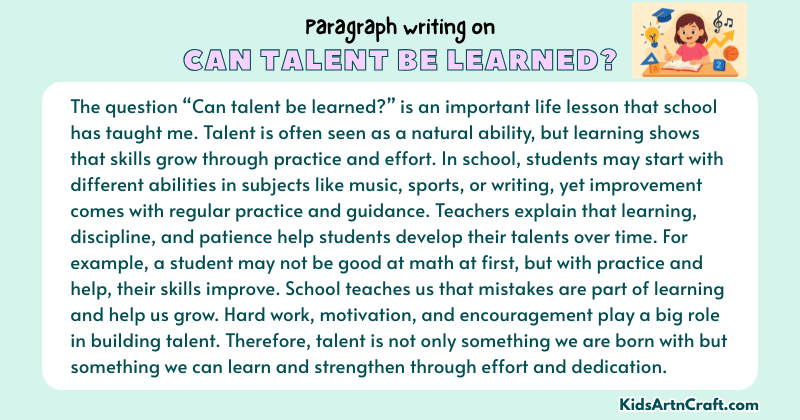
The question “Can talent be learned?” is an important life lesson that school has taught me. Talent is often seen as a natural ability, but learning shows that skills grow through practice and effort. In school, students may start with different abilities in subjects like music, sports, or writing, yet improvement comes with regular practice and guidance. Teachers explain that learning, discipline, and patience help students develop their talents over time. For example, a student may not be good at math at first, but with practice and help, their skills improve. School teaches us that mistakes are part of learning and help us grow. Hard work, motivation, and encouragement play a big role in building talent. Therefore, talent is not only something we are born with but something we can learn and strengthen through effort and dedication.
2. Persuasive Paragraph on Can Talent Be Learned? (Tries to Convince You)
Talent can be learned, and school teaches us this valuable lesson about life. Many people believe talent is natural, but learning shows that practice and effort matter more. In school, students who work hard often improve faster than those who rely only on natural ability. For example, a child who practices drawing every day can become skilled even without natural talent. Teachers encourage students to try, fail, and try again because effort leads to success. If talent were only natural, learning would not matter. School proves that anyone can improve with time, support, and determination. Believing talent can be learned helps students stay confident and motivated. It teaches us not to give up and to believe in growth. Therefore, talent is not fixed—it can be developed. This lesson helps students face challenges with courage and confidence.
3. Descriptive Paragraph on Can Talent Be Learned? (Paints a Picture with Words)
In a classroom full of students, talent grows quietly through learning. At first, some students struggle while others seem confident, but over time, change becomes visible. Hands that once shook while writing now move smoothly. Voices that were shy in class become clear and strong. Through practice, patience, and guidance, skills slowly develop. School shows that talent is not sudden magic but a journey of effort and improvement. Mistakes become stepping stones, and practice becomes a path to success. Teachers encourage students, creating an environment where growth feels possible. Watching this progress makes it clear that talent is shaped by learning. The classroom becomes a place where effort shines brighter than natural ability. School teaches us that talent can be built, improved, and discovered through dedication and belief in oneself.
4. Narrative Paragraph on Can Talent Be Learned? (Tells a Story)
I once believed that talent was something you were born with. In school, I struggled with public speaking and thought I would never be good at it. My teacher encouraged me to practice and not give up. At first, I made mistakes and felt nervous, but I kept trying. Slowly, I improved. One day, I spoke confidently in front of the class, and I felt proud. That moment taught me an important lesson: talent can be learned. School showed me that effort and practice matter more than natural ability. This experience changed how I see challenges. Now, I believe that with hard work and patience, anyone can develop their skills. School taught me that talent grows through learning and belief.
‘Can Talent Be Learned?’ Paragraphs in Different Structured Methods
1. Can Talent Be Learned? Paragraph Writing with PEEL Method
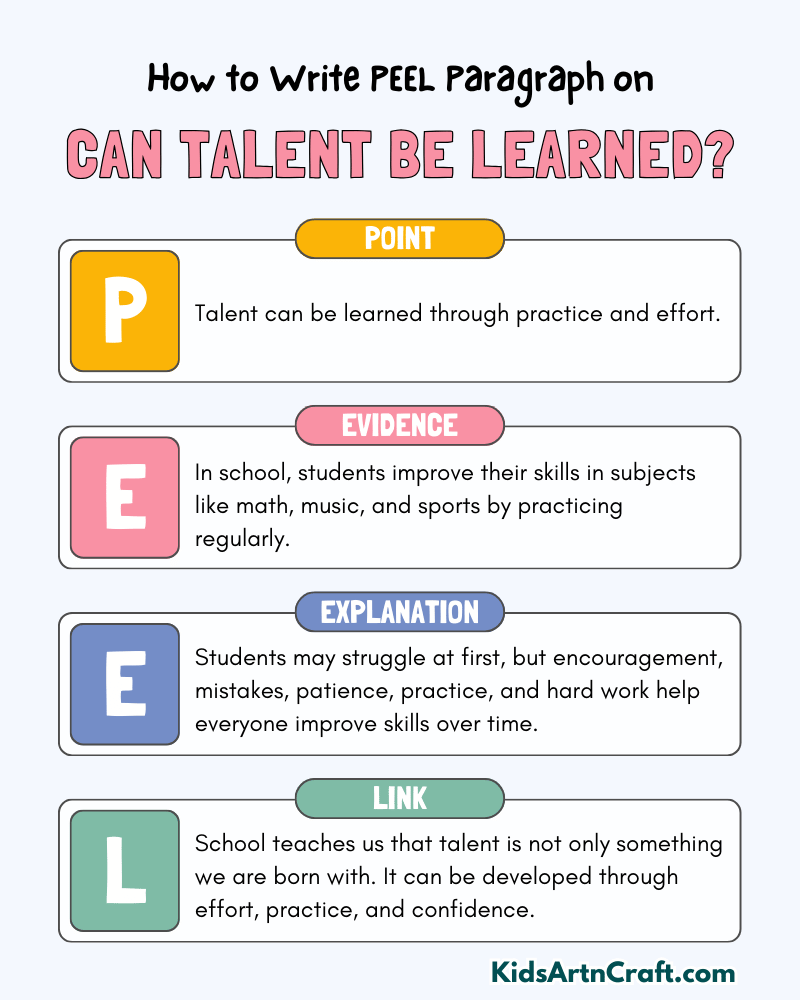
PEEL Method (Point, Evidence, Explanation, Link)
Point: Talent can be learned through practice and effort.
Evidence: In school, students improve their skills in subjects like math, music, and sports by practicing regularly.
Explanation: Students may struggle at first, but encouragement, mistakes, patience, practice, and hard work help everyone improve skills over time.
Link: School teaches us that talent is not only something we are born with. It can be developed through effort, practice, and confidence.
2. Can Talent Be Learned? Paragraph Writing with TEEL Method
TEEL Method (Topic, Evidence, Explanation, Link)
Topic: Talent is not fixed and can be learned with effort and practice.
Evidence: For example, a student who practices reading or drawing every day becomes better.
Explanation: School shows that learning helps students improve their abilities over time.
Link: This teaches us that effort is more important than natural ability. Talent grows when students believe in learning and never give up.
3. Can Talent Be Learned? Paragraph Writing with TEXAS Method
TEXAS Method (Topic, Example, Explanation, Analysis, Summary/Significance)
Topic: Talent can be learned through dedication and learning.
Example: A child who practices singing regularly can improve their voice.
Explain: Skills develop when students practice and receive guidance.
Analysis: Practice builds confidence and skill, showing that learning shapes talent.
Summary: School teaches us that talent is not natural only. It can be developed with effort and patience.
4. Can Talent Be Learned? Paragraph Writing with Hamburger Method
Hamburger Method (Top Bun, The Fillings, Bottom Bun)
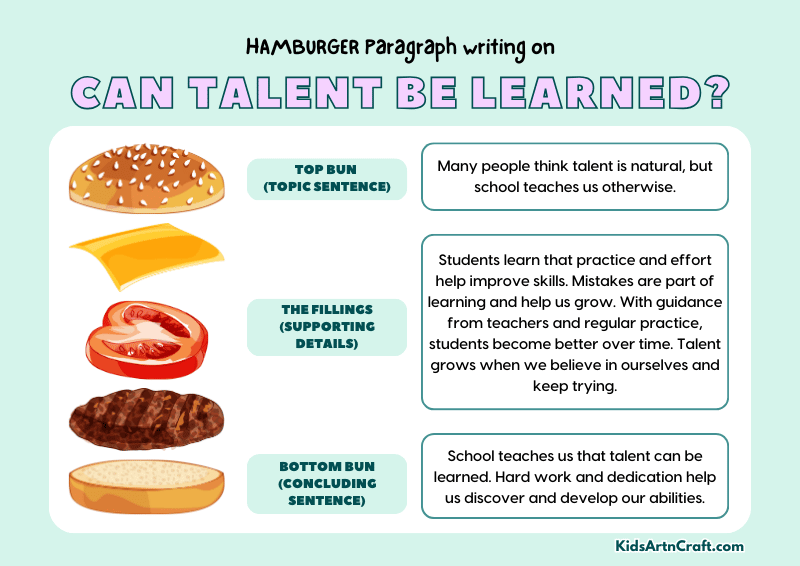
Top Bun (Topic Sentence):
Many people think talent is natural, but school teaches us otherwise.
The Fillings (Supporting Details):
Students learn that practice and effort help improve skills. Mistakes are part of learning and help us grow. With guidance from teachers and regular practice, students become better over time. Talent grows when we believe in ourselves and keep trying.
Bottom Bun (Concluding Sentence):
School teaches us that talent can be learned. Hard work and dedication help us discover and develop our abilities.
Importance of Talent and Learning
- Talent can be developed through focused practice and effort over time. [Source: Wikipedia – Deliberate Practice & Expertise]
- Innate talent is limited; most skills can be learned with the right training. [Source: Scientific American – Talent Myths]
- A growth mindset and persistence help people improve and master skills. [Source: APA – Growth Mindset]
Additional Facts About Talent
- Practice strengthens brain pathways, improving performance over time. [Source: Wikipedia – Deliberate Practice & Learning]
- Motivation, support, and goal-setting are key to developing talent. [Source: Wikipedia – Talent Development Research]
- Skill mastery combines practice with personal traits like memory and cognition. [Source: Wikipedia – Talent vs Practice Research]
Hope you liked these paragraphs on ‘Can Talent Be Learned?’. Don’t forget to join the Telegram group for FREE Printables.