

Paragraph Writing
Paragraph on Parts of a Plant


A plant has different parts, each with a special job. Roots take in water and nutrients, the stem supports the plant, leaves make food, flowers help in reproduction, and fruits hold seeds. Enhance your paragraph-writing skills by examining four styles—Expository, Persuasive, Descriptive, and Narrative—while structuring your ideas effectively using PEEL, TEEL, TEXAS, and the Hamburger Model.
Read This Article in Other Languages
- पौधे के भागों पर अनुच्छेद (Hindi / हिंदी)
- Párrafo sobre las partes de la planta (Spanish / Español)
- Paragraphe sur les parties de la plante (French / Français)
- Absatz über die Teile der Pflanze (German / Deutsch)
- فقرة عن أجزاء النبات (Arabic / العربية)
- উদ্ভিদের অংশসমূহ সম্পর্কে অনুচ্ছেদ (Bengali / বাংলা)
- மரத்தின் பகுதிகள் பற்றிய பத்தி (Tamil / தமிழ்)
- మొక్క యొక్క భాగాలపై పేరా (Telugu / తెలుగు)
- സസ്യങ്ങളുടെ ഭാഗങ്ങളെക്കുറിച്ചുള്ള പാരഗ്രാഫ് (Malayalam / മലയാളം)
- پودوں کے حصوں پر پیراگراف (Urdu / اردو)
- Parágrafo sobre as partes da planta (Portuguese / Português)
Translation Disclaimer: These links use Google Translate, an automated translation service. Translations may vary in accuracy and are provided for convenience only.
Different Styles of Paragraphs on ‘Parts of a Plant’
1. Expository Paragraph on Parts of a Plant (Explains with Facts)
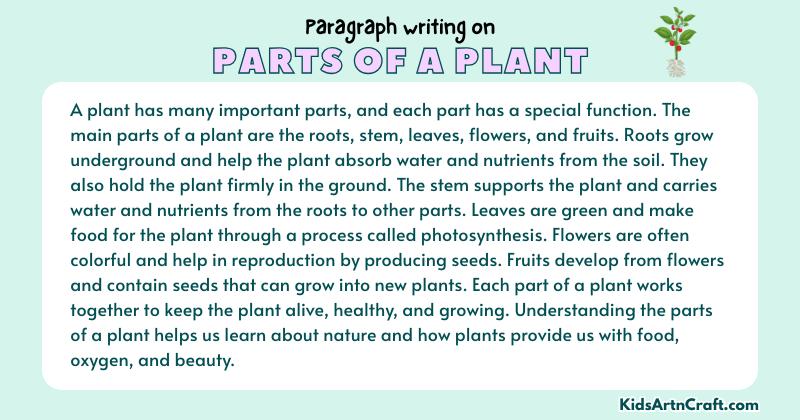
A plant has many important parts, and each part has a special function. The main parts of a plant are the roots, stem, leaves, flowers, and fruits. Roots grow underground and help the plant absorb water and nutrients from the soil. They also hold the plant firmly in the ground. The stem supports the plant and carries water and nutrients from the roots to other parts. Leaves are green and make food for the plant through a process called photosynthesis. Flowers are often colorful and help in reproduction by producing seeds. Fruits develop from flowers and contain seeds that can grow into new plants. Each part of a plant works together to keep the plant alive, healthy, and growing. Understanding the parts of a plant helps us learn about nature and how plants provide us with food, oxygen, and beauty.
2. Persuasive Paragraph on Parts of a Plant (Tries to Convince You)
Knowing the parts of a plant is very important, and everyone should learn about them. Roots, stems, leaves, flowers, and fruits all have special roles that help the plant survive. Roots absorb water and nutrients, stems carry them to other parts, and leaves make food through sunlight. Flowers help the plant produce seeds, and fruits contain seeds for new plants. By understanding these parts, children can grow plants successfully at home or in gardens. Learning about plant parts also teaches us to care for nature and protect our environment. Schools should encourage gardening and nature lessons to show students how plants grow. Everyone should plant more trees and flowers to make the world green, healthy, and beautiful. Caring for plants starts with knowing their parts and how they work.
3. Descriptive Paragraph on Parts of a Plant (Paints a Picture with Words)
A plant has many interesting parts that help it grow. The roots are thick and strong, spreading underground to absorb water and nutrients. The stem is tall or short, smooth or rough, and supports the plant while carrying food and water. The leaves are green, soft, or sometimes shiny, and they make food using sunlight. Flowers bloom in bright colors such as red, yellow, pink, or white, attracting bees and butterflies. Fruits hang from branches, round or oval, with seeds inside, ready to grow into new plants. Each part of the plant has a special look and purpose. When you look closely, you can see tiny veins in the leaves and delicate petals on the flowers. Plants are not just green; they are full of life, color, and function. Every part works together to make the plant strong and beautiful.
4. Narrative Paragraph on Parts of a Plant (Tells a Story)
Last week, I planted a small sunflower seed in my garden. I noticed its tiny roots growing underground, holding the seed firmly in the soil. A thin green stem soon sprouted above the ground, reaching for sunlight. Tiny leaves appeared, and I learned that they would make food for the plant. After some weeks, a small bud appeared at the top of the stem, which slowly opened into a bright yellow flower. I also observed how the flower could turn into a fruit containing seeds for new plants. Watching each part of the sunflower grow taught me how roots, stems, leaves, flowers, and fruits all work together to keep the plant alive. I realized that every part has a role, and plants are amazing living things. Caring for the sunflower made me happy and taught me the importance of understanding and protecting plants.
‘Parts of a Plant’ Paragraphs in Different Structured Methods
1. Parts of a Plant Paragraph Writing with PEEL Method
PEEL Method (Point, Evidence, Explanation, Link)
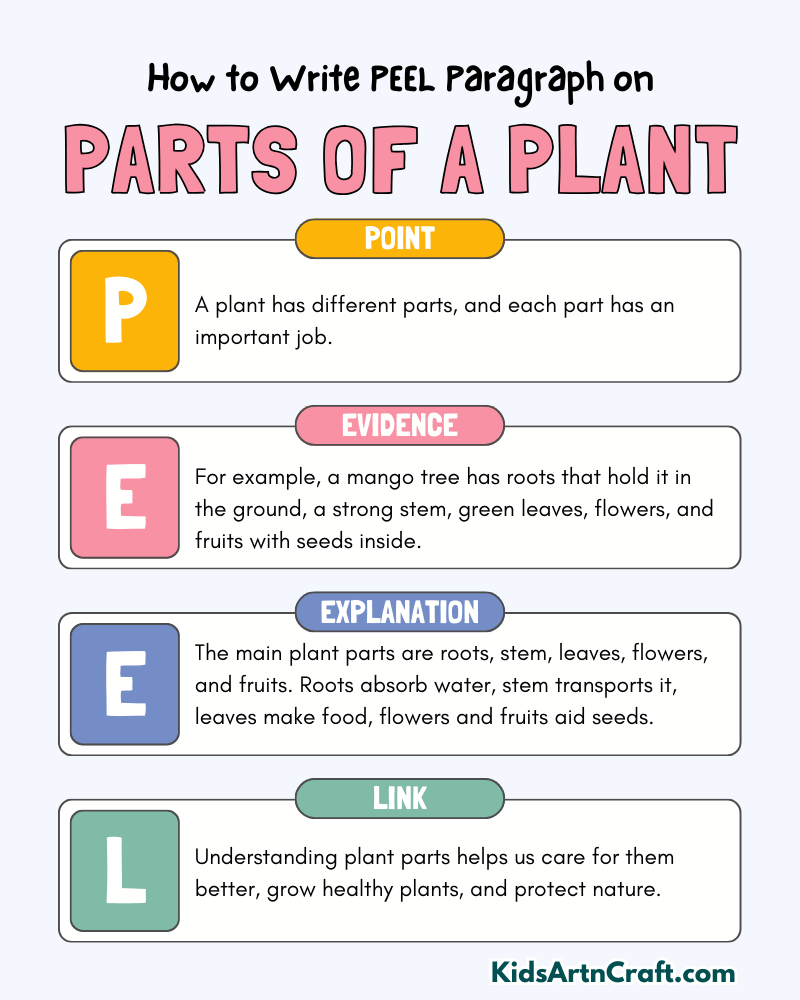
Point: A plant has different parts, and each part has an important job.
Evidence: For example, a mango tree has roots that hold it in the ground, a strong stem, green leaves, flowers, and fruits with seeds inside.
Explanation: The main plant parts are roots, stem, leaves, flowers, and fruits. Roots absorb water, stem transports it, leaves make food, flowers and fruits aid seeds.
Link: Understanding plant parts helps us care for them better, grow healthy plants, and protect nature.
2. Parts of a Plant Paragraph Writing with TEEL Method
TEEL Method (Topic, Evidence, Explanation, Link)
Topic: Plants have many important parts that help them grow.
Evidence: Roots absorb water, stems carry nutrients, leaves make food, flowers make seeds, and fruits protect seeds.
Explanation: Roots, stems, leaves, flowers, and fruits all have special roles.
Link: By learning about plant parts, we can grow our own plants, enjoy fresh fruits and vegetables, and care for the environment.
3. Parts of a Plant Paragraph Writing with TEXAS Method
TEXAS Method (Topic, Example, Explanation, Analysis, Summary/Significance)
Topic: Plants have different parts with special jobs.
Example: Flowers help make seeds, and fruits contain seeds to grow new plants.
Explanation: Roots take water, stems carry it, and leaves make food.
Analysis: Each part works together to help the plant survive and grow.
Summary: Plants are amazing, and knowing their parts helps us care for them and enjoy their benefits.
4. Parts of a Plant Paragraph Writing with Hamburger Method
Hamburger Method (Top Bun, The Fillings, Bottom Bun)
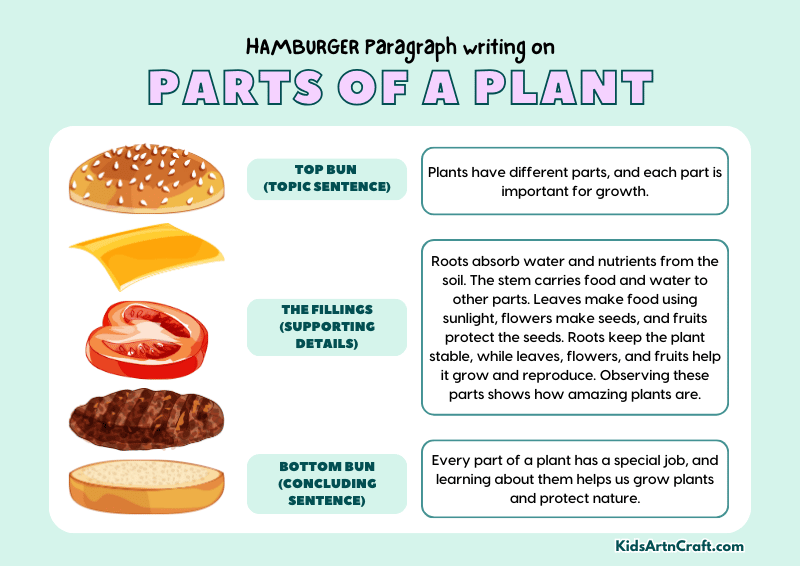
Top Bun (Topic Sentence):
Plants have different parts, and each part is important for growth.
The Fillings (Supporting Details):
Roots absorb water and nutrients from the soil. The stem carries food and water to other parts. Leaves make food using sunlight, flowers make seeds, and fruits protect the seeds. Roots keep the plant stable, while leaves, flowers, and fruits help it grow and reproduce. Observing these parts shows how amazing plants are.
Bottom Bun (Concluding Sentence):
Every part of a plant has a special job, and learning about them helps us grow plants and protect nature.
Importance of Plant Parts
- Plant parts help plants grow, survive, and reproduce. [Source: National Geographic Kids]
- Roots, stems, leaves, flowers, fruits, and seeds each play a unique role in a plant’s life. [Source: Food and Agriculture Organization (FAO)]
Additional Facts About Plant Parts
- Roots absorb water and nutrients while anchoring the plant. [Source: National Geographic Kids]
- Leaves produce food and oxygen through photosynthesis. [Source: National Geographic]
- Flowers and fruits help in reproduction and seed dispersal. [Source: Britannica]
- Stems transport water and nutrients between roots and leaves, supporting plant growth. [Source: FAO]
Hope you liked these paragraphs on ‘Parts of a Plant’. Don’t forget to join the Telegram group for FREE Printables.