





Paragraph Writing
Paragraph on Should Robots Replace Human Workers


Robots can help humans by doing dangerous or repetitive tasks, but they should not completely replace workers. Human skills, creativity, and decision-making are important and cannot be fully replaced by machines. Strengthen your ability to write paragraphs on ‘Should robots replace human workers’ in four styles—Expository, Persuasive, Descriptive, and Narrative—while structuring your ideas using PEEL, TEEL, TEXAS, and the Hamburger Model.
Read This Article in Other Languages
- रोबोट इंसानी श्रमिकों की जगह क्यों ले रहे हैं पर अनुच्छेद (Hindi / हिंदी)
- Párrafo sobre por qué los robots reemplazan a los trabajadores humanos (Spanish / Español)
- Paragraphe sur pourquoi les robots remplacent les travailleurs humains (French / Français)
- Absatz darüber, warum Roboter menschliche Arbeiter ersetzen (German / Deutsch)
- فقرة عن سبب استبدال الروبوتات للعمال البشر (Arabic / العربية)
- রোবট কেন মানব কর্মীদের পরিবর্তে ব্যবহার হচ্ছে – অনুচ্ছেদ (Bengali / বাংলা)
- ரோபோட் மனித ஊழியர்களை ஏன் மாற்றுகின்றன என்ற பத்தி (Tamil / தமிழ்)
- రోబోట్లు ఎందుకు మానవ కార్మికులను ప్రతిస్థాపిస్తున్నాయ్ గురించి పేరా (Telugu / తెలుగు)
- റോബോട്ടുകൾ മനുഷ്യ തൊഴിലാളികളെ 왜 മാറ്റുന്നു – പാരഗ്രാഫ് (Malayalam / മലയാളം)
- روبوٹس انسان مزدوروں کی جگہ کیوں لے رہے ہیں پر پیراگراف (Urdu / اردو)
- Parágrafo sobre por que os robôs substituem os trabalhadores humanos (Portuguese / Português)
Translation Disclaimer: These links use Google Translate, an automated translation service. Translations may vary in accuracy and are provided for convenience only.
Different Styles of Paragraphs on ‘Should Robots Replace Human Workers’
1. Expository Paragraph on Should Robots Replace Human Workers (Explains with Facts)
The debate over whether robots should replace human workers is becoming more relevant as technology grows. Robots can complete tasks quickly, accurately, and consistently, especially in fields like manufacturing and heavy work. They do not get tired, make fewer errors, and can operate in dangerous places where humans may be at risk. This makes them useful for increasing productivity and reducing workplace accidents. However, fully replacing humans can cause major economic and social issues. Many people depend on jobs for their livelihood, and losing them can lead to unemployment and financial stress. Humans also offer creativity, empathy, and complex problem-solving that robots cannot match. A better approach is to let robots handle repetitive or risky tasks while humans focus on jobs requiring emotional understanding and innovative thinking. Technology should support people and create new opportunities through training and skill development.
2. Persuasive Paragraph on Should Robots Replace Human Workers (Tries to Convince You)
Robots should not replace human workers, and it is important to understand why. While robots can work faster and perform repetitive tasks without getting tired, they lack the creativity and emotional understanding that people bring to the workplace. Every community depends on jobs for stability, and allowing robots to take over human roles would put millions of families at risk. Humans are adaptable; they can learn, communicate, and solve unexpected problems in ways machines cannot. Replacing them entirely would weaken the social and economic structure of society. Instead of removing workers, we should use robots to support them by taking over dangerous or physically exhausting tasks. This partnership can make workplaces safer while still allowing people to keep their jobs and develop new skills. Governments and companies should invest in training programs that help workers use advanced technology rather than fear it. The goal should not be a future where humans are unnecessary, but one where technology and people work together for progress. Therefore, robots should assist—not replace—human workers.
3. Descriptive Paragraph on Should Robots Replace Human Workers (Paints a Picture with Words)
Imagine a workplace where machines hum softly as robotic arms move with perfect precision, lifting heavy boxes, sorting items, and assembling parts without a single pause. The lights reflect on their smooth metal surfaces, and each movement follows a programmed rhythm. In this futuristic scene, human workers stand nearby, guiding the robots or checking screens that display data. Some people imagine this environment becoming completely robot-run, with no humans present, only the glow of computers and the silent flow of automated work. But the atmosphere would feel empty without human laughter, interaction, and creativity. While robots bring efficiency and flawless repetition, humans bring warmth, intuition, and the ability to adjust when something unexpected happens. A workplace filled only with machines may look neat and organized, yet it lacks the human touch that makes work meaningful. The blend of both—robots handling repetitive tasks and humans leading with thought and emotion—creates a more balanced and lively picture of the future of work.
4. Narrative Paragraph on Should Robots Replace Human Workers (Tells a Story)
Riya walked into the factory for her first day after the new robots were installed. She had imagined rows of machines replacing people, but what she saw surprised her. The robots moved smoothly, assembling products with incredible speed, but the workers were still there, supervising and giving instructions. Riya joined her team, and her supervisor explained how the robots had taken over the most dangerous tasks, making the workplace safer for everyone. As she watched the machines work, she realized they were not her competitors but her tools. One robot suddenly paused, confused by an unexpected object on the belt. Riya stepped forward, cleared the item, and adjusted the settings. The machine resumed its task instantly. “They still need us,” her supervisor smiled. Riya felt relieved. She understood that robots were not there to replace humans but to support them. By the end of the day, she felt proud knowing that teamwork—between people and machines—could create a better and safer workplace for all.
‘Should Robots Replace Human Workers’ Paragraphs in Different Structured Methods
1. Should Robots Replace Human Workers Paragraph Writing with PEEL Method
PEEL Method (Point, Evidence, Explanation, Link)
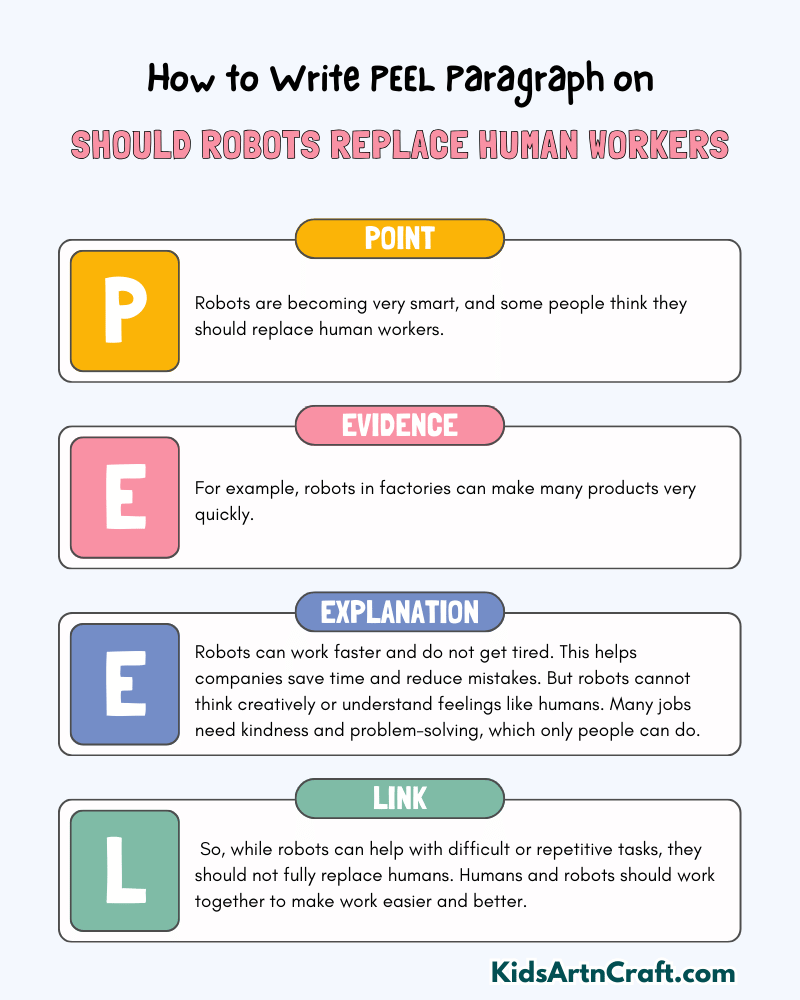
Point: Robots are becoming very smart, and some people think they should replace human workers.
Evidence: For example, robots in factories can make many products very quickly.
Explanation: Robots can work faster and do not get tired. This helps companies save time and reduce mistakes. But robots cannot think creatively or understand feelings like humans. Many jobs need kindness and problem-solving, which only people can do.
Link: So, while robots can help with difficult or repetitive tasks, they should not fully replace humans. Humans and robots should work together to make work easier and better.
2. Should Robots Replace Human Workers Paragraph Writing with TEEL Method
TEEL Method (Topic, Evidence, Explanation, Link)
Topic: Robots are useful, but they should not replace human workers completely.
Evidence: For example, in some factories, robots help pack products quickly.
Explanation: Robots are good at jobs that involve heavy lifting or repeating the same action many times. They make work faster and safer.
Link: However, many jobs need human ideas, emotions, and communication. Robots cannot understand people’s feelings or solve problems creatively. That is why humans are still important. Linking Sentence: So, robots should support human workers, not take their place.
3. Should Robots Replace Human Workers Paragraph Writing with the TEXAS Method
TEXAS Method (Topic, Example, Explanation, Analysis, Summary/Significance)
Topic Sentence: Robots are becoming common, but they should not replace human workers.
Example: For example, robots can help in hospitals by carrying supplies or cleaning rooms.
Explanation: Robots can do difficult or boring tasks more easily than people.
Analysis: Even with these benefits, robots cannot think with emotions or make important decisions. Many jobs need human care, creativity, and problem-solving.
Summary: So, robots should be helpers, not replacements for human workers.
4. Should Robots Replace Human Workers Paragraph Writing with Hamburger Method
Hamburger Method (Top Bun, The Fillings, Bottom Bun)
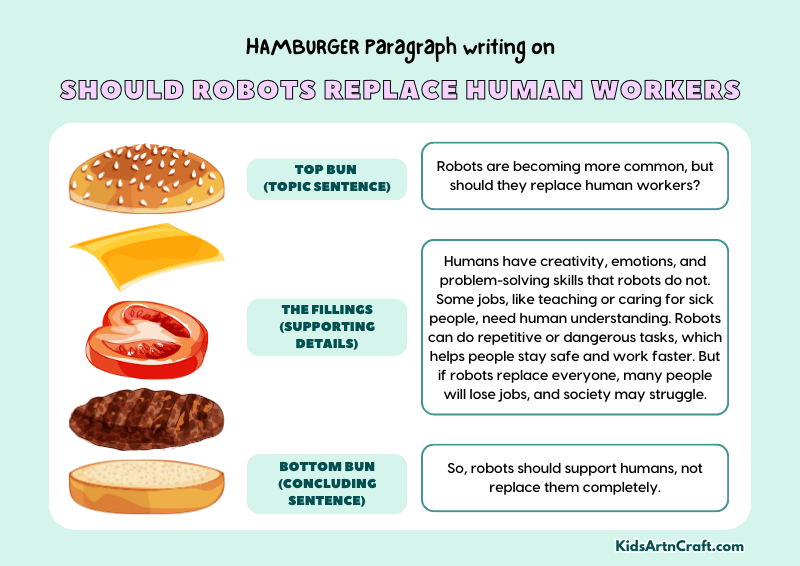
Top Bun (Topic Sentence):
Robots are becoming more common, but should they replace human workers?
The Fillings (Supporting Details):
Humans have creativity, emotions, and problem-solving skills that robots do not. Some jobs, like teaching or caring for sick people, need human understanding. Robots can do repetitive or dangerous tasks, which helps people stay safe and work faster. But if robots replace everyone, many people will lose jobs, and society may struggle.
Bottom Bun (Concluding Sentence):
So, robots should support humans, not replace them completely.
Importance of Robots in Work
- Robots can do repetitive and heavy tasks that are hard for humans. [Source: MIT News]
- Some human jobs, especially routine ones, may be replaced by robots. [Source: Web Asha Technologies]
Additional Facts About Robots and Jobs
- Jobs that need creativity or human interaction are less likely to be replaced. [Source: MDPI Research]
- Robots also create new jobs in programming, maintenance, and supervision. [Source: IJonEST Research]
- Humans and robots can work together to do tasks more efficiently. [Source: IJonEST Research]
- Automation affects jobs differently depending on the industry and skill level. [Source: Eurasian Business Review]
Hope you liked these paragraphs on ‘Should Robots Replace Human Workers’. Don’t forget to join the Telegram group for FREE Printables.
Check this article to learn how To Make Paper Robotic Hand for kids.