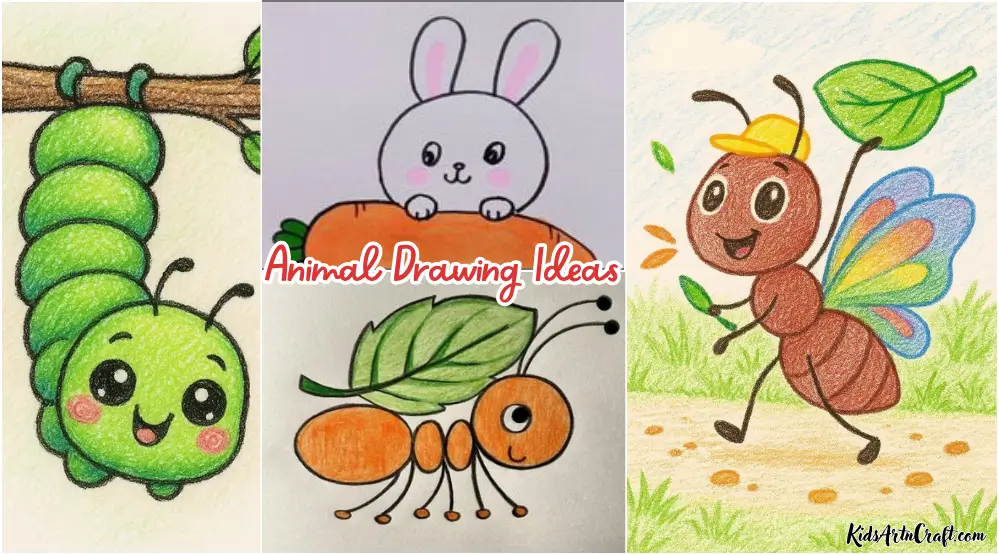
Animals are among the most popular subjects for children’s drawing. From cute pets and farm animals to wild animals, birds, reptiles, sea creatures, and imaginary animals, there are endless possibilities for creative animal drawing.
Children can begin with simple shapes and outlines, then gradually add eyes, ears, legs, tails, fur patterns, feathers, scales, horns, wings, and other details. Whether your child is a beginner, preschooler, student, or an enthusiastic young artist, animal drawing is a fun way to practice observation, creativity, line control, and coloring skills.
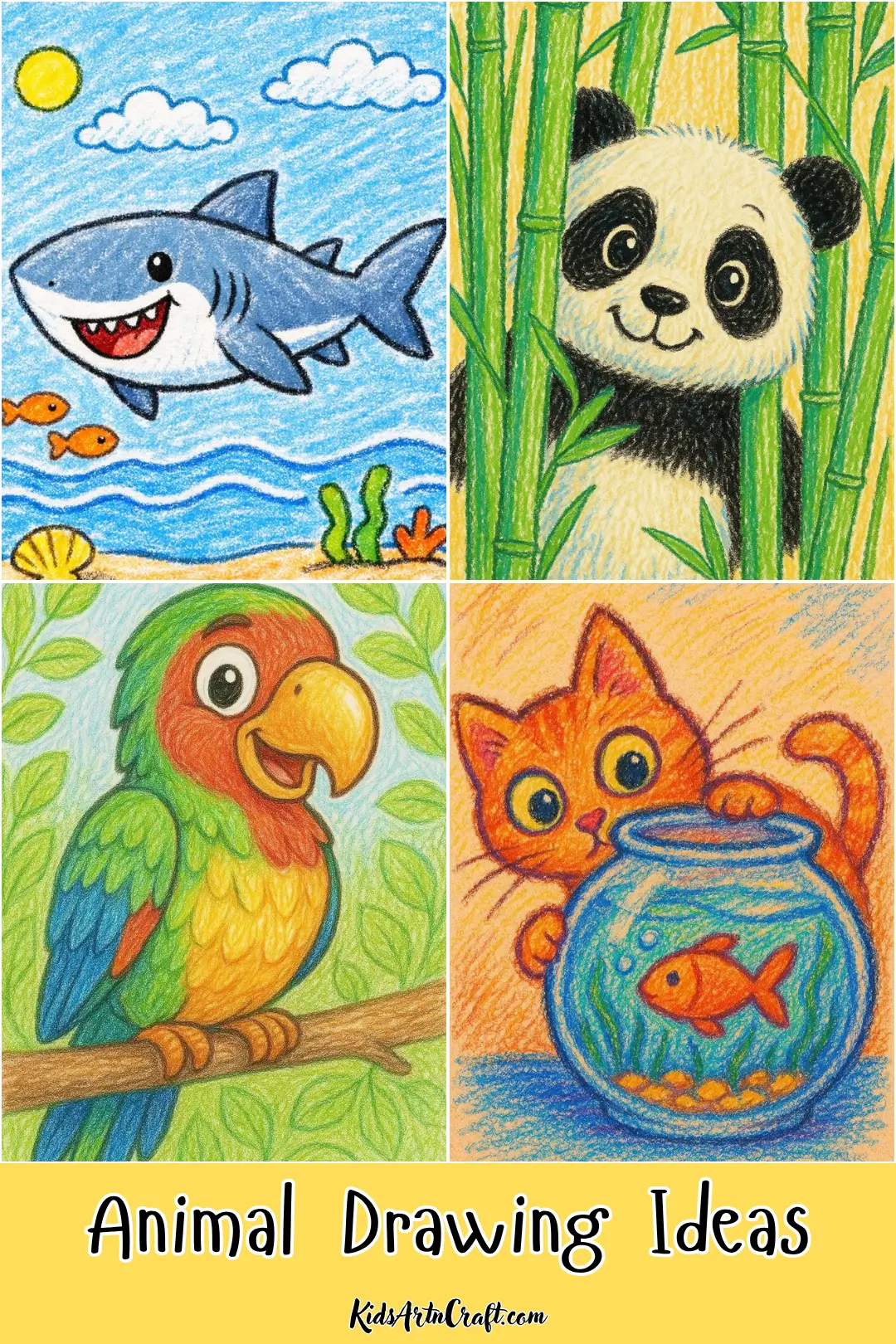
Fun and colorful animal drawing ideas for kids featuring a playful shark, panda, parrot, and cat.
Animal Drawing Ideas by Type
🐶 Farm and Domestic Animal Drawings
- Dog: Dog Drawing Sketches for Kids — Simple dog sketch ideas for young artists.
- Cow: Cow Drawing Sketches for Kids — Fun cow drawing references for kids.
- Goat: Goat Drawing Sketches for Kids — Easy goat sketches to practice animal shapes.
- Sheep: Sheep Drawing Sketches for Kids — Cute sheep drawing ideas for children.
- Pig: Pig Drawing Sketches for Kids — Beginner-friendly pig drawing inspiration.
- Ox: Ox Drawing Sketches for Kids — Practice drawing a strong farm animal with simple lines.
- Buffalo: Buffalo Drawing Sketches for Kids — Buffalo sketch references for animal drawing practice.
For more farm-themed inspiration, explore Farm Animal Drawings for a collection of animals children can draw together.
🦁 Wild Animal Drawings
- Lion: Lion Drawing Sketches for Kids — Create a simple lion with a recognizable mane.
- Tiger: Tiger Drawing Sketches for Kids — Practice tiger shapes and bold stripe patterns.
- Elephant: Elephant Drawing Sketches for Kids — Easy elephant drawing references for kids.
- Hippo: Hippo Drawing Sketches for Kids — Explore the large body and short legs of a hippo.
- Monkey: Monkey Drawing Sketches for Kids — Fun monkey sketches with expressive poses.
- Zebra: Zebra Drawing Sketches for Kids — Draw a zebra and experiment with its stripes.
- Cheetah: Cheetah Drawing Sketches for Kids — Introduce children to spotted big-cat drawings.
- Antelope: Antelope Drawing Sketches for Kids — Practice graceful body proportions and horns.
- Deer: Deer Drawing Sketches for Kids — Easy deer sketches for nature-themed artwork.
- Moose: Moose Drawing Sketches for Kids — Explore the distinctive antlers and body shape.
- Wolf: Wolf Drawing Sketches for Kids — Try expressive wolf faces and full-body sketches.
- Koala: Koala Drawing Sketches for Kids — A cute wild animal drawing for young artists.
- Alligator: Alligator Drawing Sketches for Kids — Practice long bodies, tails, and textured details.
- Baboon: Baboon Drawing Sketches for Kids — Explore an unusual and expressive animal subject.
- Raccoon: Raccoon Drawing Sketches for Kids — Draw a raccoon with its characteristic facial markings.
- Beaver: Beaver Drawing Sketches for Kids — Practice a beaver’s rounded body and broad tail.
- Kangaroo: Kangaroo Drawing Sketches for Kids — Fun kangaroo sketches with long legs and a tail.
🐰 Cute and Small Animal Drawings
- Rabbit: Rabbit Drawing Sketches for Kids — Simple rabbit sketches with cute features.
- Mouse: Mouse Drawing Sketches for Kids — Easy mouse drawing ideas for beginners.
- Hamster: Hamster Drawing Sketches for Kids — A cute subject for practicing rounded shapes.
- Guinea Pig: Guinea Pig Drawing Sketches for Kids — Draw a friendly little pet with simple details.
- Hedgehog: Hedgehog Drawing Sketches for Kids — Practice spiky textures and a rounded body.
- Otter: Otter Drawing Sketches for Kids — Fun otter sketches for animal lovers.
🐦 Bird Drawing Ideas
- Goose: Goose Drawing Sketches for Kids — Simple goose sketches for beginners.
- Duck: Duck Drawing Sketches for Kids — A familiar bird that is easy for children to draw.
- Penguin: Penguin Drawing Sketches for Kids — Cute penguin drawing references for kids.
- Turkey: Turkey Drawing Sketches for Kids — Practice the turkey’s body and decorative tail feathers.
- Ostrich: Ostrich Drawing Sketches for Kids — Explore long legs and a distinctive neck.
- Hawk: Hawk Drawing Sketches for Kids — Practice the shape and wings of a bird of prey.
- Eagle: Eagle Drawing Sketches for Kids — Great for practicing wings and feather details.
- Emu: Emu Drawing Sketch for Kids — A fun unusual bird for children’s drawing practice.
- Crow: Crow Drawing Sketches for Kids — Simple crow sketches for nature-inspired artwork.
- Flamingo: Flamingo Drawing Sketches for Kids — Practice long legs, a curved neck, and elegant poses.
🐍 Reptile, Amphibian, and Creepy-Crawly Drawings
- Snake: Snake Drawing Sketches for Kids — Experiment with curved lines and snake patterns.
- Turtle: Turtle Drawing Sketches for Kids — A simple subject for shell patterns and coloring.
- Toad: Toad Drawing Sketches for Kids — Explore rounded forms and textured skin.
- Spider: Spider Drawing Sketches for Kids — A fun drawing for practicing symmetry and legs.
- Bat: Bat Drawing Sketches for Kids — Create a bat with wide wings and simple shapes.
- Oyster: Oyster Drawing Sketches for Kids — An unusual sea-life drawing idea for curious learners.
🦌 Animal Drawing Ideas Inspired by Winter
Reindeer is a particularly fun choice for winter and Christmas artwork. Children can add antlers, snowflakes, trees, gifts, and other seasonal details around their drawing.
- Reindeer: Reindeer Drawing Sketches for Kids — A festive animal drawing idea for winter projects.
🐉 Fantasy Animal Drawings
- Dragon: Dragon Drawing Sketches for Kids — Encourage imaginative drawing with wings, scales, horns, and tails.
- Unicorn: Unicorn Drawing Sketches for Kids — A magical choice for colorful and creative artwork.
Animal Drawing Ideas by Style
Easy Animal Drawings for Beginners
- Easy Animal Drawings for Beginners — Simple ideas for children starting animal drawing.
- Easy Animal Drawing Ideas for Kids — Beginner-friendly animal subjects.
- Easy-to-Make Animal Drawings — Quick and approachable drawing ideas.
- Easy-to-Make Animal Drawings for Kids — Simple projects designed for young artists.
- Easy Animal Drawings for Kids 2 — More easy animal drawing inspiration.
- Easy Animal Drawings for Kids — A broad collection of simple animal sketches.
For toddlers, begin with particularly simple forms using Easy Animal Drawings for Toddlers.
Simple Animal Drawing Ideas
- Simple Animal Drawing Ideas — Straightforward ideas for young artists.
- Simple Animal Drawing Ideas for Kids — Easy subjects suitable for children.
- Simple Animal Drawings for Kids — Basic sketches that children can recreate.
- Fun Easy Animal Drawings for Kids — Combines simple drawing with playful subjects.
- Easy-to-Draw Animal Drawings for Kids — Drawing references for beginners.
Cute Animal Drawings
- Easy Cute Animal Drawing for Kids — Easy ideas for adorable animal characters.
- Cute Animal Drawings for Little Champs — Fun ideas for young children.
- Cute Animal Drawings with Coloring — Combine drawing and coloring practice.
- Cute Animal Drawings for Animal Lovers — A playful collection for animal fans.
- Cute Easy Animal Drawing Ideas — Simple and adorable drawing inspiration.
- Simple Cute Animal Drawings for Kids — Easy cute subjects for beginners.
- Easy-to-Draw Cute Animal Drawings for Kids — Cute sketches using simple forms.
- Lovely Animal Drawings for Kids — Charming animal ideas for children’s art.
- Cute Animal Drawings for Kids — A broad collection of cute animal sketches.
- Beautiful Animal Drawings for Kids — More detailed and attractive animal art.
- Baby Animal Drawings for Kids — Adorable baby-animal subjects for young artists.
Cartoon Animal Drawings
Cartoon animals are excellent for children who enjoy character design. They can exaggerate eyes, ears, expressions, poses, and body proportions.
- Cartoon Animal Drawings for Kids — Fun cartoon-style animal inspiration.
- Easy Cartoon Animal Drawings for Kids — Simplified cartoon animals for beginners.
- Cute Cartoon Animal Drawings for Kids — Cute characters with playful features.
- Cute Animals Easy to Make Drawings for Kids — Easy character-style animal drawings.
Animal Drawing Ideas by Age and Skill Level
Choosing an appropriate difficulty level helps children enjoy drawing without becoming frustrated.
For Toddlers and Preschoolers
Toddlers can focus on large shapes, simple outlines, and coloring. Preschoolers can begin adding eyes, ears, tails, and other recognizable details.
Useful collections include:
- Cute Animal Drawings for Preschoolers — Simple animal art for preschool children.
- Easy Peasy Animal Drawings for Kids — Very approachable drawing ideas.
- Animal Drawings for Kids to Make at Home — Easy projects for home art time.
- Animal Drawing Ideas for Classroom — Useful for group and school activities.
For Older Kids and Improving Artists
Children who are already comfortable with basic outlines can experiment with proportion, poses, textures, shading, and backgrounds.
- Animal Drawing Ideas Tips — Helpful ideas for improving animal drawings.
- Creative Animal Drawing Ideas for Kids — More imaginative approaches to animal art.
- Animal Drawing Ideas for Kids — A broad resource for developing artists.
- How to Make Animal Drawing Ideas for Kids — Helps children turn simple concepts into drawings.
- Easy Animal Drawings for Creative Adventure — Encourages creative exploration through animals.
Animal Drawing by Habitat
Another engaging way to teach animal drawing is to group animals according to where they live. Children can draw the animal first and then create a simple habitat around it.
Forest Animal Drawings
Forest scenes can include trees, leaves, grass, rocks, birds, and wild animals. Children can combine several drawings into one large nature scene.
- Forest Animal Drawing Ideas for Kids — Forest-themed drawing inspiration.
- Forest Farm Animal Drawing Ideas for Kids — Combines forest and farm animal subjects.
- Forest Farm Animal Drawings for Kids — More habitat-based animal drawing ideas.
Sea and Water Animal Drawings
Water-themed artwork can include turtles, otters, seals, oysters, fish, waves, plants, and underwater scenery. Encourage children to create an entire aquatic environment rather than drawing the animal alone.
Animal Drawing Scenes
Children can also combine different animals into one picture. For example, they can draw a farm with cows and goats, a forest with deer and wolves, or a winter scene with reindeer.
This approach develops storytelling skills while making animal drawing more meaningful and creative.
Animal Drawing for Home and Creative Projects
Drawing at home does not require complicated materials. A pencil, eraser, paper, crayons, colored pencils, or markers are enough to begin.
For additional inspiration, explore:
- Beautiful Animal Drawings for Kids to Make — Attractive animal art ideas for creative projects.
- Free Animal Drawings for Kids — Accessible animal drawing inspiration.
- Easy Animal Drawings for Creative Adventure — Fun ideas for imaginative drawing sessions.
Animal Drawing Activities for Kids
Drawing becomes even more engaging when it is turned into an activity. Instead of simply copying an animal, children can draw it, color it, create a habitat around it, or combine several animals into a story scene.
Drawing and Coloring Activity
Children can first sketch an animal using a pencil and then color it with crayons, markers, or colored pencils. Encourage them to experiment with realistic colors as well as imaginative combinations.
Explore Animal Drawing Coloring Activities for Kids for ideas that combine drawing and coloring.
Animal Drawing Activity Ideas
For additional project inspiration, see Animal Drawing Activities Ideas for Kids. Children can turn individual sketches into posters, greeting cards, classroom displays, or story illustrations.
Learn Through Drawing
Animal drawing can also support observation and learning. Children can talk about where an animal lives, what it eats, how it moves, and what makes its appearance unique.
For more inspiration, explore Learn to Make Animal Drawings.
Step-by-Step Animal Drawing Tutorials
Once children understand basic shapes, step-by-step tutorials can help them learn how to construct an animal from simple lines.
A good approach is to begin with the body shape, add the head, establish the legs and tail, and then finish with facial features and textures.
Explore these tutorial collections:
- Simple Animal Drawings Tutorial — Beginner-friendly guided drawing ideas.
- Easy-to-Make Animal Drawing Tutorial — Simple instructions for young artists.
- Simple Animal Drawing at Home Tutorial for Kids — Suitable for home drawing sessions.
- Easy Animal Drawing Learn at Home Tutorial Kids — Practice animal drawing from home.
- Step-by-Step Animal Drawing Video Tutorial for Everyone — Guided video-based drawing practice.
- Animal Drawing Tutorial Kids — Animal drawing guidance for children.
- Easy Animal Drawing for Kids Step-by-Step — Follow a structured drawing process.
- Learn to Draw Animals Drawings — Practice drawing different animals.
- Easy Animal Drawing Tricks for Kids — Simple techniques for easier animal sketches.
How to Make Animal Drawing Easier for Kids
Children do not need to create a perfect drawing on their first attempt. The goal is to make the process enjoyable and gradually improve their skills.
1. Start With Basic Shapes
Use circles and ovals for heads and bodies. Add rectangles or simple lines for legs and curved lines for tails.
2. Add the Main Features
Once the basic outline is complete, add eyes, ears, noses, mouths, horns, wings, or other features that identify the animal.
3. Add Texture and Patterns
Children can use short lines for fur, curved marks for feathers, spots for cheetahs, stripes for zebras and tigers, or scales for reptiles.
4. Give the Animal an Expression
A small change in the eyes or mouth can make an animal look happy, surprised, sleepy, playful, or curious.
5. Create a Background
Add grass, trees, clouds, water, mountains, houses, nests, or other environmental elements to turn an individual animal into a complete scene.
6. Finish With Color
Coloring gives children another opportunity to practice creativity. They can use realistic colors or invent completely new animal characters.
Animal Drawing Ideas for Classroom Projects
Animal drawing works particularly well for classroom activities because every child can choose a different animal while following the same basic instructions.
Teachers can ask students to:
- Draw an animal and label its body parts.
- Draw an animal in its natural habitat.
- Create a farm animal poster.
- Draw several animals in a forest.
- Design a fantasy animal.
- Draw and color an animal alphabet.
- Create an animal storybook.
- Compare two animals through drawings.
- Draw an animal using only basic shapes.
For more classroom inspiration, use Animal Drawing Ideas for Classroom.
Animal Drawing Ideas for Different Skill Levels
Animal drawing can grow with a child’s artistic ability.
Beginner: Use simple shapes and outlines.
Developing artist: Add facial features, body details, patterns, and coloring.
Intermediate artist: Experiment with poses, movement, shading, texture, and backgrounds.
Creative artist: Design cartoon characters, fantasy animals, animal scenes, and imaginative creatures.
A child who starts with a simple rabbit or duck can eventually progress to more detailed subjects such as an eagle, tiger, cheetah, or dragon.
Tips for Better Animal Drawings
Here are a few easy tips that can make children’s animal sketches more successful:
- Look at the animal’s overall shape first rather than drawing individual details immediately.
- Use light pencil lines for the first outline so mistakes are easy to erase.
- Break complicated animals into shapes such as circles, ovals, triangles, and curved lines.
- Pay attention to proportions, especially the size of the head compared with the body.
- Practice different poses instead of drawing every animal standing in the same position.
- Add recognizable features such as a trunk for an elephant, a mane for a lion, or stripes for a zebra.
- Use texture carefully to suggest fur, feathers, scales, or skin.
- Let children experiment rather than expecting every drawing to look realistic.
For additional advice and inspiration, Animal Drawing Ideas Tips can help children explore different approaches.
Frequently Asked Questions About Animal Drawing
What is the easiest animal to draw for kids?
Animals with simple, recognizable shapes are usually easiest for beginners. Rabbits, mice, ducks, dogs, pigs, and turtles are good starting points because their bodies can be built from basic shapes.
How can kids learn animal drawing?
Children can start with basic shapes, follow simple references, and gradually add details. Step-by-step tutorials are especially useful because they break a complicated animal into smaller stages.
What should beginners draw first?
Start with the animal’s overall body and head shape. Once the proportions look right, add legs, ears, tail, eyes, and other identifying features.
How can I make animal drawing more fun?
Turn drawing into a complete activity. Children can draw an animal, color it, create its habitat, invent a story about it, or combine several animals into one scene.
Can preschoolers learn animal drawing?
Yes. Preschoolers can begin with very simple animal outlines, basic shapes, and coloring. As their fine-motor skills develop, they can add more details.
Final Thoughts
Animal drawing offers children an enjoyable way to explore art, nature, imagination, and storytelling. There is no single correct way to draw an animal. A child might begin with a simple outline, turn it into a cute cartoon character, add colors and patterns, or place it inside a detailed habitat.
With individual animal references, easy drawing collections, cute and cartoon styles, classroom activities, habitat themes, and step-by-step tutorials, children can continually discover new subjects to draw.
The best approach is to start simple, practice regularly, experiment with different animals and drawing styles, and let creativity lead the way.